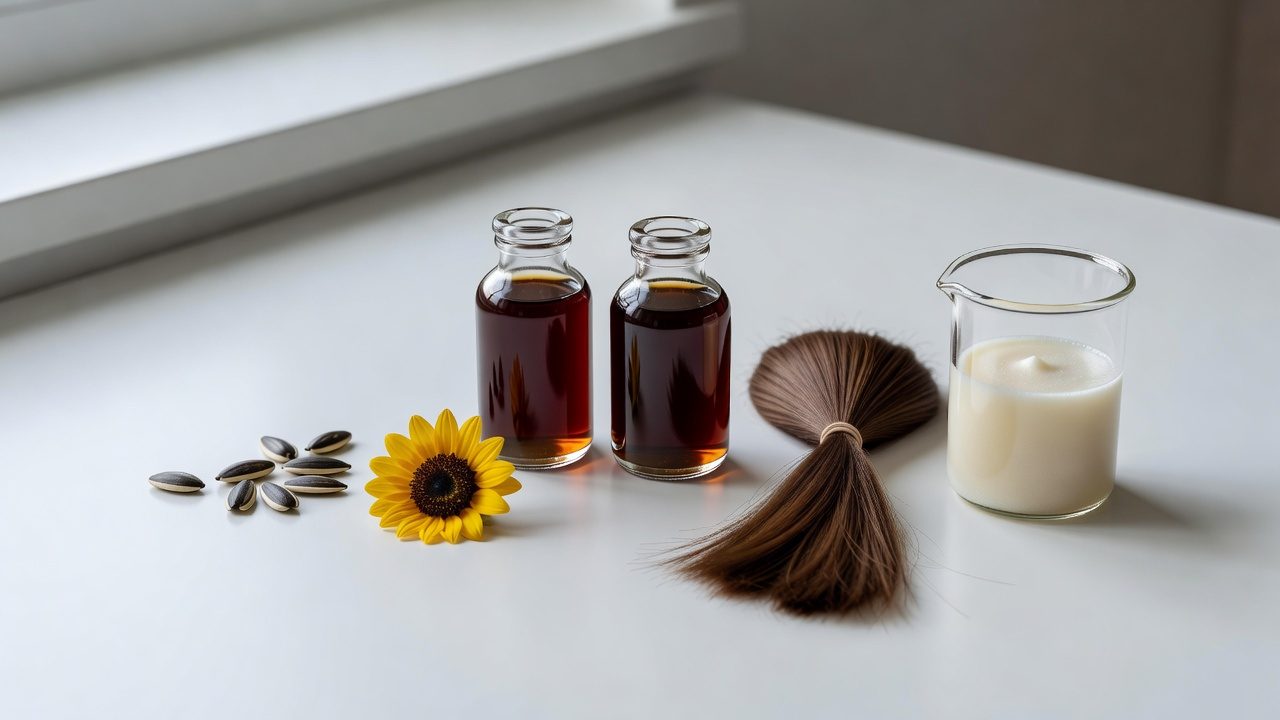
Heliogenol and Heliogenol GL are the same polyphenol-rich sunflower seed extract from Croda, supplied in two different carriers. Heliogenol is a glycolic extract declared as Butylene Glycol (and) Helianthus Annuus (Sunflower) Seed Extract, while Heliogenol GL swaps the butylene glycol for water and glycerin and is declared as Water (Aqua) (and) Glycerin (and) Helianthus Annuus (Sunflower) Seed Extract. Both are hair actives used at 0.2 to 1 percent, so the choice comes down to your label, your natural-origin target and your documentation needs, not to a different benefit.
Search results for the two names mostly show catalog stubs, which is why formulators keep asking how the grades differ. This guide puts the public data side by side: INCI, carrier, appearance, density, pH window, certifications, use levels by format and what the available test data really supports. It also covers one practical point most listings skip, which is how a polyphenol extract behaves in an alkaline hair color base.
What Heliogenol is
Heliogenol is an extract of sunflower seeds, described in Croda's formulation notes as a sunflower seed cake extract, the material left after the oil is pressed out. Distributor datasheets describe it as a concentrated glycolic extract titrated in polyphenols, and Croda positions it for protection against free radical damage on dyed and natural hair. The product was originally sold by Sederma, now part of Croda, and an early US patent on hair color protection, US 7,074,396 filed in 2003, describes Heliogenol as a liquid sunflower extract in butylene glycol at 25 percent active, supplied by Sederma.
Croda does not publish the full polyphenol profile on its public pages. Food-science studies on sunflower kernels and sunflower meal consistently identify chlorogenic acid and related caffeoylquinic acids as the dominant phenolic compounds, which fits the antioxidant positioning. That chemistry also explains two things you will notice at the bench: the liquid is dark, green-brown to dark brown, and it is sensitive to high pH, which we come back to below.
Heliogenol vs Heliogenol GL side by side
The active part is the same plant extract in both grades. The difference sits in the solvent system. The original grade uses butylene glycol, a common glycol that also helps keep plant extracts microbiologically stable. The GL grade uses water and glycerin. Croda's product page for the original lists it as Halal and vegan suitable and as free of ethylene and propylene oxide derivatives, preservatives, EDTA and BHT or BHA. The page for Heliogenol GL lists Halal and an ISO 16128 derived-natural rating. Both are listed as compliant with the IECIC inventory for China and as available in Asia, Europe, Latin America and North America.
Supplier data published through the CM Studio marketplace adds the physical numbers. The original grade is a green-brown to dark brown liquid with a specific gravity of 1.030 to 1.080 and an effective pH range of 4.0 to 6.0. Heliogenol GL has the same color description, a specific gravity of 1.150 to 1.180 and an effective pH range of 4.5 to 6.5, and its SDS composition lists glycerin at 30 to 40 percent. Both carry the same recommended use of 0.2 to 1 percent.
What the carrier changes on your label
On an ingredient list the switch is visible. With the original grade you declare butylene glycol and the sunflower seed extract, each in its correct position by weight. With GL you declare water, glycerin and the extract instead. At 1 percent of GL the glycerin contribution is only about 0.3 to 0.4 percent, so it will rarely change the feel of a shampoo or conditioner, but it can matter if your brand avoids glycols entirely or if you calculate a natural origin index under ISO 16128. Butylene glycol from petrochemical sources lowers that index, while water and glycerin count toward it, which is the most likely reason the GL grade exists.
Why density matters when you scale up
The two grades do not weigh the same per milliliter. GL is roughly ten percent denser, because of its glycerin content. Always dose both by weight on a scale, never by volume with a pipette, and recalculate if you move a formula from one grade to the other on a volume basis. If you buy small trial packs sold by volume, such as a 10 mL sample, convert to grams using the specific gravity on your certificate of analysis before you plan batch sizes.
Use levels by format
Distributor sheets for Heliogenol give a format ladder within the 0.2 to 1 percent range: up to 1 percent in shampoos, 0.5 to 1 percent in rinse-off conditioners and balms, 0.2 to 0.5 percent in leave-in serums and sprays, and up to 1 percent in repair masks. The logic is simple. Rinse-off products lose most of the extract down the drain, so they sit at the top of the range, while leave-on products keep the extract on the fiber and need less. Low levels in leave-on sprays also limit tint, since the extract is dark.
The GL grade is published with the same 0.2 to 1 percent recommendation, and because the botanical part is the same, the same ladder is a sensible starting point. Use it as a starting point rather than a conversion rule: the suppliers do not publish the extract solids of each grade side by side, so if you switch grades in an existing product, run a short stability and color check rather than assuming identical behavior.
Processing, pH and compatibility
Both grades are water-soluble liquids. Distributor guidance for the original grade says to add it at room temperature or at about 45 C, so the usual habit is to stir it into the water phase of a cold-process shampoo, or into a conditioner or mask after the emulsion has cooled. Avoid long holds at high temperature, which is a general rule for polyphenol-rich extracts.
The pH window deserves more attention than it usually gets. The published effective ranges, 4.0 to 6.0 for the original and 4.5 to 6.5 for GL, match the mildly acidic pH of most shampoos, conditioners and leave-in products. Above that range chlorogenic acid oxidizes more readily. A 2016 study in the journal Molecules showed that alkalized sunflower meal and model solutions form green trihydroxybenzacridine pigments when chlorogenic acid quinones react with amino groups, the same reaction that turns sunflower seed baked goods green. In a cosmetic, that means a risk of color drift and lost antioxidant capacity in alkaline bases.
Where it fits in a hair color routine
Croda lists hair colour among the applications, but oxidative dye creams are usually strongly alkaline, well outside the published pH windows. The practical approach is to place either grade in the acidic steps around the color service: the post-color conditioner, the color-care shampoo, the weekly mask and the leave-in spray. If you do want it in the color base itself, handle that as a development project and check shade, stability and odor over time.
Partners in shampoos and conditioners
The extract is a nonionic plant material, so it works alongside the usual cationic conditioning agents. In conditioners and masks it pairs naturally with behentrimonium chloride. In shampoos, a cationic polymer such as polyquaternium-10 adds slip and helps the product feel conditioning. For lengths that see heat styling, SymHair Thermo adds a thermal care angle, and a lipid such as Cutissential 18-MEA supports a smoother cuticle feel. Our guide to Cutissential Behenyl 18-MEA vs 18-MEA 40 explains how to choose between those two lipid grades.
What the data supports
Distributor summaries of the supplier's test data describe a free radical measurement on hair with a fluorescent probe, in which a 1 percent Heliogenol solution reduced radicals by about 70 percent when applied before UV exposure, and a shampoo test in which it protected dyed hair color better than vitamin E. We have not seen the original reports, so regard these as supplier claims to verify against the current technical file rather than as independent results.
Independent data points to a more modest role. In Example 3 of US 7,074,396, 0.6 percent Heliogenol in a conditioning base with a UV absorber and cationic surfactants gave only five to six percent more color retention than the control after 9.5 days of continuous UV exposure, while the full system with melanin performed clearly better. A broader study by Meinert and colleagues in the Journal of Cosmetic Science in 2004 found that commercial antioxidants in hair sun care products lowered chemiluminescence, a marker of reactive species, but that their effect on dyed hair color depended strongly on the shade.
The takeaway is that a sunflower polyphenol extract is a supporting layer, not a complete color-care system on its own. It works best combined with conditioning polymers, film formers, lipids and, where your market allows, a hair-specific UV absorber. If antioxidant protection for oil phases is part of your brief, our article on ascorbyl palmitate as an antioxidant for oils covers the oil-soluble side of the same idea.
Which grade should you choose
Choose the original Heliogenol when you want the grade with the longest track record, the widest literature, the published vegan listing and the preservative-free and EDTA-free composition notes, or when butylene glycol is already in your formula and adds nothing new to the label. It is also the grade most indicative formulas and legacy briefs refer to.
Choose Heliogenol GL when your brand avoids glycols, when you report a natural origin index under ISO 16128, or when you prefer water and glycerin on the label. Confirm its preservation status and any vegan statement on the current documents, because the public product page does not list those items the way it does for the original grade. Whichever you pick, keep the TDS, SDS and lot certificate of analysis on file and record the grade name in your formula sheet, since the two INCI lines are not interchangeable on a label.
Our Heliogenol sunflower extract is the original butylene glycol grade, available from a 0.33 oz (10 mL) trial pack up to bulk sizes, with lot documents on request. For other hair and scalp ingredients, browse our cosmetic actives section, and for leave-on scalp formats see our DIY scalp serum guide.
Keeping claims cosmetic
Keep finished product wording on what consumers see and feel: hair color that looks fresher for longer, more shine, a smoother surface and less wear during combing. Statements such as helping protect the look of hair color from sun exposure fit a hair care product. Do not present the extract as a sunscreen for skin, avoid any wording about scalp disorders or hair growth, and do not turn supplier laboratory percentages into consumer promises unless your own finished product has been tested.
Frequently asked questions
Is Heliogenol the same as Heliogenol GL?
Both contain the same Croda sunflower seed extract and share the 0.2 to 1 percent use range. Heliogenol is in butylene glycol, while Heliogenol GL is in water and glycerin, so the INCI on your label is different.
What is the INCI of Heliogenol GL?
Croda lists it as Water (Aqua) (and) Glycerin (and) Helianthus Annuus (Sunflower) Seed Extract. The original grade is Butylene Glycol (and) Helianthus Annuus (Sunflower) Seed Extract.
How much Heliogenol should I use in a shampoo?
Up to 1 percent in shampoos and masks, 0.5 to 1 percent in rinse-off conditioners and 0.2 to 0.5 percent in leave-in sprays and serums, added to the water phase at room temperature or about 45 C.
Can I put Heliogenol in an alkaline hair dye?
The published effective pH ranges are 4.0 to 6.0 for Heliogenol and 4.5 to 6.5 for GL. Sunflower polyphenols can discolor at high pH, so use it in the acidic care steps after coloring unless your own tests show stability.
Try it with a 1 g sample pack
Neat peptide powders in 1 g packs, INCI on every page, shipped from Florida.
Shop peptide powders