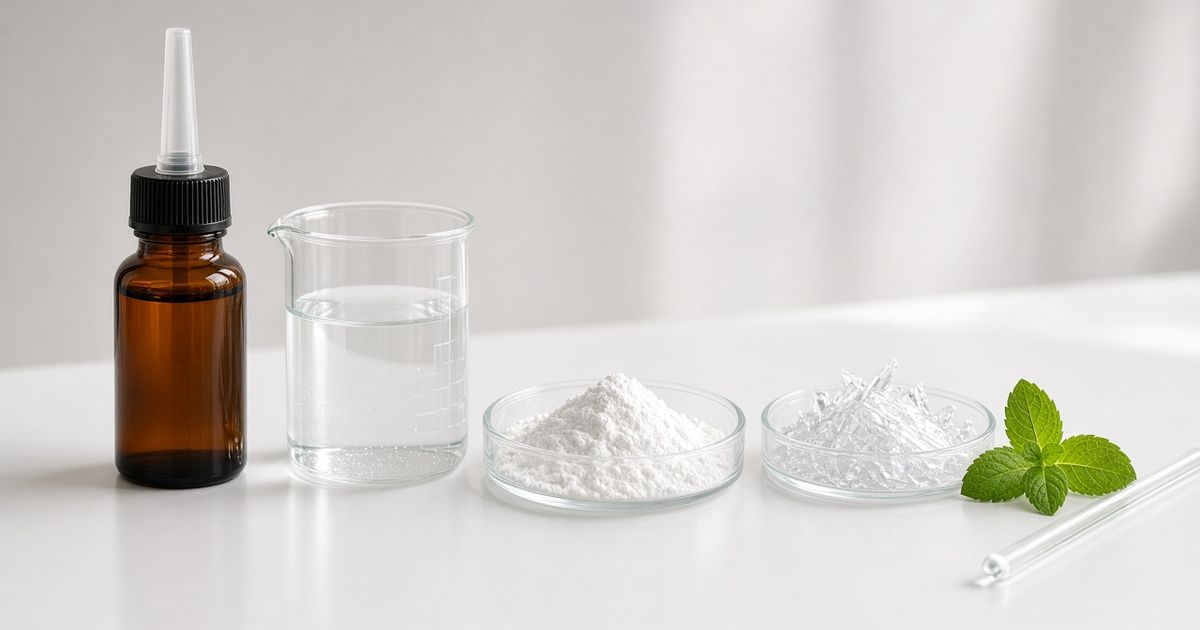
Thinning-looking hair is one of the most common cosmetic concerns worldwide, and leave-on scalp serums have become a popular way to care for the scalp between washes. For formulators and DIY makers, a scalp serum is a rewarding project: it is a light, water-based product, most of the actives dissolve at room temperature, and the format keeps ingredients on the scalp instead of rinsing them away. This guide covers the cosmetic actives most often used in scalp serums, what the public evidence says about each, how to combine them, and a 100 g recipe with phases, use levels and pH.
First, an important boundary. Hair loss can have medical causes, including hormonal, nutritional, autoimmune and drug-related ones. Persistent or sudden shedding should be assessed by a dermatologist. Cosmetic scalp serums are designed to condition the scalp and support the look of fuller, thicker-looking hair. They are not intended to diagnose, prevent or address any medical condition, and in the United States a product that claims to make hair grow back is regulated as a drug, not a cosmetic. That distinction shapes how we describe every ingredient below.
Why a Leave-On Scalp Format
Shampoos spend a minute or two on the scalp before being rinsed. A leave-on serum or tonic stays in contact for hours, so ingredients have far more time on the skin. Scalp products also need to be light: an oily or sticky base weighs hair down and makes the roots look flat, which works against the visual goal. That is why most scalp serums are water or water-alcohol solutions with a little humectant, a gentle cooling agent and a few actives, rather than creams.
Key Actives for Scalp Serums
Our materials are not the original branded products of the companies that developed these peptides, so we use the INCI names that appear on an ingredient label. They describe exactly what each molecule is.
Acetyl Tetrapeptide-3
Acetyl Tetrapeptide-3 is a four-amino-acid signal peptide used widely in scalp and lash products. It is often supplied together with red clover extract in commercial complexes, but here it is offered on its own as a water-soluble solution, so you can choose your botanical partners. Public data on this peptide comes mainly from supplier studies rather than independent peer-reviewed trials, which is worth keeping in mind when reading marketing copy. In formulation it is easy to handle: add it in the water phase during cool-down, below 40 °C, with gentle mixing. The product data lists a compatible pH range of 4.0 to 8.0 and asks formulators to follow the use level on the certificate of analysis.
Biotinoyl Tripeptide-1
Biotinoyl Tripeptide-1 links biotin to the GHK tripeptide. It is a pure, water-soluble powder used in very small amounts in hair and lash products. Because pure peptide powders are dosed at fractions of a percent, the stock solution method described in the recipe below is the reliable way to weigh it. Our product page does not quote a single use percentage and points to the supplier certificate of analysis. As with most cosmetic peptides, the published evidence is limited and largely from manufacturer data, so regard it as a supporting conditioning ingredient.
Caffeine
Caffeine is one of the most studied cosmetic ingredients for the scalp. A laboratory study by Fischer and colleagues in the International Journal of Dermatology (2007) examined caffeine's effect on human hair follicles cultured in vitro (PubMed 17214716). In vitro findings on isolated follicles do not show what a finished cosmetic does on a living scalp, so caffeine in a serum should be described as a conditioning, invigorating ingredient. Practically, caffeine dissolves in water to roughly 2% at room temperature, according to standard chemical references, so use 1% or less in a serum to stay well clear of crystallization in a cool bathroom.
D-Panthenol
D-panthenol, provitamin B5, is a classic hair care humectant. It helps the scalp feel comfortable and moisturized, and on the hair shaft it is used to add softness and a smooth feel. It is water-soluble and very easy to formulate at 0.5 to 2%.
Menthol for a Cooling Feel
Menthol crystals give the tingling, fresh sensation many people associate with scalp tonics. Menthol is practically insoluble in water and glycerin, so it must be dissolved first in alcohol, essential oils or a solubilizer such as polysorbate 20 before it meets the water phase. Keep the level low, around 0.1 to 0.3%; higher amounts can feel harsh and are best avoided on sensitive skin.
Building the Formula
A good scalp serum balances four things: actives that suit the purpose, a light humectant base, a pleasant sensory profile and a pH close to that of healthy skin. Glycerin at a low level, 1 to 3%, provides moisture without stickiness. A solubilizer carries the menthol. A broad-spectrum preservative is essential, because a water-based product applied with fingertips or a dropper is exposed to microorganisms with every use.
Water or Water-Alcohol Base
Many commercial scalp tonics contain ethanol, which dries quickly, dissolves menthol and leaves no residue on the roots. The trade-off is that alcohol can feel drying on a sensitive or flaky scalp. The recipe below is alcohol-free and uses a solubilizer instead, which makes it gentler and easier to make without special handling. If you prefer a faster-drying tonic, a common approach is to replace part of the water with cosmetic-grade ethanol, then retest pH and clarity, because alcohol changes both. Keep in mind that a higher alcohol content changes which preservative system is appropriate, so check with your preservative supplier.
pH Target
Healthy skin, including the scalp, has a mildly acidic surface. A finished pH of 5.0 to 5.5 suits the scalp, falls within the compatible range listed for Acetyl Tetrapeptide-3 and keeps caffeine and panthenol stable. Measure with a calibrated meter and adjust in small steps.
Making a Peptide Stock Solution
To dose Biotinoyl Tripeptide-1 accurately, dissolve 0.10 g of the powder in 9.90 g of distilled water to make 10.00 g of a 1% stock. Each 0.50 g of stock then carries 0.005 g of peptide, the amount used in the recipe below. Use the stock the same day, because an unpreserved solution should not be stored.
Recipe: Light Scalp Serum With Peptides and Caffeine, 100 g
A clear, non-greasy leave-on serum for the scalp. Acetyl Tetrapeptide-3 solution is used at the standard 5% level, Biotinoyl Tripeptide-1 as pure peptide at 0.005%, caffeine at 1% and menthol at 0.2%. All amounts are in grams and the batch totals exactly 100.00 g.
Phase A: Water Phase, 40 °C Then Cool
Distilled water 86.70 g, caffeine 1.00 g, glycerin 2.00 g, D-panthenol 2.00 g. Warm the water to 40 °C and stir in the caffeine until fully dissolved. Add glycerin and D-panthenol and mix until clear. Let the phase cool to 25 °C.
Phase B: Cooling Phase, Room Temperature
Menthol crystals 0.20 g, polysorbate 20 1.50 g. Combine in a small beaker and stir until the menthol is completely dissolved and the mixture is clear. Add Phase B to Phase A slowly with stirring.
Phase C: Cool-Down Phase, Below 30 °C
Acetyl Tetrapeptide-3 solution 5.00 g, Biotinoyl Tripeptide-1 1% stock solution 0.50 g (0.10 g powder dissolved in 9.90 g distilled water, so 0.50 g of stock carries 0.005 g peptide), phenoxyethanol and ethylhexylglycerin preservative blend 1.00 g. Add each ingredient in this order with gentle stirring.
Phase D: pH Adjustment
Citric acid 10% solution 0.10 g. Stir for two minutes and measure with a calibrated pH meter. Target pH 5.3, with an acceptable window of 5.0 to 5.5.
Usage Levels in This Formula
Caffeine 1.00%. D-panthenol 2.00%. Glycerin 2.00%. Menthol 0.20%. Polysorbate 20 1.50%. Acetyl Tetrapeptide-3 solution 5.00%. Biotinoyl Tripeptide-1 0.005% as pure peptide. Phenoxyethanol and ethylhexylglycerin 1.00%. Citric acid 10% solution 0.10%. Water to 100%.
Packaging and Application
Fill into a dropper bottle or a bottle with a nozzle applicator. Apply to a dry or towel-dried scalp in sections and massage lightly with the fingertips. Do not rinse. Keep away from the eyes, because menthol stings. Use each batch within about three months and discard it if it clouds, separates or changes odor.
Important Note on Your Ingredients
This formula is calculated at standard industry usage levels for each ingredient. Final amounts, pH and results depend on the specific raw materials you use, their concentration and the batch, so always check the certificate of analysis (CoA) and technical data sheet (TDS) supplied with each ingredient and adjust if they recommend a different level. Make a small test batch first, observe it for two weeks for clarity, color, odor and pH, and patch test before regular use.
Scalp Care Habits That Support the Look of Fuller Hair
A serum works best as part of a routine. Gentle cleansing that removes oil and product buildup without stripping the scalp, conditioning the lengths to reduce breakage, avoiding tight hairstyles that pull at the hairline and limiting high heat styling all help hair look fuller, because hair that breaks less keeps more visible density. The American Academy of Dermatology publishes practical hair care guidance for the public, and it is a good starting point for anyone who notices changes in their hair.
Patch Testing and Safety
Test the serum on a small area behind the ear or on the inner forearm for several days before applying it to the whole scalp. Stop use if redness, itching or flaking develops. Anyone with a scalp condition, recent sudden shedding, or who is pregnant or breastfeeding should talk to a dermatologist before using new actives.
Expanding a Hair Care Line
A scalp serum pairs naturally with a lash or brow serum built on similar peptides, and with a conditioning spray for the lengths. If you are also developing facial products, our peptide serum formulation guide explains how to combine peptides for the face. Browse the full peptides catalog, including peptide solutions, and supporting ingredients in actives.
Related Products and Guides
Related products for scalp formulas include Biotinoyl Tripeptide-1 solution, a ready liquid alternative to the powder, and liposomal caffeine for formulators who prefer an encapsulated form. For face care, see our peptide serum recipe for wrinkles and the guide on how to use GHK-Cu copper peptide powder.
Sources
Fischer TW et al. Effect of caffeine and testosterone on the proliferation of human hair follicles in vitro. International Journal of Dermatology, 2007. https://pubmed.ncbi.nlm.nih.gov/17214716/
Caffeine solubility: PubChem compound record for caffeine, https://pubchem.ncbi.nlm.nih.gov/compound/Caffeine
Product data: IngredientOS product pages for each ingredient; supplier certificates of analysis.
Frequently asked questions
Can I put caffeine in a scalp serum?
Yes. Caffeine is water-soluble to about 2% at room temperature, so 0.5 to 1% dissolves easily and stays in solution. It is used as a conditioning, invigorating ingredient.
Why does my serum turn cloudy when I add menthol?
Menthol does not dissolve in water. Dissolve it fully in a solubilizer such as polysorbate 20 or in alcohol first, then add that mixture to the water phase.
How often should a scalp serum be applied?
Most leave-on scalp serums are applied once or twice a day to a clean scalp. Consistent use over several weeks matters more than large amounts.
Can a DIY scalp serum stop hair loss?
No. A cosmetic scalp serum conditions the scalp and supports the look of fuller hair. Hair loss with a medical cause needs assessment by a dermatologist.
Try it with a 1 g sample pack
Neat peptide powders in 1 g packs, INCI on every page, shipped from Florida.
Shop peptide powders