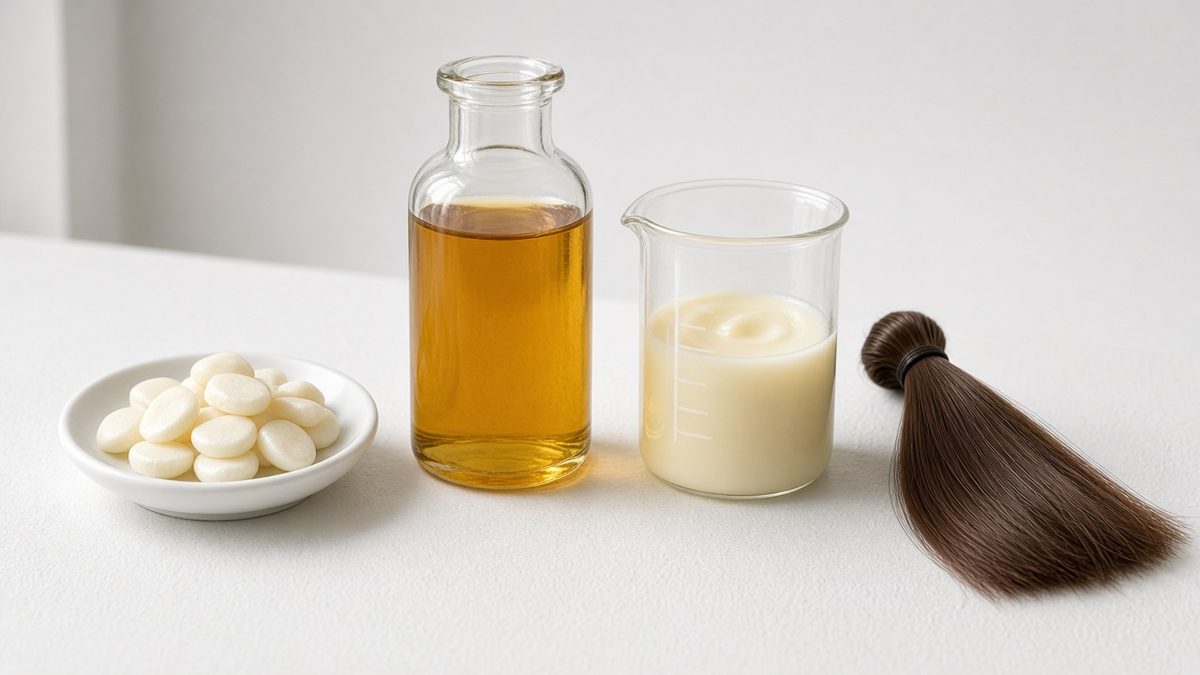
Cutissential Behenyl 18-MEA and Cutissential 18-MEA 40 are two Croda grades built on the same idea: a quaternized derivative of 18-methyleicosanoic acid, the main lipid bound to the surface of healthy hair. The difference is the delivery system. Behenyl 18-MEA is a solid pastille that combines the 18-MEA quat with behentrimonium methosulfate and cetyl alcohol for conditioners and treatments, while 18-MEA 40 is a liquid in dipropylene glycol that is anionic-compatible and suits shampoos, sprays and cold-process formulas.
Formulators often search for one name and land on the other, because Croda presents both on a single data sheet and many distributor listings mix them up. This guide sets out what each grade contains, how it is declared on a label, where it goes in a batch and which product briefs each one serves best, using Croda's published product information and distributor data rather than guesswork.
What 18-MEA is and why hair loses it
18-methyleicosanoic acid, usually shortened to 18-MEA, is a branched fatty acid with 21 carbon atoms. It is the dominant fatty acid of the thin lipid layer that sits on the outer face of the cuticle cells, where it is held by a covalent thioester bond to cuticle proteins rather than simply resting on top. Work by Jones and Rivett, published in Micron in 1997, described this layer and its role in the structure of mammalian hair fibers, and it remains the standard reference on the subject.
That bound layer is what makes healthy, untreated hair feel slippery and shed water. Croda's data sheet notes that chemical treatment and environmental stress, including sunlight and even everyday grooming, can remove part or all of it. Bleaching and perming are the harshest because alkaline and oxidative conditions attack the thioester link. Once the layer is gone, the fiber surface becomes more hydrophilic, it tangles and feels rough, and it looks dull. Neither Cutissential grade can recreate the covalent bond, so the realistic goal in a formula is to deposit a cationic conditioning film that mimics the feel and water repellency of the original surface.
Cutissential Behenyl 18-MEA vs 18-MEA 40 at a glance
Composition and INCI
Croda lists Cutissential Behenyl 18-MEA with the INCI name Behentrimonium Methosulfate (and) C10-40 Isoalkylamidopropylethyldimonium Ethosulfate (and) Cetyl Alcohol. It is a solid at 25 C, supplied as off-white, wax-like pastilles. Two of the three components, behentrimonium methosulfate and cetyl alcohol, are the classic pair used to build a conditioner emulsion, so the grade is effectively a conditioning base with the 18-MEA quat already blended in.
Cutissential 18-MEA 40 is declared as C10-40 Isoalkylamidopropylethyldimonium Ethosulfate (and) Dipropylene Glycol. It is a liquid, described by distributors as amber and ranging from a liquid to a soft paste, with the active quat carried in dipropylene glycol. It was previously sold as Incroquat 18-MEA-40, and older documents and some Asian distributors still list the conditioning component under its former INCI name, Quaternium-33, with CAS number 72102-40-0. If you meet Quaternium-33 on an older formula sheet, it refers to the same material.
Physical form and handling
The physical form decides most of the practical differences. A pastille is easy to weigh and store, but it has to be melted, which ties it to a heated oil phase. A liquid can be weighed into a cold mix, a surfactant base or a spray without any heating. Distributor handling notes for 18-MEA 40 say a sediment can appear in storage and redissolves when the material is warmed to about 40 C, so shake or warm the drum before sampling rather than pouring off a clear top layer.
Use level
Distributor technical summaries list Cutissential Behenyl 18-MEA at 1 to 5 percent in rinse-off and leave-on conditioners and treatments. Cutissential 18-MEA 40 is listed at 1 to 3 percent in most distributor data, with some suppliers quoting up to 5 percent for nourishing shampoos and conditioners. Keep in mind that the Behenyl grade percentage includes a large share of behentrimonium methosulfate and cetyl alcohol, so 3 percent of it is not the same amount of 18-MEA quat as 3 percent of the liquid. Compare the two on performance tests, not on the percentage alone.
Profile and documentation
Croda's product pages list both grades as quaternary ammonium compounds for hair conditioning, both as Halal, both as listed in China's IECIC inventory and both as not inherently biodegradable. The Behenyl grade carries extra composition data: EO and PO free, preservative free, free of BHT and BHA, and 85 percent natural origin content under ISO 16128. Both grades list animal, plant and petrochemical sources among their ingredient origins, so neither one supports a vegan claim without written confirmation from the supplier for your specific lot.
How Cutissential Behenyl 18-MEA behaves in a formula
Because the Behenyl grade already contains a cationic emulsifier and a fatty alcohol, it is processed like any behentrimonium methosulfate conditioner base. Weigh the pastilles into the oil phase with any extra fatty alcohol, heat until everything is melted and uniform, then emulsify into the hot water phase and cool with stirring. The fatty alcohol and quat form the lamellar gel network that gives a rinse-off conditioner its body, and the 18-MEA quat rides along in that network and deposits on the fiber during use.
This makes the grade a natural fit for thick rinse-off conditioners, deep treatment masks, leave-in creams and conditioning styling creams. Croda singles it out for chemically treated hair, long hair and textured hair, where the cuticle surface is usually most worn. In a mask you can build most of the conditioning backbone from the Behenyl grade and adjust thickness with cetearyl alcohol, then add proteins such as hydrolyzed keratin after cooling. If you need extra slip or a heavier wet feel, a second cationic such as behentrimonium chloride can join it in the oil phase.
The trade-off is flexibility. The pastille is not designed for clear products, it cannot be stirred into a finished cold base, and it brings its own emulsifier, so it limits how far you can change the emulsion system. It is the right choice when the product is a classic cream conditioner anyway, and the wrong one when the brief is a shampoo or a water-thin spray.
How Cutissential 18-MEA 40 behaves in a formula
The liquid grade exists for everything the pastille cannot do. Croda describes it as anionic-compatible, readily incorporated into surfactant systems and suitable where a liquid is preferred. Distributors add that it is soluble in surfactants and dispersible in water, and that it works in cold-process and clear systems. Croda's own formulary includes a clear, water-thin leave-on spray for damaged hair built on 18-MEA 40, which shows the kind of product it was made for.
In a shampoo, add it after the primary surfactants are combined and before the final salt adjustment for viscosity. Cationic materials can interact with anionic surfactants, so start at the low end of the range, watch clarity and viscosity, and step up only if the base stays stable. In 2-in-1 shampoos, conditioning body washes and detangling sprays it gives a conditioning deposit without needing an emulsion at all. It can also be added to the cool-down phase of an emulsion that is built on a different emulsifier, which is useful when you already have a stable conditioner base and want to add an 18-MEA story to it.
Our Cutissential 18-MEA card is this liquid grade, sold from a 0.33 oz trial size, with its INCI, use level and a sample conditioner recipe. It sits in the cosmetic actives range next to other hair and skin concentrates.
Which grade to choose
By product type
Choose Cutissential Behenyl 18-MEA for opaque, thick rinse-off conditioners, intensive masks, overnight treatments and leave-in creams, especially for bleached, colored, relaxed or long hair. It simplifies the formula because one raw material supplies the emulsifier, part of the fatty phase and the 18-MEA quat, and its 85 percent natural origin rating helps if the brand reports ISO 16128 indexes.
Choose Cutissential 18-MEA 40 for shampoos, clear or translucent products, sprays, serums, styling liquids and any cold-process line. It is also the easier option for a small lab or an indie brand that already has a conditioner base it likes, because it can be added without rebuilding the emulsion. Some brands use both across a range: the liquid in the shampoo and the pastille in the matching conditioner and mask, which keeps the same 18-MEA story across every step of the routine.
By process and equipment
If your production runs hot batches with a heated oil phase, the Behenyl grade fits without extra steps. If you blend at room temperature, fill small batches by hand or make products in a mixer without heating, the liquid grade is the only practical choice. Cost per finished kilogram depends on the supplier price and on how much of each grade your performance testing actually needs, so price both at the use level that passes your own combing and feel tests.
Testing the 18-MEA effect
The classic test for both grades is a bleached hair tress. Prepare a base without the 18-MEA quat and the same base with it, treat matched tresses and compare wet and dry combing, frizz and shine. A simple water drop placed on a dried tress makes the change in water repellency visible: on a stripped tress the drop spreads and soaks in, while a well conditioned tress lets it bead for longer. These are practical bench checks that help you choose a use level; any numerical claim on the pack needs your own instrumental or consumer testing.
For a deeper repair concept, the 18-MEA grades work well alongside cystine-based or keratin-based actives. Our comparison of Crodasone Cystine vs Crodasone W explains another Croda hair grade family and how its forms differ, and the scalp serum actives guide covers leave-on hair actives that can share a routine with an 18-MEA conditioner.
Labeling and claims
Declare each grade by its full INCI name and list every component in its correct position by weight in the finished formula. For the Behenyl grade that means behentrimonium methosulfate, cetyl alcohol and C10-40 isoalkylamidopropylethyldimonium ethosulfate each appear separately, together with any extra amounts of the same materials you added. For the liquid grade, dipropylene glycol must be declared as well.
Keep claims cosmetic and focused on the look and feel of hair: smoother, softer, shinier, easier to comb, less frizzy and more manageable. Language about replenishing the look of the hair's natural lipid layer is consistent with how Croda describes the materials. Avoid wording that suggests repair of the hair structure beyond appearance, or any effect on the scalp or hair growth, unless your own data and your local regulations support it.
Frequently asked questions
What is the difference between Cutissential Behenyl 18-MEA and Cutissential 18-MEA 40?
Both carry the same 18-MEA derived quat, C10-40 Isoalkylamidopropylethyldimonium Ethosulfate. Behenyl 18-MEA is a solid pastille that also contains behentrimonium methosulfate and cetyl alcohol for conditioners and masks, while 18-MEA 40 is a liquid in dipropylene glycol for shampoos, sprays and cold-process products.
What is the INCI name of Cutissential Behenyl 18-MEA?
Croda lists it as Behentrimonium Methosulfate (and) C10-40 Isoalkylamidopropylethyldimonium Ethosulfate (and) Cetyl Alcohol. Each component must be declared on the label in its correct order by weight.
Can Cutissential 18-MEA be used in a shampoo?
Yes, the liquid 18-MEA 40 grade is anionic-compatible and is designed to go into surfactant systems, including clear ones. Start at the low end of the 1 to 3 percent range and check clarity and viscosity before raising the level.
Is Quaternium-33 the same as Cutissential 18-MEA?
Quaternium-33 is the former INCI name of C10-40 Isoalkylamidopropylethyldimonium Ethosulfate, the 18-MEA quat in both Cutissential grades. Older labels and documents may still use the old name.
Try it with a 1 g sample pack
Neat peptide powders in 1 g packs, INCI on every page, shipped from Florida.
Shop peptide powders