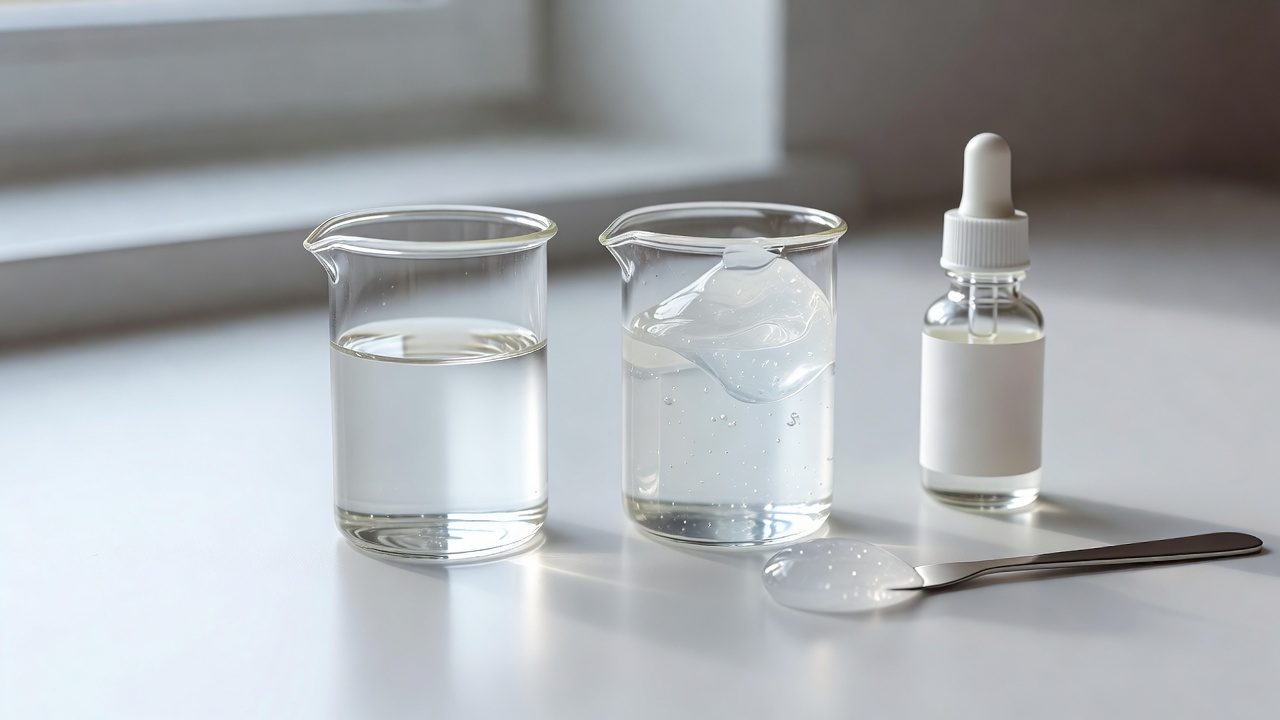
Sodium Hyaluronate Crosspolymer and Sodium Hyaluronate share the same hyaluronic acid backbone, but the crosspolymer has its chains tied together into a three-dimensional network, so it swells with water and sits on the skin as a more elastic, longer-lasting film instead of a free-flowing solution of chains. Sodium Hyaluronate is the better-documented workhorse and is chosen by molecular weight for slip and quick hydration; the crosspolymer is the add-on for a cushioned, bouncy feel and hydration that holds up longer. Most good hydrating serums use both, at very different levels.
Most pages that rank for this pair stop at the film-versus-penetration story. This guide goes further for the bench: what the INCI name actually tells you about the chemistry, what the published use data and studies say, why one supplier recommends 0.01 percent and another 10 percent, and how to process the network without breaking it.
Same Backbone, Different Architecture
Sodium Hyaluronate: linear chains sold by weight
Hyaluronic acid is a linear polysaccharide built from repeating units of N-acetyl-D-glucosamine and D-glucuronic acid, and Sodium Hyaluronate is its sodium salt. Almost everything labeled hyaluronic acid in a finished product is this salt. Grades differ mainly by chain length. Long chains, such as our High Molecular Weight Hyaluronic Acid powder, thicken water and leave a smooth surface film. Short chains, such as the Low Molecular Weight Hyaluronic Acid 10-20 kDa, add little viscosity and are used for a lighter, less tacky feel. The chains are separate and only entangled, so they move freely through the water phase.
Sodium Hyaluronate Crosspolymer: one name, several chemistries
A crosspolymer is the same salt after a crosslinker has bonded chains to each other. The Cosmetic Ingredient Review scientific literature review released on March 26, 2026 lists six INCI names that share the backbone and differ only by the crosslinker. Plain Sodium Hyaluronate Crosspolymer, CAS 105524-32-1, is defined as hyaluronic acid crosslinked with vinyl sulfone. The numbered versions use diglycidyl ether for -2, oxidized hyaluronate linked with propylbisoxyamine for -3, 1,4-butanediol diglycidyl ether for -4, PEG-9 diglycidyl ether for -6 and sodium trimetaphosphate for -7. The plain name is by far the most used, with 5396 formulations in the 2025 FDA registration and listing data cited by CIR.
Two practical consequences follow. First, the name on your label should match the crosslinker on the supplier documents, so check the certificate of analysis rather than assuming. Second, materials sold under the same INCI can still behave differently, because crosslink density, gel particle size and the share of free linear hyaluronate all change water uptake and texture. Contipro, for example, sells a powder labeled Sodium Hyaluronate (and) Sodium Hyaluronate Crosspolymer and explains that standard 300 kDa hyaluronate is added during crosslinking because the powder would otherwise not dissolve. Our Sodium Hyaluronate Crosspolymer is a liquid grade, and its exact INCI, polymer content and carrier are stated on the CoA for each lot.
How Each One Behaves on Skin and in the Bottle
A solution of linear Sodium Hyaluronate dries to a thin, continuous film. Long chains feel silky but can turn tacky as the level rises, and the film redissolves easily when skin gets wet. A crosslinked network behaves more like a swollen gel. Water fills the mesh, the crosslinks stop the chains from drifting apart, and the result spreads with a soft, slightly springy cushion. Our crosspolymer card describes the feel as smooth and slightly cushiony rather than sticky, and notes that the network adds body to gels, so the main thickener can often be reduced.
Neither form is a penetration ingredient in the usual sense. Hyaluronic acid heavier than about 100 kDa has limited capacity to pass into the epidermis, and crosslinking makes the molecule larger still. The crosspolymer works at the surface and outer stratum corneum, holding water there for longer, while lower-weight linear grades are the ones formulators use when they want a lighter film that settles into the surface layers. That division of labor is why a multi-weight blend plus a crosspolymer is now a common hydrating serum brief.
What the Published Data Compare
Linear Sodium Hyaluronate has the larger record. A frequently cited study by Pavicic and colleagues, published in JDD in 2011, tested creams with 0.1 percent hyaluronic acid at five molecular weights between 50 and 2000 kDa and reported better hydration with all of them, with the lower weights linked to the stronger results on wrinkle depth. CIR reviewed Sodium Hyaluronate in 2009 and again in 2023 and concluded it is safe in the present practices of use and concentration. The 2023 review deliberately left crosslinked material out, which is why the crosspolymers now have their own assessment.
Direct comparisons of crosslinked and linear forms are scarcer and mostly industry-run. Sundaram and colleagues reported in JDD in 2018 that earlier skin explant work by Teoxane had found its crosslinked hyaluronic acid serum lowered trans-epidermal water loss and raised epidermal hydration more than non-crosslinked high or low molecular weight hyaluronic acid. Their own study used 24 women aged 35 to 55 in a split-face design, applying the serum twice daily to one side of the face for 28 days, and measured better surface topography and hydration on the serum side. An open-label study of a serum with Sodium Hyaluronate, Sodium Hyaluronate Crosspolymer and peptides, by Robinson and colleagues in the Journal of Cosmetic Dermatology in 2022, reported higher hydration at weeks 4 and 8 in 46 participants. Neither study isolates the crosspolymer alone, so read them as support for the format, not as a measured margin over linear grades.
Use Levels: Why 0.01 and 10 Percent Can Both Be Right
Supplier ranges for the crosspolymer look contradictory until you check what is being weighed. Contipro recommends 0.01 to 0.1 percent of its dry powder and states safety testing up to 1 percent. Handymade gives 1 to 10 percent for a ready solution whose declared composition is 87 to 97 percent water and 1 to 10 percent crosspolymer, plus pentylene glycol and caprylyl glycol. The CIR use survey reported the plain crosspolymer at up to 0.47 percent in leave-on face and neck products and moisturizing products, measured as the ingredient itself. Dose a liquid grade by its polymer content and the numbers line up.
For our liquid crosspolymer the card gives no fixed range and directs you to the supplier TDS and the lot CoA, and its original serum recipe uses 5 g in a 100 g batch. Linear Sodium Hyaluronate is used far more widely, with 4713 formulations in the 2023 FDA voluntary registration data and a maximum reported level of 7.5 percent in face and neck products, again as ingredient rather than solution. If you use a ready solution such as our Hyaluronic acid liquid 1%, 3 g of it in 100 g of serum adds 0.03 percent Sodium Hyaluronate.
Processing Without Breaking the Network
pH and temperature
Both forms belong in the water phase. Our crosspolymer card lists a pH range of 3.0 to 7.0 and compatible solvents of water, glycerin and propylene glycol. Our low molecular weight card gives 4.0 to 10.0 and warns against heating above 60 C for 60 minutes. Contipro reports that its crosslinked grade decomposes below pH 4 or above pH 10, faster with heat, and gives safe holding conditions such as 2 hours at 50 C at pH 5. The practical window that suits every grade here is a finished pH of roughly 5 to 6, with the crosspolymer added at the end of the process or to a cooled base.
Shear, salts and cationic ingredients
A network can be torn. The card advises against long, very high shear and suggests adding the crosspolymer after emulsification with gentle mixing. High electrolyte levels and strong acids reduce viscosity in both forms, so add salts last and measure viscosity over time. The anionic network can also bind cationic polymers. Contipro names polyquaternium-4 and polyquaternium-10 as incompatible and notes that multivalent metals such as zinc and magnesium can change the network, which matters if you plan to add a zinc salt. Keep strong oxidizers and enzymes that break down hyaluronic acid out of the formula.
Using Both in One Serum
The simplest frame comes straight from the crosspolymer card. Hydrate 0.30 g hydroxyethylcellulose in 84.60 g water with 4.00 g glycerin and 1.00 g panthenol. Then stir in 5.00 g Sodium Hyaluronate Crosspolymer, 3.00 g Hyaluronic acid liquid 1% and 1.00 g niacinamide dissolved in a little water. Finish with a preservative at 1.00 g and a botanical extract at 0.10 g, and adjust to about pH 5.5. To widen the weight range, swap part of the linear solution for a low molecular weight grade or our Multi-Weight Hyaluronic Acid Solution, and keep the total viscosity in check before adding more gum.
Humectants pair well with this base. Our guide to 2-hydroxyethylurea in serums explains how to add a non-sticky humectant on top of a hyaluronic system, and the peptide serum recipe for wrinkles shows where peptides fit in the same pH window. If you want a crosslinked feel from a different family, our Crosslinked Hyaluronic Acid Concentrate and the acetylated Sodium Acetylated Hyaluronate are alternatives, all in the cosmetic actives section. Run stability and preservative challenge tests on any version before launch.
Which One to Choose
Start with Sodium Hyaluronate if you need one hyaluronic ingredient. It is cheap, well characterized, sold in clear weight grades and backed by a recent CIR conclusion. Add the crosspolymer when the brief asks for a cushioned, bouncy texture, a hydrating film that holds up through the day, or better glide and comfort in a primer or foundation, uses our card lists for it. Use it at a low polymer level, check the crosslinker on the CoA, and protect it from shear, extreme pH and cationic polymers.
Keep claims cosmetic. A plumper-looking, smoother, well-moisturized surface and longer-lasting hydration measured with a corneometer are appropriate. Do not compare a topical crosspolymer to injectable hyaluronic acid or promise volume or structural change, and remember that raw material data describe the ingredient, not your finished product.
Sources
Cosmetic Ingredient Review, Safety Assessment of Sodium Hyaluronate Crosspolymers as Used in Cosmetics, scientific literature review, March 26, 2026. Cosmetic Ingredient Review, Safety Assessment of Hyaluronates as Used in Cosmetics, final report, 2023. Pavicic T. et al., JDD 2011;10(9):990-1000. Sundaram H. et al., JDD 2018;17(4):442-450. Robinson D.M. et al., Journal of Cosmetic Dermatology, 2022. Contipro CrossLinked HA product sheet. Handymade Sodium Hyaluronate Crosspolymer technical data sheet. pH, solubility, processing notes and the recipe come from the IngredientOS product cards.
Frequently asked questions
Is Sodium Hyaluronate Crosspolymer the same as hyaluronic acid?
It is made from it. The crosspolymer is Sodium Hyaluronate whose chains have been bonded together by a crosslinker, vinyl sulfone for the plain INCI name, which turns separate chains into a water-swollen network.
Can I use Sodium Hyaluronate Crosspolymer and Sodium Hyaluronate together?
Yes, and it is the most common approach. The linear grade gives slip and quick hydration, the crosspolymer adds cushion and a longer-lasting film. Our Sodium Hyaluronate Crosspolymer card pairs 5 g of it with 3 g of a 1 percent hyaluronic solution in a 100 g serum at about pH 5.5.
How much Sodium Hyaluronate Crosspolymer should I use?
It depends on the form. Dry powders are recommended at 0.01 to 0.1 percent, ready solutions at 1 to 10 percent, and the CIR survey reported the ingredient at up to 0.47 percent in leave-on face products. Always follow the TDS and CoA for your lot.
Does the crosspolymer penetrate deeper than Sodium Hyaluronate?
No. Crosslinking makes the molecule larger, so it stays on the surface and outer stratum corneum and holds water there longer. Lower molecular weight linear grades are used for a lighter film that settles into the surface layers.
Try it with a 1 g sample pack
Neat peptide powders in 1 g packs, INCI on every page, shipped from Florida.
Shop peptide powders