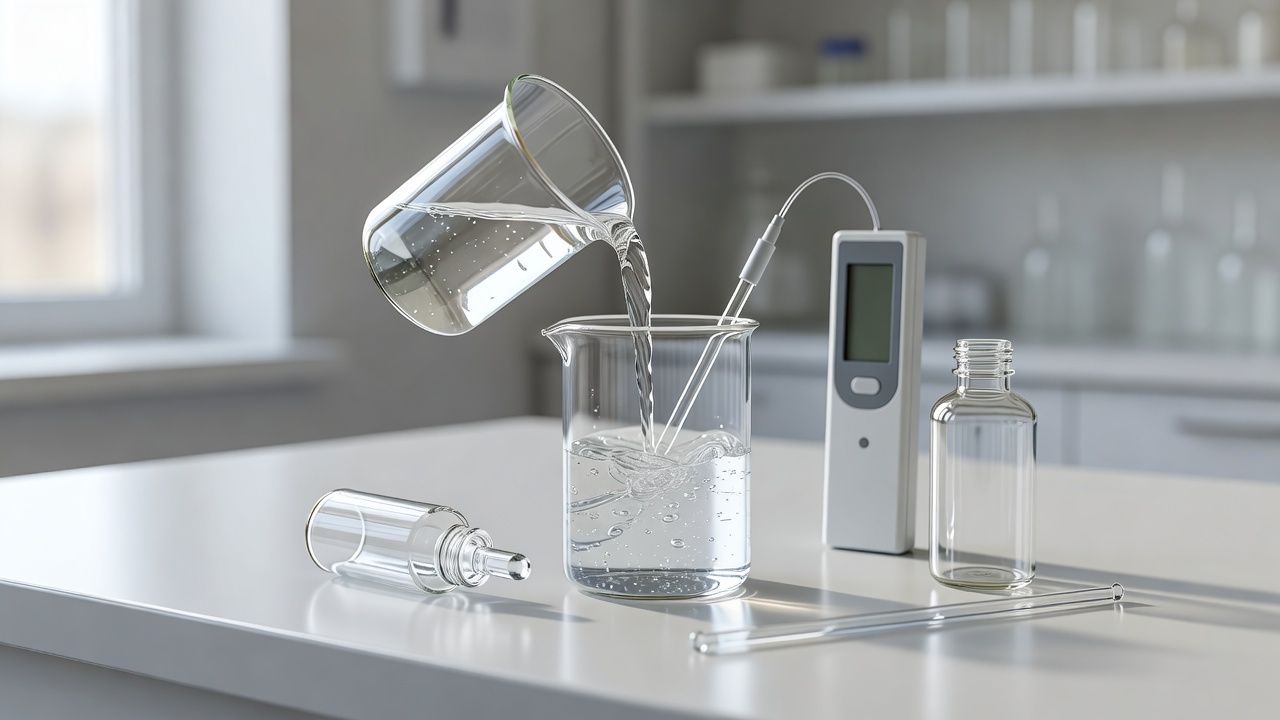
Hydroxyethyl urea, also written 2-hydroxyethylurea, is a water-soluble humectant that gives a serum glycerin-level hydration without the sticky after-feel. Manufacturer data suggest 1 to 10% of the supplied solution in leave-on products and a finished pH of 5 to 8, and the one real trap is a slow upward pH drift that a lactate or phosphate buffer keeps in check.
Most pages that rank for this ingredient either sell a finished serum or repeat a supplier brochure. This one is written for the person at the bench: what the molecule is, how to read the as-supplied percentage, why serums benefit more than creams, how to stop the pH from creeping, and how to prove the swap from glycerin is worth it in your own formula.
What 2-Hydroxyethylurea Actually Is
Urea With a Small Alcohol Arm
Chemically it is urea with a 2-hydroxyethyl group attached to one nitrogen, formula C3H8N2O2, molecular weight about 104 and CAS number 2078-71-9. The INCI name on a label is Hydroxyethyl Urea, and the EU CosIng database lists it with humectant and skin-conditioning functions. That extra hydroxyethyl arm is what changes the handling: plain urea is a crystalline solid, while hydroxyethyl urea is usually sold as a clear, nearly colorless aqueous solution that pours straight into the water phase.
Trade Names and Generic Grades
The best-known commercial grade is Hydrovance, originally developed by National Starch and documented in a technical bulletin that compares it directly with glycerin. Generic grades with the same INCI name are offered by several producers. We carry both: a generic Hydroxyethyl Urea liquid and the Hydrovance trade grade in a 10 mL trial size. Because both are solutions, the number that matters for formulation is the active content printed on the certificate of analysis, not the name on the drum.
Reading the Use Level Correctly
As Supplied Versus Active
The Hydrovance bulletin gives its ranges as supplied: 1 to 10% in leave-on creams, lotions and gels, and 1 to 20% in rinse-off products. The clinical comparisons in the same document were run at a 5% active level against 5% glycerin, which is a different basis. Mixing those two numbers up is the most common reason a hydroxyethyl urea serum feels either weak or unexpectedly heavy. Before you write a formula, take the active percentage from your lot CoA and decide which basis your formula sheet uses, then write it on the sheet so nobody on your team converts it twice.
A Quick Conversion Habit
The arithmetic is simple. If the CoA states a given active content, divide your target active percentage by that content and multiply by 100 to get the amount of solution per 100 g. A solution that is half active needs twice the weight to reach the same active level. Remember that the water carried in with the solution belongs to your water phase, so reduce the free water by the same amount to keep the batch at its intended total.
Why Serums Benefit More Than Creams
The Tack Problem
A cream hides a lot of humectant behind its emollients. A clear serum does not. Glycerin above a few percent in a thin water gel leaves a tacky film that many users dislike, which pushes formulators to cut it and lose some of the moisture feel. Hydroxyethyl urea was introduced precisely for this gap: the manufacturer reports moisturization comparable to glycerin by corneometer, with a non-tacky skin feel and little effect on formula viscosity. In a serum, where skin feel decides whether a product is used twice a day, that trade is the main reason to choose it.
Where It Shows Up in the Market
You can see the pattern on real labels. SkinCeuticals Retexturing Activator lists Hydroxyethyl Urea second, directly after water, in an oil-free serum, and Korean barrier serums such as Aestura Ato Barrier 365 Hydro Cera-HA Serum carry it lower in the list next to ceramides, niacinamide and hyaluronic acid. Those are finished products with their own testing, so read them as evidence of formulation habits, not as proof that a given level will perform in your base.
Keeping the pH From Drifting
What the Manufacturer Warns About
Hydroxyethyl urea is nonionic and comfortable across a wide pH window, and the bulletin recommends a finished pH of 5 to 8. It also states openly that some formulations drift to a higher pH during stability testing. Urea-type molecules can slowly break down in water, and the breakdown products push the pH upward, which you may notice only after weeks at elevated temperature. For a serum that is meant to sit near skin pH, that slow climb is the main stability risk.
Buffering the Water Phase
The suggested fixes are low molecular weight esters such as triethyl citrate, cyclic esters or lactones, and buffer systems, especially lactates and phosphates. For a simple serum, a lactate buffer is the most practical choice: sodium lactate with a little lactic acid holds the pH where you set it and adds its own humectant feel. A National Starch patent on hydroxyalkylureas describes combining hydroxyethyl urea with ammonium lactate for a stronger moisture reading than either alone, which supports the idea of a lactate partner, although that patent data is not a claim you can borrow for a new product. Measure pH on day one, after two weeks and after four weeks at 40 °C, and only call the system stable when the readings stay within your window.
Building Three Serum Styles Around It
Clear Water Gel
This is where the ingredient earns its place. Start with a light gel of xanthan or a small amount of carbomer, add hydroxyethyl urea solution in the middle of the supplier range, keep glycerin at a modest level for slip, and add low molecular weight hyaluronic acid for the familiar plumping feel. The result should dry down without stickiness, which is easy to judge by pressing two fingers together a minute after application.
Essence or Toner-Serum
In very thin, watery formats there is no polymer to mask tack at all, so humectant choice decides the feel. Hydroxyethyl urea can carry most of the humectant load here, supported by betaine or panthenol, and it does not cloud a clear liquid. Because it has little effect on viscosity, you control the texture entirely with your thickener.
Milky Serum or Light Emulsion
In a fluid emulsion, add it to the water phase either before heating or at cool-down, since the bulletin notes it incorporates at ambient or elevated temperature. Here it reduces the drag that a high glycerin level can add to a light lotion, and it combines well with ceramide and fatty-acid systems that support the look of a smooth, comfortable skin surface.
Partners and Things to Watch
Comfortable Combinations
Being nonionic, hydroxyethyl urea sits easily next to niacinamide, panthenol, hyaluronic acid, plant extracts and water-soluble peptides. If you are planning a peptide serum, the humectant base described in our peptide serum recipe guide can take hydroxyethyl urea in place of part of the glycerin, and the smoothing approach in our adenosine serum guide uses a similar pH range. More water-phase ingredients are collected in the cosmetic actives section.
Plain Urea Is a Different Tool
Our Urea card covers the classic molecule, which is used at higher levels in body and foot care for rough-looking, dry skin. It is a solid, it is more prone to the pH climb described above, and at higher doses it is chosen for the way it softens rough-feeling skin. Hydroxyethyl urea is the lighter, serum-friendly relative. Never swap the two on a formula sheet or on a label.
Preservation
The bulletin describes Hydrovance as preservative free, which means the raw material itself is unpreserved, not that your serum can be. A water-rich serum full of humectants is an easy target for microbes, so use a broad-spectrum preservative system suited to your pH and check its compatibility with the buffer you choose.
Proving the Swap at the Bench
A Simple Side-by-Side
The fairest way to judge the ingredient is to make two versions of the same serum that differ only in the humectant. Keep the same active level of hydroxyethyl urea in one and glycerin in the other, matching the water so both batches total the same weight. Ask a small group to apply each to opposite forearms and rate tack, slip and how the skin feels after an hour. If you have access to a corneometer, measure before application and at intervals afterward, the same way the manufacturer did.
What to Record
Note pH, appearance, viscosity and odor for both batches at the start and after storage at room temperature and 40 °C. A faint ammonia-like note or a rising pH reading in the hydroxyethyl urea batch tells you the buffer needs work before launch. Keep the results with the batch record, since they also help you write honest marketing copy later.
Labeling and Claims
On an ingredient list the name is Hydroxyethyl Urea, placed by concentration like any other ingredient. In the US a serum built on it is a cosmetic, so keep the copy on feel and appearance: lightweight hydration, a non-sticky finish, skin that feels soft, smooth and comfortable. Claims about changing skin structure or calming a skin condition move the product toward drug territory, and that applies no matter how well the humectant performs in a test.
Buying and Storage
Ask for the INCI name, the active content and the pH of the supplied solution on every lot CoA, and compare cost on the active basis rather than per liter of solution. A small trial size is enough for the side-by-side test above. Store the solution tightly closed at room temperature, away from heat, and keep the original lot number with any batch you make.
Sources
Hydrovance moisturizing agent technical bulletin: INCI, suggested use levels as supplied, pH range and stabilization systems. https://www.essentialingredients.com/pdf/HydrovanceTechnicalBulletin.pdf
US Patent 7,816,310, Increased moisturization efficacy using hydroxyalkylurea and ammonium lactate. https://patents.google.com/patent/US7816310B2/en
European Commission CosIng database, entry Hydroxyethyl Urea. Retail ingredient list of SkinCeuticals Retexturing Activator. Product data: IngredientOS Hydroxyethyl Urea and Hydrovance cards and supplier certificates of analysis.
Frequently asked questions
How much hydroxyethyl urea should a serum contain?
The Hydrovance bulletin suggests 1 to 10% of the supplied solution in leave-on products. Check the active content on your CoA, decide whether your formula is written on an as-supplied or active basis, and start in the middle of the range.
Is hydroxyethyl urea the same as urea?
No. It is urea with a hydroxyethyl group attached, sold as a liquid, lighter in feel and suited to clear serums. Plain urea is a solid used more often in body and foot care, and the two are not interchangeable on a formula sheet.
What pH does a hydroxyethyl urea serum need?
A finished pH of 5 to 8 is recommended. Some formulas drift upward during storage, so a lactate or phosphate buffer and pH checks during stability testing are good practice.
Can hydroxyethyl urea replace glycerin?
It can replace part or all of it. The manufacturer reports moisturization comparable to glycerin at the same active level with a less tacky feel. Test both versions side by side in your own base before deciding.
Try it with a 1 g sample pack
Neat peptide powders in 1 g packs, INCI on every page, shipped from Florida.
Shop peptide powders