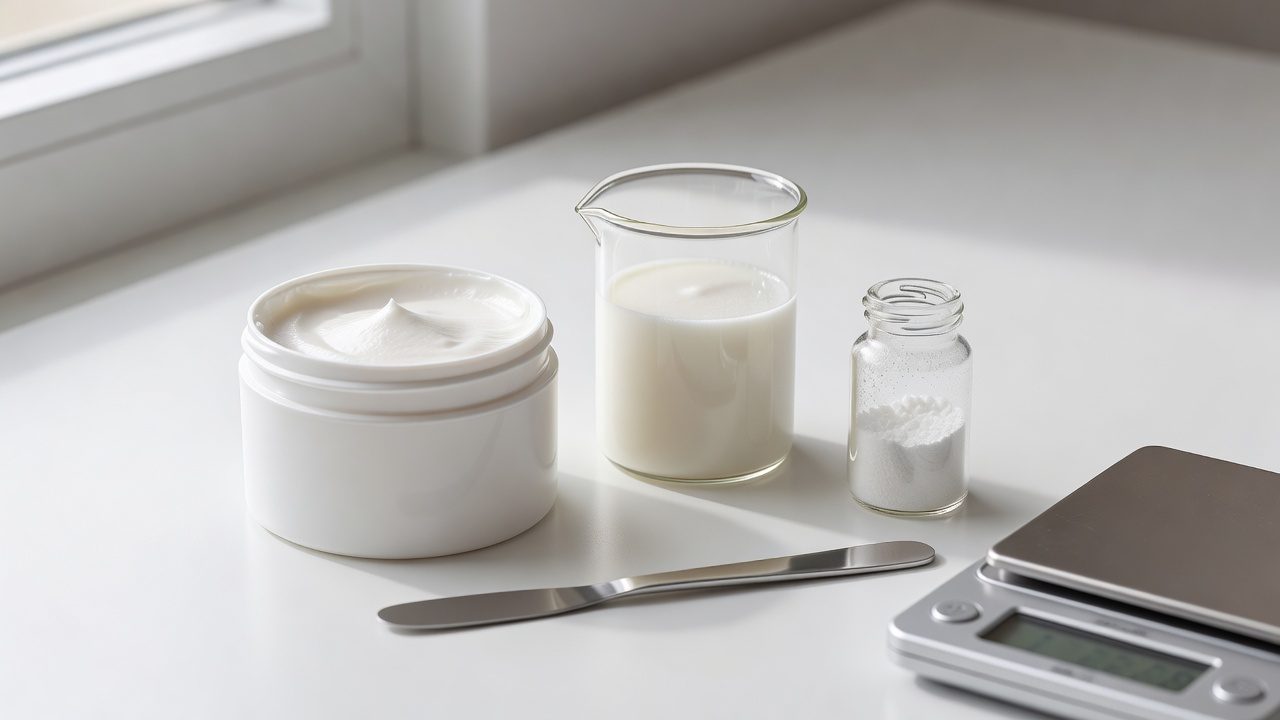
An Idealift cream is a face or neck cream built around Acetyl Dipeptide-1 Cetyl Ester, the lipodipeptide that Sederma sells as Idealift for a firmer, more lifted looking jawline. The supplier material holds 7,500 ppm of peptide and is used at 4 percent, which puts about 300 ppm of peptide in the finished cream, and the same 300 ppm target applies whether you start from the commercial gel, from the sister solution Calmosensine or from neat powder. A cream is the natural home for it, because the peptide is fat-loving, the supplier gel is opaque and the published consumer test used a day cream.
This guide is for people who build the cream themselves. It skips the basics of what a peptide is and goes straight to the decisions that change the result: which form of the peptide you are holding, how to hit the dose, when to add it, and what to pair with it.
Start with the form you actually bought
Acetyl Dipeptide-1 Cetyl Ester is the dipeptide tyrosine and arginine, acetylated at one end and joined to a sixteen carbon cetyl ester at the other. Sederma writes it as N-acetyl-Tyrosyl-Arginyl-O-hexadecyl ester, the CAS number is 196604-48-5 and distributor specifications give a molecular weight of about 604. The cetyl tail is what makes it a lipopeptide, and it is also why the pure peptide does not behave like a typical water soluble peptide powder.
Three raw materials on the market carry this one peptide, and mixing them up is the most common mistake we see. The first is Idealift itself, which Croda lists with the INCI Butylene Glycol (and) Water (Aqua) (and) Sorbitan Laurate (and) Hydroxyethylcellulose (and) Acetyl Dipeptide-1 Cetyl Ester. It is a white to off-white opaque gel, supplied without preservatives, and the 2009 Sederma bulletin defines it as 7,500 ppm of the lipodipeptide.
The second is Calmosensine, an older Sederma product with the same peptide in a slightly different carrier: Butylene Glycol, Aqua, Laureth-3, Hydroxyethylcellulose, Acetyl Dipeptide-1 Cetyl Ester. Sederma describes the active content as about 1 percent and recommends 3 percent, and its consumer tests were run at 300 ppm of peptide, stated as equivalent to 3 percent Calmosensine. You can see that system on our Calmosensine solution card.
The third is the neat peptide. Our Idealift powder is this dry form, and so are the generic Acetyl Dipeptide-1 Cetyl Ester powders sold by peptide makers. One European distributor specification lists it as a white powder, purity above 95 percent by HPLC, insoluble in water, with an optimum pH of 5 to 7 and a use level of 0.03 to 0.75 percent. Note that the low end of that range, 0.03 percent, is exactly the 300 ppm that both Sederma systems deliver at their recommended doses.
The dose math behind a 4 percent Idealift cream
Because the three forms differ so much in strength, it helps to think in ppm of peptide rather than in percent of raw material. Four percent of a 7,500 ppm gel gives 300 ppm in the cream. Three percent of a material at about 10,000 ppm gives the same 300 ppm. With neat powder you weigh 0.03 percent directly, which is 30 mg in a 100 g test batch and 300 mg in a 1 kg batch.
Thirty milligrams is close to the limit of what a hobby scale can weigh accurately, so for small batches a premix is the safer route. Dissolving 100 mg of powder into 10 g of a suitable carrier gives a 1 percent premix, and 3 g of that premix in a 100 g cream again lands at 300 ppm. This is simple arithmetic, and it is worth writing down on the batch sheet, because a decimal slip with a neat peptide changes the dose by a factor of ten.
The distributor range goes far above 300 ppm, but there is no published Idealift data at higher levels that we could find, so going higher mainly raises your cost. If you want more firming-look activity, adding a second peptide with a different target is usually a better use of budget than doubling this one.
Why a cream, not a water serum
The Sederma bulletin calls Idealift water soluble, and in practice the commercial gel does disperse into water phases, but that is thanks to its carrier. Butylene glycol, the nonionic emulsifier sorbitan laurate and hydroxyethylcellulose are there to keep a fat-loving peptide evenly suspended. Take the carrier away and, according to the distributor specification above, the neat peptide is insoluble in water. An emulsion gives it an oil phase and emulsifier film to sit in, which is one reason Sederma tested it in a cream.
The gel is also opaque, so in a water-clear toner it can leave haze, while in a white cream nobody will notice. And the claim itself, a firmer looking jaw line and neck, suits products massaged over a larger area twice a day, which is how the consumer study was run.
Processing: the step where the two Sederma systems differ
Idealift gel goes in hot
This is the detail most first time users miss. The Sederma bulletin for Idealift says to introduce it into the water phase between 60 and 80 C, which is unusual for a peptide, since most peptide solutions are added at cool-down. Follow it: weigh the gel into the water phase before or during heating, then emulsify as normal. Croda gives an effective pH range of 5.5 to 7.5 for Idealift, so finish the cream in that window and check pH after any neutralizer goes in.
Calmosensine goes in cool
Calmosensine, despite carrying the same peptide, is labelled for incorporation at room temperature. Sederma's own example emulsions with it add the carbomer neutralizer at about 50 C and add Calmosensine with the fragrance at about 35 C. So if you switch from one Sederma system to the other, the processing step moves too. This is also why you should never swap one for the other in a tested formula without new stability work.
Neat powder needs a premix
For the dry peptide there is no supplier TDS from Sederma, so the CoA and the seller's guidance for your lot come first. What the commercial carriers show is that a glycol plus a mild nonionic emulsifier is the system Sederma chose to disperse it. A practical approach is to make the premix described above in a glycol or in part of the oil phase, confirm it is uniform with no visible specks, and add it to the emulsion at a step where it can be mixed in thoroughly. Then check the final pH stays in the 5 to 7.5 area that both the distributor and Croda point to.
What the 4 percent cream test actually measured
Sederma's claim substantiation, dated June 2009, used 26 women with an average age of 62, aged 54 to 75, who applied a day cream with 4 percent Idealift to half of the face and a placebo to the other half, twice daily for two months. Jowl surface measured by image analysis fell 4.7 percent from baseline at one month and 11.3 percent at two months. Firmness measured with Sederma's Aeroflexmeter rose 6.2 percent at one month and 7.8 percent at two months, and resistance to sagging rose 24 percent at two months. Jaw line curvature measured by FOITS changed by 7.5 percent at two months.
The cell work was run at only 6 ppm of the peptide. Sederma reports elastin and tropoelastin release in normal human fibroblasts at more than four times the control, a 94 percent increase in elastin actually settled in the matrix, and higher levels of fibrillin-1, fibulin-5 and LOXL-1, proteins that help assemble elastic fibres. That fibre architecture angle is the main thing that separates Idealift from collagen-focused signal peptides.
Read all of this as supplier data. It is a placebo-controlled half-face study, which is better than a satisfaction survey, but it is small, run by the manufacturer and not published in a peer reviewed journal. On your own label, stay with cosmetic wording such as firmer looking skin, a more defined looking jaw line and smoother looking contours.
Pairing Idealift in a cream
Idealift's story is elastin and elastic fibre organisation, so it combines logically with peptides that speak to collagen. A palmitoyl peptide such as Palmitoyl Tripeptide-38 powder adds a matrikine for the look of wrinkles, and our post on Palmitoyl Tripeptide-38 vs Matrixyl 3000 explains how those collagen messengers differ. If you would rather add a second elastin message, Biopeptide EL is an elastin-derived peptide, and the comparison of Biopeptide EL vs Biopeptide CL covers its use level and pH. For a contour brief built around the oval of the face, OVALISS fits the same product story.
Hydrators such as glycerin and hyaluronic acid sit comfortably alongside and give the immediate smoothness that a peptide cannot. Keep strong oxidizers out of the same phase, and if you plan very low pH exfoliating acids, put them in a separate product so the cream can stay in the 5.5 to 7.5 window. As with any multi-peptide cream, run a stability check at room temperature and at 40 C for a few weeks and test preservation, because the Idealift gel itself contains no preservative.
Choosing between gel, solution and powder
If you want to copy the tested system and keep your label claims closest to the supplier data, the commercial Idealift gel at 4 percent is the reference. If you already stock Calmosensine for comfort products, it carries the same peptide at a similar finished dose, but its documentation is built around skin comfort rather than contour, so your claim support is weaker. Neat powder is the most economical per batch, since one gram covers more than three kilograms of cream at 300 ppm, but it puts the dispersion work on you.
Whichever you choose, compare the alternatives in our peptide powders and peptide solutions sections, keep the batch sheet in ppm of peptide, and ask for the CoA of your lot before you scale up.
Frequently asked questions
How much Idealift should I put in a cream?
Sederma recommends 4 percent of the commercial Idealift gel, which holds 7,500 ppm of peptide, so the finished cream contains about 300 ppm of Acetyl Dipeptide-1 Cetyl Ester. With neat powder, 0.03 percent gives the same 300 ppm.
When do I add Idealift to an emulsion?
The Sederma bulletin says to introduce the Idealift gel into the water phase between 60 and 80 C. Calmosensine, which carries the same peptide, is added at room temperature, at about 35 C in Sederma's example formulas.
Are Idealift and Calmosensine the same ingredient?
They carry the same peptide, Acetyl Dipeptide-1 Cetyl Ester, but in different carriers and with different documentation. Idealift is positioned for a firmer, lifted look, Calmosensine for skin comfort, and their processing temperatures differ.
What pH should an Idealift cream have?
Croda gives an effective pH range of 5.5 to 7.5 for Idealift, and a distributor specification for the neat peptide gives an optimum of pH 5 to 7. Aim for about 5.5 to 6.5 and check after neutralizing.
Try it with a 1 g sample pack
Neat peptide powders in 1 g packs, INCI on every page, shipped from Florida.
Shop peptide powders