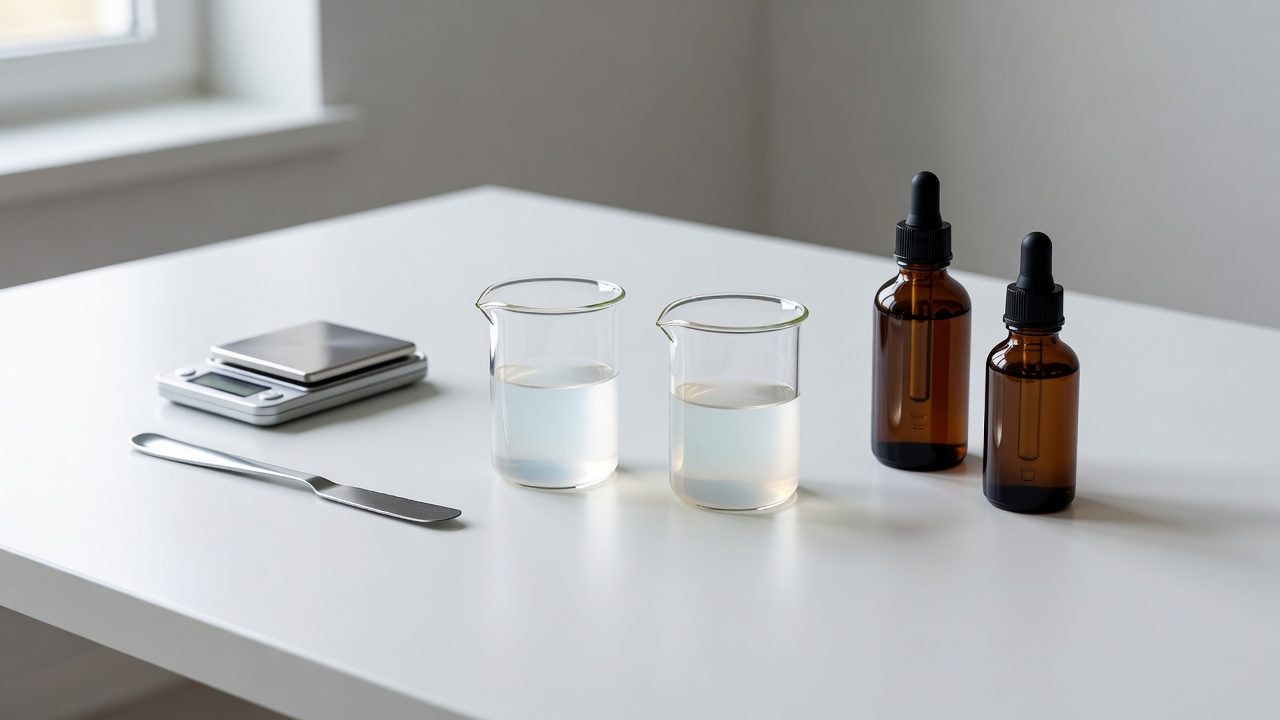
Biopeptide EL and Biopeptide CL are sister peptide solutions from Sederma, now part of Croda, and each carries about 100 ppm of a single palmitoylated peptide in a glyceryl polymethacrylate gel. The difference is the signal: Biopeptide EL holds Palmitoyl Hexapeptide-12, a copy of the Val-Gly-Val-Ala-Pro-Gly repeat in elastin, while Biopeptide CL holds Palmitoyl Tripeptide-1, the Gly-His-Lys fragment of collagen. Pick EL for an elasticity and suppleness story, CL for a smoothing and collagen story, or use both side by side.
Searches for Biopeptide EL usually come from people ready to buy it, and the listings they find rarely explain what they are paying for. This guide sets the two solutions next to each other: the declared composition of each, why both once shared a single INCI name, how little peptide actually ends up in a finished product, how to handle them on the bench and what the safety and test record says.
Two Sister Solutions With One Shared Past
What Biopeptide EL contains
Croda lists the INCI of Biopeptide EL as Glyceryl Polymethacrylate (and) PEG-8 (and) Palmitoyl Hexapeptide-12, a liquid at 25 C aimed at face, neck and eye contour care. The active is Pal-VGVAPG, CAS 171263-26-6, a white powder in neat form with a molecular weight of 737 and a logP of 5.09 according to the 2014 Cosmetic Ingredient Review safety assessment. That same review identifies the trade solution as containing 100 ppm Palmitoyl Hexapeptide-12. Our Biopeptide EL card lists the peptide INCI and CAS, and the full vehicle declaration for each lot is on the CoA.
What Biopeptide CL contains
Biopeptide CL is declared as Glyceryl Polymethacrylate (and) Propylene Glycol (and) Palmitoyl Tripeptide-1. Its active is Pal-GHK, CAS 147732-56-7, molecular weight 578.80 and estimated logP 4.81, and CIR again gives 100 ppm for the trade solution. So the two products differ in two places on the label: the peptide and the glycol, PEG-8 in EL and propylene glycol in CL. If your brand avoids one of those glycols, that alone can decide the choice. Our Biopeptide CL card covers the CL solution, and the same tripeptide is also sold alone as Palmitoyl Tripeptide-1 solution.
Why older documents say Palmitoyl Oligopeptide
For almost twenty years both peptides were listed under one INCI name, Palmitoyl Oligopeptide, created in 1994. CIR notes that the name was retired in 2013 and that trade names filed under it were reassigned to either Palmitoyl Tripeptide-1 or Palmitoyl Hexapeptide-12. That is why an old formula sheet, an archived label or a copied supplier page can say Palmitoyl Oligopeptide for either product. When you rebuild an older formula, read the sequence or the trade name on the CoA, then label it with the current name that matches it.
An Elastin Signal Versus a Collagen Signal
Both peptides belong to the matrikine family, short fragments of matrix proteins that cells read as messages. The case for Biopeptide EL starts with a 1984 paper in The Journal of Cell Biology by Senior and colleagues. They found that the free hexapeptide VGVAPG, a sequence repeated in tropoelastin, attracted fibroblasts and monocytes in culture, with optimal activity at about 10 to the minus 8 molar and a response at least half of the maximum produced by platelet-derived growth factor. Fibroblasts responded only once they had begun making elastin, which links the sequence to the elastin receptor on those cells. Croda positions EL accordingly, as a chemotactic fragment of elastin for firmness and elasticity.
Pal-GHK is built on the collagen-derived tripeptide that also forms GHK-Cu, without the copper. Distributor pages for Croda describe CL as a messenger for collagen renewal that stimulates collagen and glycosaminoglycan synthesis, and claims built on it should follow that supplier test data. Its human data in the CIR review are small but concrete: a cream with 3 ppm Palmitoyl Tripeptide-1 applied around the eyes of 15 women twice daily for 4 weeks reduced wrinkle length and depth and overall roughness, and 4 ppm applied for 4 weeks in 23 women gave a small but significant increase in skin thickness of about 4 percent against vehicle, measured by ultrasound. For Palmitoyl Hexapeptide-12 the published record is mostly cell work, so keep EL claims to the look and feel of firmer, more supple skin.
How Much Peptide Ends Up in the Bottle
Croda gives a recommended use of 2 to 5 percent for both solutions, which is where most formulators start. At 100 ppm of peptide in the raw material, 2 percent of Biopeptide EL puts about 2 ppm of Palmitoyl Hexapeptide-12 into the finished product, and 5 percent puts about 5 ppm, or 0.0005 percent. Biopeptide CL works out the same for Pal-GHK. Those numbers look tiny, but they are normal. A submission summarized by CIR stated that cosmetic peptides are used between 1 and 30 ppm and that levels below 10 ppm are customary, and the highest level in the industry use survey was 0.002 percent, or 20 ppm, of Palmitoyl Hexapeptide-12 in leave-on products.
This arithmetic also explains why one peptide shows up in several products. Dermaxyl, the oil-soluble ceramide paste, carries 200 ppm of the same Palmitoyl Hexapeptide-12 according to CIR, and Maxi-Lip carries 1,000 ppm of Pal-GHK for lip products. Matrixyl 3000 pairs about 100 ppm of Pal-GHK with about 50 ppm of Palmitoyl Tetrapeptide-7. When you compare prices between these materials, compare the cost per ppm of peptide delivered at your use level, not the price per bottle. Our post on Dermaxyl vs Matrixyl walks through the oil-phase route for Pal-VGVAPG, and the Palmitoyl Tripeptide-38 vs Matrixyl 3000 comparison runs the same ppm math for the Pal-GHK blend.
Handling Both on the Bench
pH and temperature
Croda data compiled on the CM Studio+ marketplace give an effective pH range of 4.0 to 6.0 for both Biopeptide EL and Biopeptide CL, so a finished pH around 5.0 to 5.5 suits either one and leaves a margin on both sides. Distributor instructions for both say to add the solution at the end of the process, at cool-down below 40 C, and recommend long-term storage of the raw material at about 4 C. Neither solution needs heating to dissolve, so there is no reason to put it in a hot phase.
Clarity and the carrier gel
Glyceryl polymethacrylate is a film-forming humectant gel, and in both products it keeps a fatty-tailed peptide evenly dispersed in a water-friendly base. Distributors describe the solutions as colorless to opalescent. At 2 to 5 percent they usually disappear into creams and lotions, but in a water-clear gel they can leave a faint haze. Premixing the solution with a little of the glycerin or the glycol from your formula, then adding it to the gel with gentle stirring, gives the cleanest result. Weigh by mass rather than volume, because the gel clings to pipettes and cups, and rinse the weighing vessel with batch water so the whole dose goes in.
Compatibility
Both peptides sit comfortably with glycerin, panthenol, hyaluronic acid, niacinamide and most emulsifier systems used in the 5 to 6 pH band. Strong acid exfoliant formulas below pH 4 fall outside the effective range, so put them in a separate product. If you combine either solution with a copper peptide, check clarity and color over time, and follow each supplier's guidance on pH rather than averaging the two.
What the Safety Record Says
CIR reviewed Tripeptide-1, Hexapeptide-12, their metal salts and fatty acyl derivatives, and Palmitoyl Tetrapeptide-7 in 2014 and concluded they are safe in the present practices of use and concentration in cosmetics. The trade solutions were tested directly. Biopeptide EL was non-irritating to rabbit eyes, while Biopeptide CL was slightly irritating. Both were classified as non-irritants in single-application rabbit skin studies, CL was a non-irritant in a cumulative guinea pig study, and it did not cause sensitization at a 75 percent challenge concentration in the guinea pig maximization test. That record, together with the very low peptide levels, is why both are common in eye contour products. The conclusion applies only to the GHK, VGVAPG and GQPR sequences, so a peptide sold under a vague name without a stated sequence is not covered by it.
Choosing One or Using Both
Choose Biopeptide EL when the brief is elasticity: neck and decollete creams, body firming lotions and eye creams whose promise is a springier, more supple feel. Choose Biopeptide CL when the brief is smoothing and a firmer look on the face, and you want the longer human data trail of Pal-GHK. Because the two share a carrier type, a pH range and a use level, they are easy to combine, and the pairing gives a label two clearly different peptide stories. If you want Pal-GHK with a second signal already built in, the Matrixyl 3000 solution or our Palmitoyl Tripeptide-1 and Palmitoyl Tetrapeptide-7 liquid are the alternatives.
A simple 100 g serum frame for both looks like this. Hydrate 0.40 g hydroxyethylcellulose in about 81 g water with 4.00 g glycerin and 1.00 g panthenol. At room temperature stir in 3.00 g Biopeptide EL, 3.00 g Biopeptide CL and 5.00 g of our Hyaluronic acid liquid 1%, then a broad-spectrum preservative at the level its supplier specifies, and bring the water to 100 g. Adjust to pH 5.0 to 5.5 with citric acid or sodium citrate solution. At 3 percent each, the serum carries about 3 ppm of each peptide, inside the customary range CIR describes. Run stability and preservative challenge tests before launch, and keep the batch record tied to both CoAs.
Reading the CoA Before You Buy
Because the two products look alike and once shared a name, mix-ups do happen in copied listings. On a Biopeptide EL document, the peptide assay should name Palmitoyl Hexapeptide-12 or Pal-VGVAPG; a spec sheet that reports Pal-GHK content belongs to CL or another Pal-GHK material and should be questioned. Check that the peptide content is reported in ppm by HPLC, that the glycol in the INCI matches the product, PEG-8 for EL and propylene glycol for CL, and that appearance and pH match the declared ranges. Both solutions sit in our peptide solutions section, where a 10 mL sample lets you test clarity and feel in your own base before you order a larger size.
Frequently asked questions
What is the difference between Biopeptide EL and Biopeptide CL?
The peptide. Biopeptide EL contains Palmitoyl Hexapeptide-12, an elastin-derived Pal-VGVAPG sequence, with PEG-8 in the carrier. Biopeptide CL contains Palmitoyl Tripeptide-1, the collagen-derived Pal-GHK, with propylene glycol. CIR gives 100 ppm of peptide for each solution.
How much Biopeptide EL should I use?
Croda recommends 2 to 5 percent of the solution. At 100 ppm of peptide, that gives about 2 to 5 ppm of Palmitoyl Hexapeptide-12 in the finished product. Add it at cool-down below 40 C and keep the finished pH within 4.0 to 6.0.
Can Biopeptide EL and Biopeptide CL be used together?
Yes. They share a glyceryl polymethacrylate carrier, a pH range and a 2 to 5 percent use level, so they combine easily. A serum with 3 percent of each carries about 3 ppm of each peptide.
Is Palmitoyl Oligopeptide the same as Biopeptide EL?
It can be. Palmitoyl Oligopeptide was a shared INCI name retired in 2013. Materials listed under it were reassigned to Palmitoyl Tripeptide-1, as in Biopeptide CL, or Palmitoyl Hexapeptide-12, as in Biopeptide EL, so check the sequence on the CoA.
Try it with a 1 g sample pack
Neat peptide powders in 1 g packs, INCI on every page, shipped from Florida.
Shop peptide powders