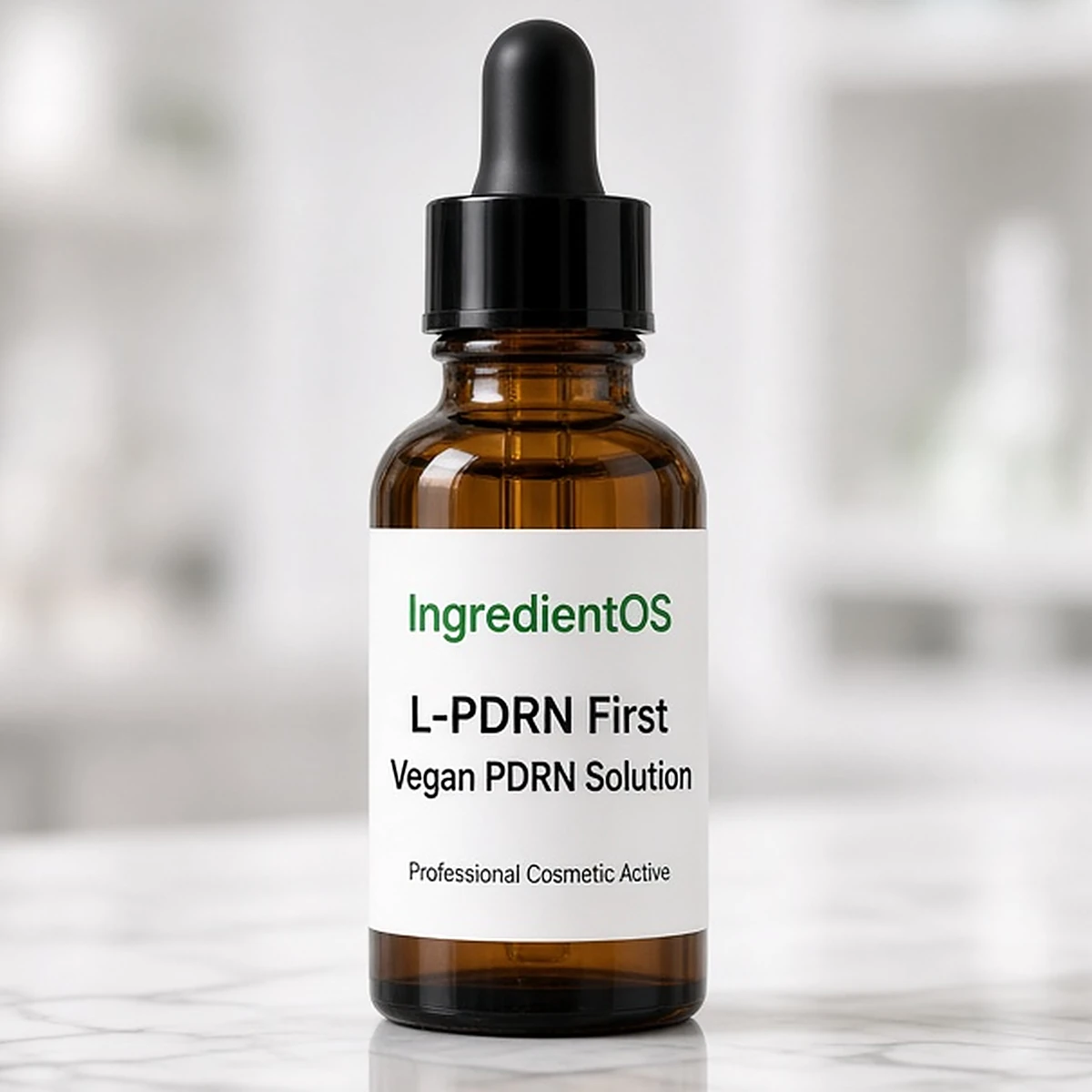
SKU: TM26101702
L-PDRN First Vegan PDRN
- Vegan microbial PDRN from Lactobacillus rhamnosus
- Daebong Life Science, made in the Republic of Korea
- Fragments under 100 bp
- Cold process or cool-down below 45 °C
INCI: Lactobacillus Ferment Lysate, Sodium Chloride, 1,2-Hexanediol, Ethylhexylglycerin, Sodium DNA, Hydrolyzed DNA. CAS: Mixture; Sodium Chloride 7647-14-5; 1,2-Hexanediol 6920-22-5; Ethylhexylglycerin 70445-33-9.
Usage Rate: 2% in the finished formula. Water phase, cold process or cool-down below 45 °C.
Packaging
Liquid sizes — 10 mL sample through bulk (US · metric)
Description
What L-PDRN First is
L-PDRN First is a liquid cosmetic active made by Daebong Life Science in the Republic of Korea. It delivers PDRN, short for polydeoxyribonucleotide, produced by controlled fermentation of Lactobacillus rhamnosus instead of being extracted from salmon. The producer describes it as a microbial, animal-free PDRN and positions it as a sustainable alternative to the salmon material that made the ingredient famous in Korean skin care. For a formulator, it is a ready water-phase active for serums, ampoules and creams built around a glassy, dewy finish and support for the look of a healthy skin barrier.
It sits with the fermented and biotech liquids in our cosmetic actives section. If your brief asks for the classic marine material, compare it with PDRN sodium or salmon DNA, which come from fish rather than fermentation.
Composition and label INCI
The label INCI is Lactobacillus Ferment Lysate, Sodium Chloride, 1,2-Hexanediol, Ethylhexylglycerin, Sodium DNA, Hydrolyzed DNA. The ferment lysate and the DNA fractions are the active part. Sodium chloride keeps the DNA in a stable salt form, while 1,2-hexanediol and ethylhexylglycerin support the stability of the liquid. Because it is a mixture, the trade product has no single CAS number; the distributor lists 7647-14-5 for sodium chloride, 6920-22-5 for 1,2-hexanediol and 70445-33-9 for ethylhexylglycerin.
Why fragment size matters
Salmon PDRN is usually described in fragments of roughly 200 to 800 base pairs. The fragments in L-PDRN First are under 100 base pairs, which the producer reports as two to eight times lighter at the molecular level. That smaller size is the core of its positioning for leave-on products, together with antioxidant activity the supplier measures at more than twice the SOD-like activity of the reference.
How to use it
Add it to the water phase in a cold process. In a hot process, wait until the emulsion has formed and add it during cool-down below 45 °C, then stir until uniform. Avoid long exposure to high temperatures, which can reduce performance. The liquid is water-soluble and works in a finished pH range of 4.0 to 8.0, so it fits most serums, toners, gels and creams without adjustment.
Pairing ideas
L-PDRN First layers well with humectants and other barrier actives. A low dose of GHK-Cu in a separate serum, niacinamide in a toner or a ceramide cream all suit a formulation-focused routine. Keep strong acids and high-alcohol bases out of the same formula, and preserve the water phase fully.
Bench example: glass skin ampoule
This 100 g bench batch shows one way to use the material. Weigh 88.3 g distilled water, 5 g glycerin and 0.2 g sodium hyaluronate, and let the hyaluronate hydrate fully until the gel is smooth. Stir in 3 g propanediol, then add 2 g L-PDRN First and 1 g broad-spectrum preservative used at its supplier rate. Finish with 0.5 g panthenol, check that the pH sits between 5.0 and 6.0, and fill into amber dropper bottles. The ampoule stays clear, light and fast to absorb.
Where it fits in a product line
L-PDRN First suits brands that want the PDRN story without fish-derived material, including vegan and cruelty-free lines. It works as the hero of a single-active ampoule, as a support active in a barrier cream, or in a light toner layered under moisturizer.
Storage
Keep the container tightly closed in a cool, dry place away from direct light and heat. Close the pack quickly after each use to limit air contact. For cosmetic formulation use only.
Key Benefits
- Vegan microbial PDRN from Lactobacillus rhamnosus
- Daebong Life Science, made in the Republic of Korea
- Fragments under 100 bp
- Cold process or cool-down below 45 °C
Product Specifications
Frequently Asked Questions
Is L-PDRN First made from salmon?
No. It is produced by fermentation of Lactobacillus rhamnosus, so it is a vegan, animal-free PDRN.
What INCI goes on my label?
Lactobacillus Ferment Lysate, Sodium Chloride, 1,2-Hexanediol, Ethylhexylglycerin, Sodium DNA, Hydrolyzed DNA.
How much should I use?
The producer recommends 2%. Add it cold, or below 45 °C during cool-down.
Can I call it PDRN on my label claims?
The material is sold as a microbial PDRN. Use the INCI on the ingredient list and keep marketing claims cosmetic.