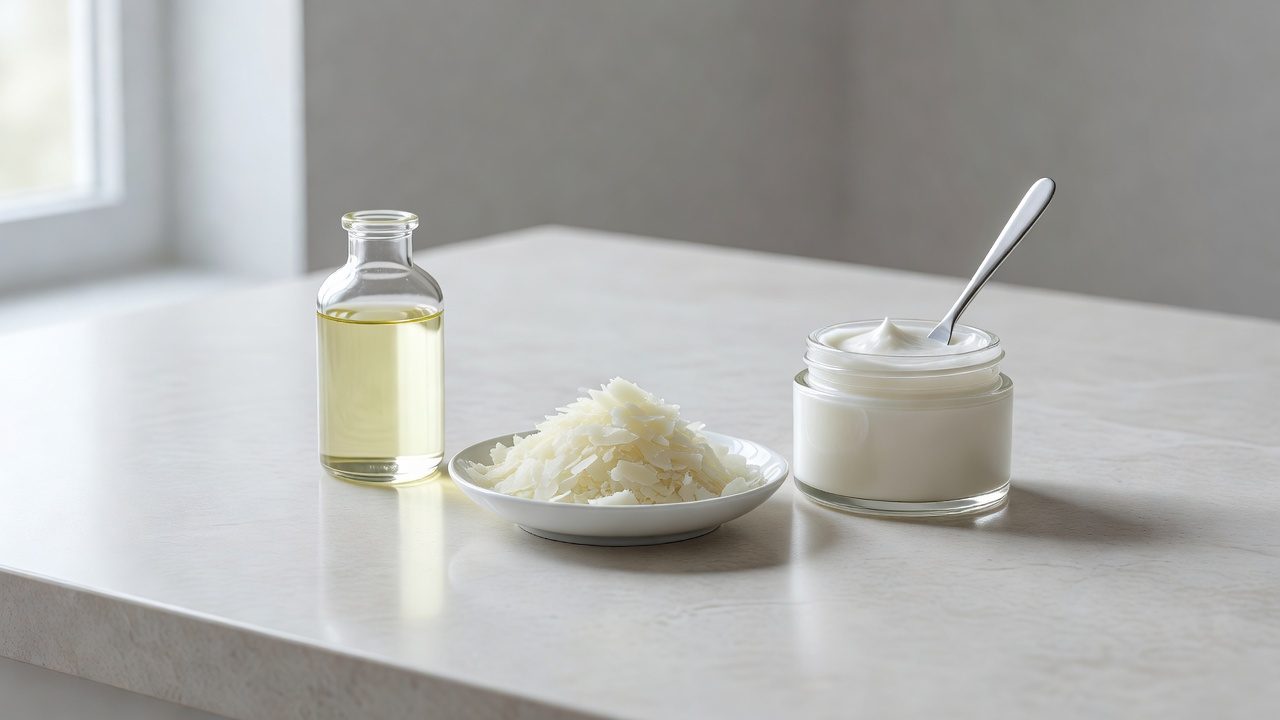
Lanol 2681 and Lanol P are both Seppic esters, but they do opposite jobs. Lanol 2681 (Coco-Caprylate/Caprate) is a light liquid emollient that thins out the feel of an oil phase, while Lanol P (Glycol Palmitate) is a waxy flake that melts into the oil phase and builds body and stability in an emulsion. In most creams they are not substitutes for each other; they are often used together.
Catalog pages list the two names side by side with an INCI and little else. Below we compare what Seppic and the safety literature say about each, how Seppic doses them in its own formulas, and how to combine them.
Two INCI names, two different molecules
Lanol 2681 carries the INCI name Coco-Caprylate/Caprate. Seppic describes it as obtained by esterifying coconut alcohol with caprylic and capric acids, which gives a mixture of esters with medium chain acids on one side and longer coconut alcohols on the other. UL Prospector lists the chemical identity as fatty acids, C8-10, C12-18-alkyl esters, CAS 95912-86-0. The result is a liquid with what Seppic calls average polarity, colorless and easy to emulsify.
Lanol P carries the INCI name Glycol Palmitate. It is a single defined ester: palmitic acid, a C16 fatty acid, joined to ethylene glycol at one end. PubChem lists it as 2-hydroxyethyl hexadecanoate, formula C18H36O3, molecular weight 300.5 (CID 20201), and the Seppic listing on Knowde gives CAS 4219-49-2 and EC 224-160-8. One hydroxyl group of the glycol stays free, giving a small polar head on a long saturated tail, which fits its role as a co-emulsifier and opacifier rather than a simple oil.
Physical form at the bench
The practical difference shows the moment you open the containers. Lanol 2681 is a pourable liquid. CM Studio, which hosts the Seppic brochure and SDS, lists it as colorless to light yellow and odorless, with a specific gravity of 0.853 to 0.863 and a flash point of 203 C, and gives the composition on the SDS as 80 to 100 percent Coco-Caprylate/Caprate. Lanol P is supplied as white flakes, solid at room temperature, with a melting point of 60 to 65 C on the Seppic Knowde listing. You pour one and weigh the other, and only one of them can go into a cold-processed formula without heating.
Our own cards match this: the Lanol 2681 card describes a liquid for the oil phase and anhydrous formulas, and the Lanol P card describes white flakes that stay solid at room temperature.
What each one does in a formula
Lanol 2681: lighter feel and less greasy oils
Seppic positions Lanol 2681 as a green universal emollient. The formulation benefit it lists first is that it decreases the greasy finish of vegetable oils, and the sensory profile it gives is soft and light, with a non greasy finish and short playtime. Seppic also calls it a superfatting agent, a reference to its use in cleansing products to leave some lipid behind on the skin.
Short playtime means the film settles quickly instead of staying slippery, which makes the ester useful as a partial replacement for heavier plant oils or to cut the drag of butters in body oils, light face creams and color cosmetics.
Lanol P: consistency, stability and opacity
Lanol P works on structure rather than slip. Seppic's product page for the flake grade, sold as Lanol P Ecailles, calls it a texturing agent that improves the consistency of the formula and brings a soft skin feel without any soaping effect. The soaping effect is the white streaking that some fatty alcohols and stearates leave when a cream is rubbed in. Seppic also lists an easy-to-rinse and opacifying effect in hygiene formulas, with a thick and creamy texture as the sensory result.
The Knowde listing names its functions as co-emulsifier, emollient and opacifier, and says it helps stabilize oil-in-water emulsions and gives consistency from cream to butter. UL Prospector sums it up as an ester of palmitic acid and ethylene glycol that acts as a stabilizer, thickener, opacifying agent and emollient.
How Seppic doses them in published formulas
Seppic does not print a single recommended use range for either ester on its product pages, so the most reliable guide is the manufacturer's own formulas. They show very different working levels.
In the Oxygene cream, a butter cream-gel formula (EU07348) that Seppic published through COSSMA, Lanol P is used at 1.00 percent alongside 10 percent isostearyl isostearate. Seppic notes that Lanol P provides the consistency for a butter texture without a greasy effect. Phases are heated separately to 75 C before emulsification, and the finished cream reaches about 40,000 mPa s Brookfield at pH 5 to 5.5, with stability reported at room temperature and 45 C. In the Happy Skin foamy emulsion (formula EU07605), Lanol P is again at 1.00 percent next to 3.00 percent Montanov 202 in the oil phase, and Seppic writes that it supports the stability of the foamy emulsion.
A Seppic patent on polyacrylate thickeners, US 6,346,239, calls Lanol P an additive with a stabilizing effect and shows it at 1.0 percent in an O/W cream with 20 percent of another Lanol ester, and Lanol 2681 at 3.0 percent in a non-greasy self-tanning gel thickened with a polymer. These are small, deliberate amounts: Lanol P as a structuring additive, Lanol 2681 as a sensory modifier.
Distributors publish wider ranges. Some retail suppliers quote 1 to 15 or 5 to 20 percent for Lanol 2681, and a European retailer gives 2 to 10 percent for Lanol P in creams, dissolved in the oil phase at about 60 C. Read these as distributor guidance rather than manufacturer data, and confirm the level against the TDS supplied with your lot.
Processing: cold versus hot
Seppic labels Lanol 2681 as cold-processable. It can be stirred into an oil phase at room temperature, added to a cold-process emulsion built on a liquid or polymeric emulsifier, or used neat in anhydrous serums and balms. With a flash point of 203 C, it can also go into the heated oil phase of a conventional cream.
Lanol P needs heat. With a melting point of 60 to 65 C, it has to be fully melted in the oil phase before emulsification, and the Seppic formulas above heat both phases to 75 C. If the oil phase is not hot enough, unmelted flakes recrystallize as grit and the stabilizing effect is lost. This makes Lanol P a poor fit for a strictly cold-processed line, while Lanol 2681 fits both workflows.
Effect on viscosity and appearance
The two materials push texture in opposite directions: Lanol 2681 lightens the oil phase, while Lanol P adds body and opacity. Run any change on a small batch and check viscosity and appearance after 24 hours and after a short heat cycle.
Using Lanol 2681 and Lanol P in the same cream
Because their roles do not overlap, the two esters combine well. A typical approach is to build the oil phase around a glucoside emulsifier such as Montanov 202, a Seppic emulsifier made from arachidyl and behenyl alcohols and arachidyl glucoside, then add Lanol P at about 1 percent for body and stability, and use Lanol 2681 as part of the emollient load to keep the finish light. Heat the oil phase until Lanol P and the emulsifier are completely molten, emulsify, and cool under gentle stirring.
If you need a more conventional structure, Cetearyl Alcohol is the usual consistency factor, and Lanol P can take over part of that job where soaping is a concern. For the emollient side, Lanol 2681 pairs naturally with Caprylic Capric Triglycerides, another medium-chain ester with a soft glide; the two together let you tune spreading without silicones. You can browse further oil-phase materials in our cosmetic actives section and the carrier oils range.
Both materials also suit oil-soluble actives. Our ascorbyl palmitate guide covers another palmitic ester that goes into the oil phase. For another example of choosing between two grades of a texture ingredient, see the Sucraclear vs Sucraclear V2 comparison.
Naturality, certifications and sourcing
The Seppic pages for the two esters differ in their labeling claims, which matters for brands chasing a natural or organic standard. For Lanol 2681, Seppic lists a natural origin content (NOC, ISO 16128) above 99 percent, 100 percent natural origin, no mineral oil, non-GMO and readily biodegradable under OECD 301, with COSMOS approval, Halal certification, mass balance certification, vegan suitability and China compliance. For Lanol P, the page lists NOC above 50 percent, non-GMO and readily biodegradable under OECD 301, with Halal, mass balance, vegan suitability and China compliance. COSMOS approval does not appear on the Lanol P page.
Seppic does not explain the gap on the page. It also publishes a palm status statement and an RSPO certificate for its emollient range, so ask for those documents if your brand has a sustainable palm policy. If you need a COSMOS-approved structuring agent, check the certification of the exact grade before choosing Lanol P.
Safety assessments
Coco-Caprylate/Caprate is one of the alkyl esters covered by the Cosmetic Ingredient Review in its safety assessment of alkyl esters (Fiume and colleagues, International Journal of Toxicology, 2015, volume 34, supplement 2). The Expert Panel concluded that these esters are safe in the present practices of use and concentration when formulated to be non-irritating. Glycol Palmitate is listed in the EU CosIng database with opacifying, skin conditioning and emulsifying functions. As with any raw material, follow the SDS for handling and run your own stability, compatibility and preservation tests on the finished formula.
Which one should you buy?
Choose Lanol 2681 when the problem is feel: a cream that drags, a body oil that stays greasy, a balm that needs a faster finish, or a cold-process line where nothing can be heated. Choose Lanol P when the problem is structure: a lotion that is too thin, an emulsion that separates under heat, or a cleanser that needs a creamy, opaque look. If your formula has both problems, use both, with Lanol P at a low structuring level and Lanol 2681 as part of the emollient phase.
Both are sold from 10 mL or 10 g samples upward, so side-by-side test batches are cheap. Request the CoA, TDS and SDS for your lot and match your percentages to that data.
Sources: Seppic product pages for Lanol 2681 and Lanol P Ecailles (INCI, properties, labeling claims, certifications); Seppic listings on UL Prospector, SpecialChem and Knowde (description, CAS, functions, melting point); CM Studio entry for Lanol 2681 (appearance, specific gravity, flash point, SDS composition); PubChem CID 20201 for 2-hydroxyethyl hexadecanoate; Seppic Oxygene cream formula EU07348 and Happy Skin formula EU07605; US Patent 6,346,239; Fiume et al., Safety Assessment of Alkyl Esters as Used in Cosmetics, Int J Toxicol 2015; IngredientOS product cards for Lanol 2681 and Lanol P.
Frequently asked questions
What is the difference between Lanol 2681 and Lanol P?
Lanol 2681 is Coco-Caprylate/Caprate, a light liquid emollient that reduces greasiness and speeds up the finish of a formula. Lanol P is Glycol Palmitate, a waxy flake with a 60 to 65 C melting point that adds consistency, opacity and stability to emulsions.
Can I replace Lanol P with Lanol 2681?
No. Lanol 2681 is a liquid and will not thicken or stabilize an emulsion the way Lanol P does. Replacing one with the other changes the texture of the product, so reformulate and retest rather than swapping them one for one.
How much Lanol P should I use in a cream?
Seppic's own published creams use Lanol P at 0.5 to 1 percent, melted in an oil phase heated to 75 C. Distributors quote up to 10 percent for very thick textures. Confirm the level with the TDS for your lot and test viscosity after 24 hours.
Is Lanol 2681 cold-processable?
Yes. Seppic labels Lanol 2681 as cold-processable, so it can be stirred into a cold-process emulsion or used in anhydrous formulas without heating. Lanol P, by contrast, must be fully melted in a hot oil phase.
Try it with a 1 g sample pack
Neat peptide powders in 1 g packs, INCI on every page, shipped from Florida.
Shop peptide powders