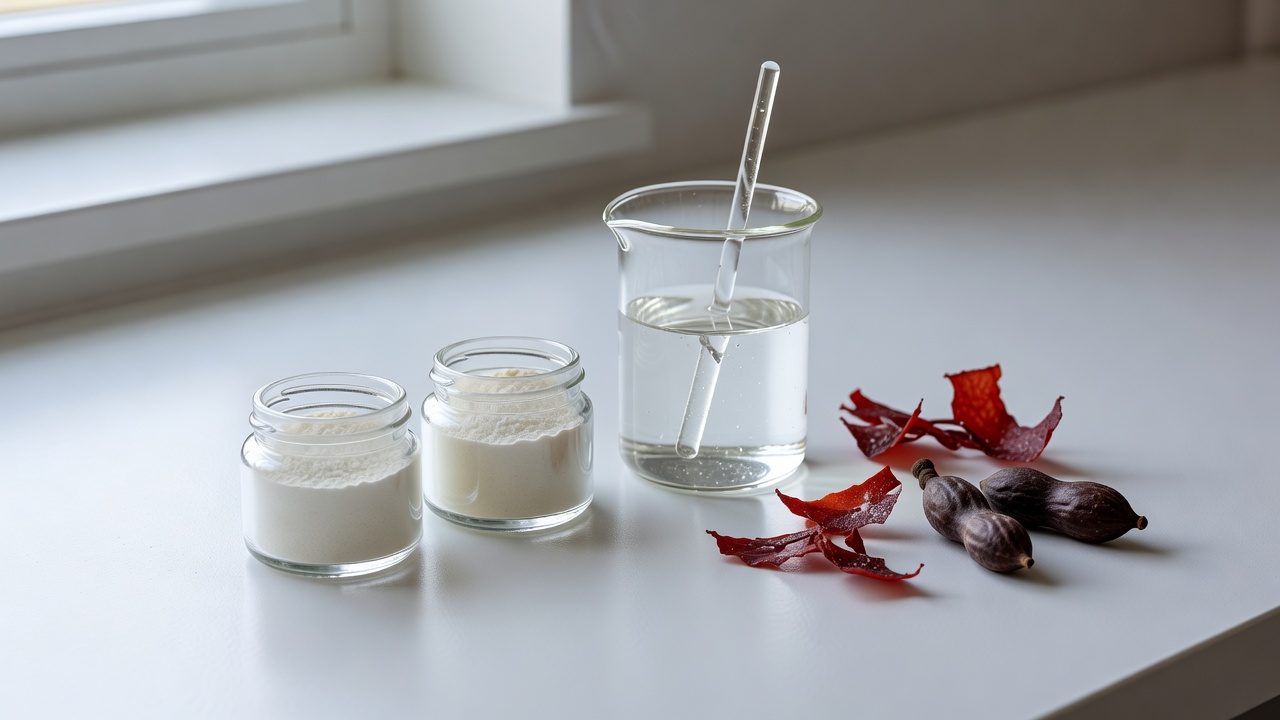
Sucraclear and Sucraclear V2 are two versions of the same natural water-gelling idea from Alchemy Ingredients: a powder blend of cellulose gum, carrageenan from Chondrus crispus and carob (locust bean) gum, plus a sugar. The original Sucraclear HC-31 lists sucrose as the sugar, while Sucraclear V2 lists glucose and names the seaweed part Chondrus Crispus Powder. Both make clear, electrolyte-tolerant water gels without a neutralizing step, so the real decision is about your ingredient list, your documentation and which grade your supplier can actually ship.
Most search results for these two names are single catalog entries, so it is hard to see the difference in one place. Below we compare the declared INCI, what each component does, the processing method, published use levels and a few formulation details that matter when you switch from one grade to the other.
Two INCI declarations, one gelling concept
Distributor literature for the original grade, sold as Sucraclear HC-31, gives the INCI as Cellulose Gum, Carrageenan, Ceratonia Siliqua Gum, Sucrose. Some catalogs write the seaweed component as Chondrus Crispus (Carrageenan) Extract, which is the form we use on our Sucraclear HC card. The Omya product page for Sucraclear V2, where Omya acts as a distributor for Alchemy, lists Cellulose Gum, Ceratonia Siliqua (Carob) Gum, Chondrus Crispus Powder, Glucose.
So the three gums stay the same in function, and two details change on paper. The sugar moves from sucrose to glucose, and the carrageenan is declared under a different INCI name. Alchemy does not publish a public explanation for the change. The company uses the V2 suffix on several reworked products, including Sucragel AP V2 and Sucrablend SP V2, so V2 should be read as a newer version of the blend, not as a separate product family with a different job.
For your label this is the practical point. If your finished product was registered or printed with the HC-31 declaration and you receive V2, your ingredient list must be updated: glucose replaces sucrose, and the carrageenan entry follows the supplier's current specification. Always copy the INCI from the specification sheet of the exact lot you buy, not from an older formula sheet.
Why a blend of three gums gels so well
Each component brings something different. Cellulose gum, the sodium salt of carboxymethyl cellulose, is an anionic water-soluble polymer that builds body and gives a smooth flow. Carrageenans are sulfated galactans from red seaweed; the kappa and iota types can form gel networks, and kappa carrageenan responds strongly to potassium ions. Locust bean gum is a galactomannan from carob seeds that does not gel on its own but interacts with carrageenan and other polysaccharides.
That interaction is well documented in food science. Dea, McKinnon and Rees described in the Journal of Molecular Biology in 1972 how unsubstituted regions of galactomannan chains associate with carrageenan and agarose helices, which is why carrageenan and locust bean gum together give firmer, more elastic gels than either alone. Sucraclear uses this synergy in a cosmetic setting. The sugar is part of the powder blend, and Alchemy does not publish a detailed role for it.
The result, according to Alchemy distributor material, is a clear, shear-thinning gel that mimics the clarity and flow of a carbomer gel. It thins when you rub it in and recovers its body at rest, which is what makes a gel feel light on skin while still holding particles in suspension.
Sucraclear vs Sucraclear V2 in practice
Clarity and texture
Both grades are positioned for transparent water gels. Alchemy's own formulation flowchart puts Sucraclear V2 on the path for a water gel that needs to be transparent, and its natural thickener comparison lists Sucraclear V2 under both transparency and high viscosity. The original HC-31 is described by distributors as forming crystal clear gels in water and as a 100 percent natural water gellant. In a simple water, glycerin and preservative gel you should not expect a different look between the two, but confirm clarity and viscosity with your own preservative and actives, since the supplier notes that clarity may be lost when other ingredients are not fully water soluble.
pH and electrolyte tolerance
HC-31 literature states stability between pH 4 and 11 and with electrolytes, and no neutralization is needed. The Omya listing for V2 highlights good electrolyte tolerance, consistent suspension and good gelling properties. The public V2 page does not print a pH range, so request the technical data sheet before you place V2 in a very acidic or alkaline product. For typical skin gels around pH 5 to 6.5 both grades sit comfortably inside the published HC-31 window.
Applications
Omya lists baby care, color cosmetics, hair care and skin care for V2, with facial and skin gels as the main formats, plus creams and lotions. The HC-31 brochure from the distributor Alfacos lists body gels, clear natural shampoos and body washes, glitter gels, hair gels, eye products and emulsions. In other words, the application map is the same, which supports seeing V2 as a drop-in successor that still deserves a stability check.
How to hydrate Sucraclear without lumps
The HC-31 instructions are straightforward. Disperse the powder in water at room temperature, then heat to about 70 C with homogenization and let the gel cool; the final viscosity develops on cooling. In an emulsion, use the thickened water as the aqueous phase. A distributor formulation guide for a daily moisturizer goes one step further: disperse the Sucraclear in glycerin first, add it to the water, heat to 75 C and homogenize until fully dispersed before adding the oil phase.
The glycerin premix is the easiest way to avoid fish eyes, because the humectant wets each particle before it meets water. Our card for the HC grade also describes a cold route in which the powder is sprinkled onto water under good stirring and left to hydrate, with hot water around 70 C giving the fastest result. If you plan to add a heat-sensitive ingredient, make the gel first, cool it below 40 C and then stir in the active. The same order works well for humectants such as hyaluronic acid liquid.
Whichever grade you use, wait 24 hours before you judge viscosity. Gum networks keep building after cooling, and a gel that looks thin right after mixing is often correct the next day.
Use levels from published sources
Distributor data for HC-31 gives 0.5 to 2.5 percent, with viscosity rising gradually as the level goes up. The ranges on our Sucraclear HC card follow the supplier: 0.5 to 2 percent for skin, eye and intimate gels, 0.5 to 2 percent to thicken surfactant cleansers, 0.5 to 1 percent to stabilize emulsions and improve fluid textures, and about 1 percent in BB creams and tinted fluids. Supplier data also notes that a gel with 1.5 percent can carry up to 30 percent alcohol, with some loss of clarity.
A real formula shows what the low end looks like. In the distributor daily moisturizer mentioned above, 1.2 percent Sucraclear HC-31 sits in a water phase with a lemon fruit water and glycerin, alongside about 17 percent oils and a glyceryl stearate and cetyl alcohol structure. The guide reports a pH of 5.5 and a viscosity of 5,500 to 6,500 mPa s on stability at 45 C. Public V2 material does not print use levels, so start at the same 0.5 to 2.5 percent range and adjust in steps of 0.25 percent after the 24 hour reading.
Pairing the gel with actives
Because both grades carry anionic cellulose gum and sulfated carrageenan, the gel is happiest with nonionic and anionic partners. Strongly cationic ingredients, such as conditioning quats, can interact with anionic gums, so test small batches before you scale a conditioner or a gel with a cationic active. Salts and charged actives are less of a concern than with carbomer, which is one of the main reasons formulators choose this blend.
For a clear hydrating gel, a simple pairing is the gel base with aloe vera gel and a hyaluronic component. If you want a different slip or a firmer jelly feel, Konjac Mannan is another plant gel former that combines well with carrageenan-type systems. When the brief is a cushiony hydrating serum, our comparison of sodium hyaluronate crosspolymer vs sodium hyaluronate explains how the hyaluronic grade changes the feel of a gel. A humectant such as hydroxyethyl urea also sits well in these bases, as covered in our 2-hydroxyethylurea serum guide. More functional and active ingredients for the same order are in our cosmetic actives section.
Switching from HC-31 to V2
If you already have a stable HC-31 formula, handle the switch like any raw material change. Make the gel at the same percentage and process, then compare appearance, pH and viscosity at 24 hours and after a short accelerated test, for example a few weeks at 40 to 45 C next to a room temperature control. Watch for syneresis, the small pool of water that can separate from a gum gel, and for any change in clarity when your preservative and actives are added.
Update the ingredient list, the product information file and any natural origin calculation, because the sugar and the carrageenan declaration change. If you sell into markets that check natural or organic certification, request the current certificate for the grade you buy. The public V2 page labels the product as naturally derived and of plant and vegetable origin, while older distributor lists mark HC-31 as Ecocert approved, so the paperwork, not the gel, is where the two grades differ most.
Which grade should you choose
Choose the grade that matches your existing label and documentation if you are reformulating nothing else. For a new formula, V2 is the version Alchemy currently presents in its natural thickener range, while HC-31 is still sold by distributors and suppliers under its original name. Functionally both give clear, salt-tolerant, shear-thinning gels at 0.5 to 2.5 percent, and both need only dispersion and hydration, with heat speeding the process.
Our Sucraclear HC is the sucrose-based grade with the HC-31 type INCI, available from a 10 g trial pack, so you can test clarity and viscosity in your own base before ordering larger sizes.
Frequently asked questions
What is the difference between Sucraclear and Sucraclear V2?
Both are Alchemy blends of cellulose gum, carrageenan and carob gum with a sugar. HC-31 declares sucrose and Carrageenan, while V2 declares glucose and Chondrus Crispus Powder. The gelling function and applications are the same.
How much Sucraclear should I use in a gel?
Published HC-31 data gives 0.5 to 2.5 percent. Skin and eye gels typically use 0.5 to 2 percent, and emulsion stabilizing needs only 0.5 to 1 percent. Judge viscosity after 24 hours.
Does Sucraclear need heating or neutralizing?
No neutralizer is needed. The powder can hydrate in cold water under stirring, but dispersing it and heating to about 70 C with homogenization gives the fastest and most even gel.
Can I replace Sucraclear HC-31 with V2 one to one?
Start at the same percentage and process, then compare clarity, pH and viscosity at 24 hours and after a short warm stability test. Update your INCI list, since the sugar and carrageenan names change.
Try it with a 1 g sample pack
Neat peptide powders in 1 g packs, INCI on every page, shipped from Florida.
Shop peptide powders