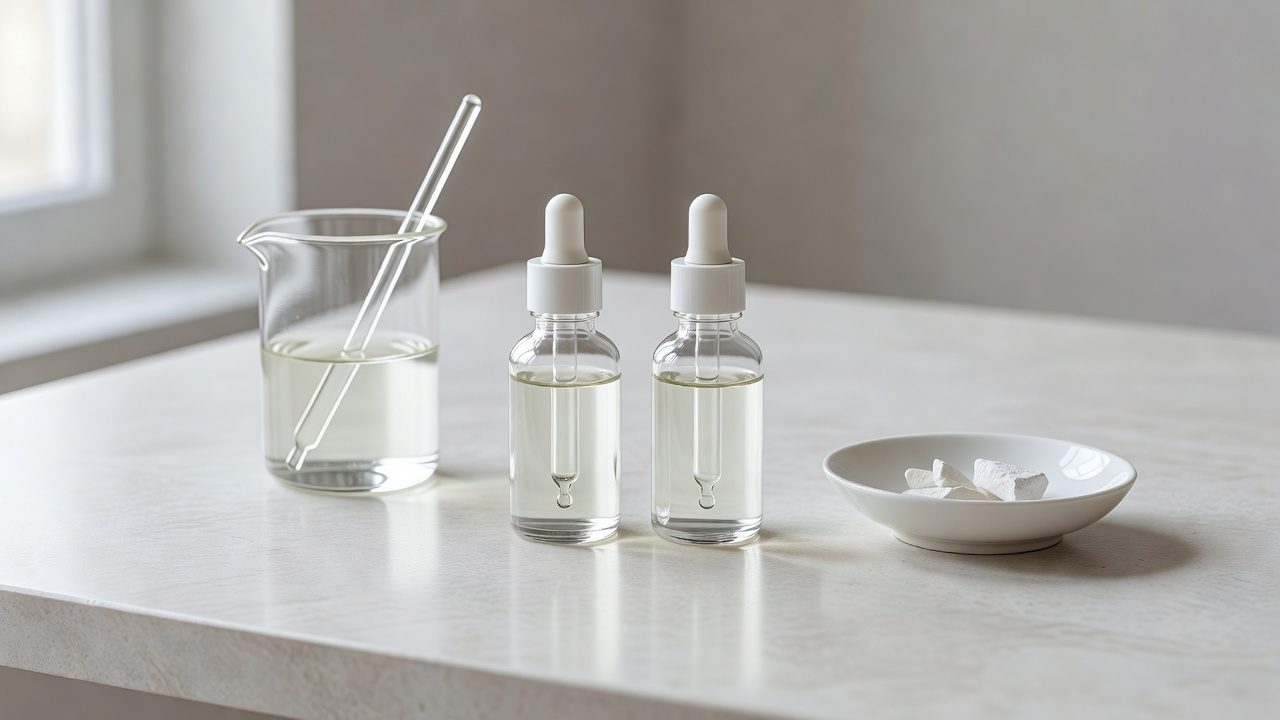
Essenskin and Essenskin free are the same Sederma active, calcium hydroxymethionine with homotaurine in a thickened water and pentylene glycol base, offered in two vehicles. The only difference in the published INCI is Polysorbate-20: the standard grade contains it and the free grade does not. Your choice therefore comes down to label policy, certifications and documentation rather than performance at the bench.
Search results for these two names are bare catalog pages with no explanation, so here we put the two declarations next to each other, explain what each component is there for, and look at what the manufacturer has and has not published for each grade.
The two INCI declarations, word for word
Croda Beauty, which sells the Sederma range, lists Essenskin as Water (Aqua) (and) Pentylene Glycol (and) Polysorbate-20 (and) 3-Aminopropane Sulfonic Acid (and) Calcium Hydroxymethionine (and) Hydroxyethylcellulose. The Essenskin free page lists Water (Aqua) (and) Pentylene Glycol (and) 3-Aminopropane Sulfonic Acid (and) Calcium Hydroxymethionine (and) Hydroxyethylcellulose. Same order, same five remaining names, one ingredient removed.
Croda does not explain the word free on the product page. Reading the two lines together, the most direct interpretation is free of Polysorbate-20, and nothing else in the public data points to a different meaning. Both pages describe a liquid at 25 C with the same positioning: to fortify and restructure thin, fragile mature skin, for face, neck, body, leg and foot care, with anti-ageing and smoothing as consumer benefits. Both list availability in Asia, Europe, Latin America and North America.
Some distributors and formulation databases use other catalog names. CM Studio, for example, lists the standard composition as Essenskin MBAL, a reference to its mass balance palm certification. The INCI on that entry is identical to the standard grade, so MBAL is a supply chain label, not a third formula.
What sits inside the bottle
Calcium hydroxymethionine
PubChem identifies calcium hydroxymethionine as calcium bis(2-hydroxy-4-methylsulfanylbutanoate), formula C10H18CaO6S2, molecular weight 338.5, with CAS numbers 4857-44-7 and 922-50-9 both in use. It is the calcium salt of the hydroxy analogue of methionine, where a hydroxyl group takes the place of the amino group. Calcium makes up roughly 11.8 percent of the salt by weight, a figure you can check from the formula. Sederma describes Essenskin as a complementary source of calcium and essential amino acids, which is a marketing description of this salt rather than a claim that free methionine is present.
Homotaurine
3-Aminopropane Sulfonic Acid, better known as homotaurine, is C3H9NO3S with a molecular weight of 139.18 and CAS 3687-18-1. A safety data sheet summary published on CM Studio gives it at 1 to 5 percent of the standard grade. At the recommended 2.5 percent use level that works out to roughly 0.025 to 0.125 percent homotaurine in the finished product, by simple arithmetic. Sederma pairs it with the calcium salt as a synergistic association in its launch description.
The base: water, pentylene glycol and cellulose
Pentylene glycol appears at 7 to 13 percent in the same SDS summary. It acts as a solvent and humectant and is widely used for its supporting role in preservation, which matters because Croda lists Essenskin as preservative free, EDTA free and BHT and BHA free. Hydroxyethylcellulose is a nonionic cellulose thickener that gives the liquid its slight body. CM Studio quotes the standard grade as a colorless to light yellow liquid with a specific gravity of 1.020 to 1.030, and our own card describes it as a thick, clear liquid.
Polysorbate-20
Polysorbate-20 is polyoxyethylene (20) sorbitan monolaurate, a nonionic surfactant used as a solubilizer and wetting agent. Croda does not publish its level in Essenskin or the exact job it does there. In a water-based concentrate like this its usual roles would be wetting, dispersing or keeping the blend homogeneous, but that is an inference from the ingredient class, not a manufacturer statement.
Why a polysorbate-free version makes sense
Polysorbates are made by ethoxylation, reacting sorbitan esters with ethylene oxide. That single process step is behind most of the reasons a brand would ask for the free grade.
The first is label policy. Many indie and clean beauty brands run PEG-free or ethoxylate-free ingredient lists, and Polysorbate-20 is a PEG derivative even though the letters PEG do not appear in its name. If your marketing says no PEGs, a single active carrying Polysorbate-20 breaks the claim, even at a trace contribution to the final formula.
The second is certification. The COSMOS natural and organic standard does not accept ethoxylated ingredients, so a formula aiming for that seal needs every component to pass, including the vehicle of each active. Choosing the free grade removes one obstacle, though it does not make the active certified on its own. Check the current certificate status with the supplier.
The third is the 1,4-dioxane question. 1,4-dioxane can form as a byproduct of ethoxylation, and New York State has limited it in cosmetic products to 10 ppm since December 31, 2022, with rinse-off personal care products such as shampoo and body wash at 1 ppm since December 31, 2023. A raw material dosed at 2.5 percent with a minor surfactant share is unlikely to decide your result, but brands that audit every ethoxylated input often prefer to remove them rather than document them.
What the manufacturer data actually covers
Sederma launched Essenskin in 2008. Its launch data, reported by Cosmetics and Toiletries and Cosmetics Business, includes in vitro results of +213 percent cell multiplication and +135 percent protein synthesis, and higher cell viability after an osmotic shock test. The in vivo study ran for two months on 29 women aged 60 on average with mature skin and a sagging neckline, none of them using hormone products, who applied a cream with 2.5 percent Essenskin against a placebo in a randomized split design on the face, arm and neck. Sederma reported skin density up 68 percent, better firmness and elasticity for 80 percent of the panel and skin 21 percent more resistant. A further 21 day consumer test on 100 panellists at Eurofins covered satisfaction on 20 criteria.
All of this predates the free grade and was published for Essenskin, not Essenskin free. The active pair and the base are the same, so formulators commonly regard the data as transferable, but that is a bridging assumption. If a claim on your pack relies on the 2008 numbers, ask Croda whether they support those claims for the free grade, and keep the answer in your product file.
Documentation and certifications are not identical
This is the most practical difference today. The Croda page for the standard Essenskin lists RSPO and Halal certifications, ISO 16128 natural and derived natural status with 83 percent natural origin content, and a sustainable palm (RSPO MBAL) note. The Essenskin free page, at the time of writing, lists none of these. That does not mean the free grade lacks them, only that they are not published, so you must request the certificate set rather than assume it carries over.
The palm note is linked to the formula itself. Polysorbate-20 is built on lauric acid, which commonly comes from palm kernel or coconut oil. Remove it and the palm supply chain question for the grade may change, which is exactly why the documents need to be checked separately rather than copied from one grade to the other.
Formulating with either grade
Dose, phase and pH
The recommended use level is 2.5 percent for both grades, and CM Studio gives an effective pH range of 5.0 to 7.0. Our Essenskin card lists a pH of 6.2 for the liquid and recommends stirring it into the water phase, or into an emulsion after cooling, at 2.5 percent. The card is the standard grade with Polysorbate-20 in the INCI. Check the supplier TDS for any temperature limit before adding it to a hot phase.
Switching grades in an existing formula
Start with a one to one swap at the same percentage and the same addition step. Then compare three things against your current batch: clarity in a gel or serum, viscosity after 24 hours, and how the finished product behaves in a short warm stability test. Polysorbate-20 can contribute a little wetting and solubilizing power, so in a clear gel that also carries a fragrance or another oil-soluble component, look for haze and adjust your own solubilizer if needed. In a full emulsion the difference is usually negligible, because the emulsifier system dominates.
Preservation
Both grades are sold without a preservative, which places the full job on your finished formula. Polysorbates are known to bind some preservatives such as parabens inside micelles, which can lower their free concentration. The amount carried in by a 2.5 percent active is small, but a change of grade is still a reason to repeat your preservative efficacy test rather than reuse the old report.
Partners in a contour range
Essenskin is positioned for neck, jawline and decollete products, so it sits well beside Ovaliss, another Sederma active aimed at the jawline, and high molecular weight hyaluronic acid for surface moisture. For a second firming story, Akosky Ethernal works in the same water phase. You can browse further firming concentrates in our cosmetic actives section. Our Calmosensine vs Calmosensine SP guide covers a similar name and grade question for another Sederma active, and the Idealift cream article shows how a jawline peptide is dosed in a cream.
Which grade to choose
Pick Essenskin free if your brand has a PEG-free or ethoxylate-free policy, if you are building toward a natural or organic certification that excludes ethoxylated inputs, or if your retailer questionnaire asks about ethoxylated raw materials. Pick the standard grade if those policies do not apply and you value the published certifications on the Croda page, including RSPO, Halal and the ISO 16128 natural origin figure. In both cases, request the TDS, SDS and certificates for the exact grade you buy, and confirm the claims support you need for the free version.
Sources: Croda Beauty product pages for Essenskin and Essenskin free (INCI, form, applications, certifications); CM Studio entry for Essenskin MBAL (recommended use, effective pH, specific gravity, SDS composition ranges); PubChem entries for calcium hydroxymethionine (CID 107344) and homotaurine (CID 1646); Cosmetics and Toiletries, October 2008, and Cosmetics Business, March 2008, on the Sederma launch data; New York State DEC, 6 NYCRR Subpart 352-1 on 1,4-dioxane limits; IngredientOS product card for Essenskin.
Frequently asked questions
What is the difference between Essenskin and Essenskin free?
The published INCI of Essenskin free is the same as standard Essenskin minus Polysorbate-20. The actives, calcium hydroxymethionine and homotaurine, and the water, pentylene glycol and hydroxyethylcellulose base are unchanged.
Is Essenskin a peptide?
No. Essenskin combines calcium hydroxymethionine, the calcium salt of a methionine analogue, with homotaurine, a sulfonic acid. It is often sold beside peptides for firming products, but it contains no peptide chain.
How much Essenskin or Essenskin free should I use?
The recommended use level is 2.5 percent in the finished product, within an effective pH range of 5.0 to 7.0. The 2008 Sederma panel tested a cream at that 2.5 percent level.
Can I replace Essenskin with Essenskin free one to one?
Start at the same percentage and addition step, then check clarity, viscosity and stability against your current batch and repeat the preservative test. Update your INCI list and confirm certificates and claims support for the free grade.
Try it with a 1 g sample pack
Neat peptide powders in 1 g packs, INCI on every page, shipped from Florida.
Shop peptide powders