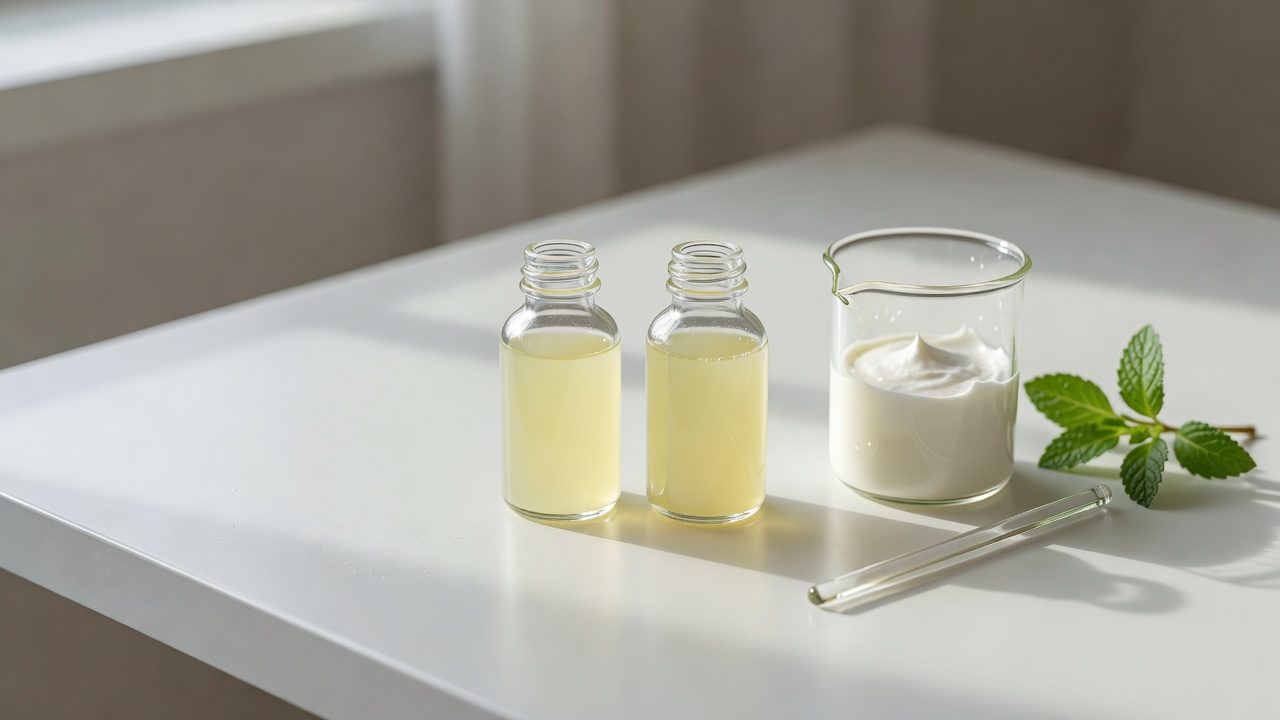
Calmosensine and Calmosensine SP are the same Sederma comfort peptide sold under two catalog names: both are declared as Butylene Glycol (and) Water (Aqua) (and) Laureth-3 (and) Hydroxyethylcellulose (and) Acetyl Dipeptide-1 Cetyl Ester, and both carry the lipodipeptide N-acetyl-tyrosyl-arginyl hexadecyl ester at about 1 percent. Calmosensine is the original name used in Sederma's technical bulletins, while Calmosensine SP is how Croda, which owns Sederma, lists the product in its current catalog. For a formula, the use level, processing and label declaration are the same.
That short answer explains why the two names compete for the same searches, but it leaves a few practical questions open. Which documents should you trust when they disagree, what does the suffix actually tell you, and how do you move a formula written for one name onto stock labelled with the other? This guide answers those questions from Sederma's published dossier, Croda's product page and the one independent clinical comparison in the literature.
Where the two names come from
The active itself is older than either name. Sederma's dossier explains that the same peptide was first sold as Sensicalmine, in a different glycolic excipient, and was later relaunched as Calmosensine in a slightly gelled base of butylene glycol and water. Sederma states that the excipient does not contribute to the activity, which is why the company pooled study data generated with both products. The original patent is WO 98/07744, cited on every Calmosensine sheet.
Sederma joined the Croda group, and Croda Beauty now publishes the material as Calmosensine SP. The SP suffix is not unique to this product. The same catalog carries Chronodyn SP, Aquaderm SP and Hydraprotectol SP, which are unrelated actives with different chemistry, so the letters are part of Croda's naming system rather than a statement about the peptide. Croda does not explain the suffix on its public pages, and we will not guess at a meaning it has not published. What can be checked is the composition, and on that point the two names match word for word.
How to read older and newer documents
In practice you will meet both names in the same project. Legacy formulas, distributor brochures and many sensitive-skin product launches from the 2000s say Calmosensine. Croda's product finder, newer SDS files and SpecialChem's datasheet, updated in 2023, say Calmosensine SP. UL Prospector still lists the plain name with Sederma's indicative formulas, such as a soothing serum, a relaxing anti-age cream and even a roll-on deodorant. When a document only differs by name, regard it as the same material. When it differs in INCI order, carrier or active content, ask for the current technical data sheet before you sign off a formula.
What is inside Calmosensine and Calmosensine SP
The functional molecule is Acetyl Dipeptide-1 Cetyl Ester. It starts from the dipeptide tyrosyl-arginine, which Takagi, Shiomi and colleagues described in Nature in 1979 as a naturally occurring brain dipeptide later known as kyotorphin. Sederma acetylated the tyrosine end and esterified the arginine end with cetyl alcohol, a 16-carbon chain. The dossier says this was done to make the peptide more lipophilic, more stable and more available at the skin surface. The peptide is entirely synthetic.
The trade product is a slightly gelled hydroglycolic solution. Butylene glycol and water are the carrier, Laureth-3 helps keep the lipophilic peptide dispersed, and hydroxyethylcellulose gives the light gel body. Sederma describes the active content as about 1 percent, preserved and stabilized. The liquid is opaque and pale yellow, which matters when you plan a crystal-clear product. The same peptide is also sold dry, for example as Idealift, and in a different Sederma gel positioned for contour care. If you want to compare those systems for a cream, our Idealift cream formulation guide sets the three side by side.
Label declaration
Whichever name is on the drum, the INCI you declare is identical: Butylene Glycol, Water (Aqua), Laureth-3, Hydroxyethylcellulose and Acetyl Dipeptide-1 Cetyl Ester, each placed in its correct order by weight in the finished product. At 3 percent of the trade solution the peptide sits near the end of most ingredient lists, while butylene glycol and water merge with the same materials you already use. Croda lists the SP product as Halal and vegan suitable and as compliant with the IECIC inventory for China, which is useful if your brand sells in Asia.
Use level and what 3 percent delivers
Sederma recommends 3 percent of the solution. Because the solution holds about 1 percent peptide, 3 percent in the formula gives roughly 300 ppm of Acetyl Dipeptide-1 Cetyl Ester, and Sederma's clinical reports express the test dose in exactly that way, 300 ppm of Tyr-Arg peptide equivalent to 3 percent Calmosensine. Some distributor sheets, including the one behind our product card, give about 3 percent for age care, 2 to 3 percent for sun and after-sun products and 1 to 2 percent for children's cosmetics. Going below 3 percent is a cost or mildness decision, but it also moves you away from the dose that was tested.
A quick way to check a supplier is to do the math. If a solution is sold as a lower or higher strength than about 1 percent peptide, the 3 percent rule no longer gives 300 ppm, and you should scale the input so the finished product still lands near that target. Ask for the assay on the certificate of analysis, not only the trade name.
Processing and compatibility
Sederma labels the material as water-soluble with incorporation at room temperature. Its indicative age prevention cream shows the order clearly: the carbomer is swollen, the oil phase is heated to 75 C and emulsified, the neutralizer goes in at 50 C, and Calmosensine is added with the fragrance at 35 C. Sederma's own panel formula put it into a carbomer and acrylates crosspolymer gel cream at 3 percent in the last phase. So the safe habit is simple: add it to the cooled batch, stir until uniform and avoid long periods of heat.
Choosing the base
Because the solution is opaque, creams, lotions, milky gels and balms hide it best. It has been formulated into carbomer gels, phosphate ester emulsions and glyceryl stearate creams in Sederma's own work, which covers the most common sensitive-skin chassis. Sederma does not publish a narrow pH window for it on its public sheets, so stay in the mild, skin-friendly range typical of leave-on products and run your usual stability checks. Keep the rest of the formula gentle as well: a comfort claim is easy to undermine with high fragrance loads, strong acids or a harsh preservative system.
For pairings, a moisturizing partner such as hyaluronic acid liquid and a classic comfort ingredient such as bisabolol or allantoin fit the same brief. Expression-line products often combine it with a neurotransmitter-type peptide; the differences between those are covered in our Pentapeptide-3 vs Acetyl Hexapeptide-8 comparison.
What the studies actually show
Sederma's dossier reports three placebo-controlled panel studies, all run at 300 ppm peptide. In an electrodermal response test with 18 volunteers, hands were stroked with sandpaper before and after application, and the duration of the skin's emotional response fell by 16.7 percent at one hour and 20.8 percent at two and three hours, against 8.7 to 13 percent with placebo, which was not significant. In a heat perception test on 21 volunteers, the temperature at which each sensation threshold was reported moved 1.3 to 1.6 C higher after the peptide, compared with about 0.5 C for placebo. In a capsaicin stinging test on 14 volunteers, 9 reported less stinging on the cheek that received the peptide cream first, over one hour of follow-up.
Sederma also reports in vitro data: higher expression of POMC, the precursor of beta-endorphin, in keratinocytes at 0.5 to 2 ppm, lower CGRP release from cultured nerves, and fewer contractions in a nerve and muscle co-culture at 1 ppm. These are cell models, useful for the story behind the ingredient, not for consumer claims.
An independent comparison
The only peer-reviewed human comparison we found is Schoelermann and colleagues, Journal of the European Academy of Dermatology and Venereology, 2016. In 31 volunteers with sensitive skin, capsaicin was applied to both nasolabial folds and then a product with 4-t-butylcyclohexanol or a product with Acetyl Dipeptide-1 Cetyl Ester was applied. Both reduced the burning sensation over the first 15 minutes. The 4-t-butylcyclohexanol product acted faster in the first two minutes, while peak burning, its severity and its duration did not differ between the products. The study was run by the maker of the competing ingredient, which is worth keeping in mind, but it confirms that the peptide gives a comfort effect in a real face test.
Which one should you buy
If your formula, regulatory file or claim dossier was written for Calmosensine, Calmosensine SP is the current name for the same composition, and you can move the formula across without changing the percentage or the processing step. What you should update is the paperwork: keep the latest TDS, SDS and certificate of analysis on file, confirm the INCI line matches your label and record the lot used in your stability batches. If a supplier offers a product called Calmosensine with a different INCI or a different carrier, it is not the same material, whatever the name says.
Our Calmosensine solution carries the INCI above, ships from a 10 mL sample for bench work and comes with lot documents on request. For the dry form of the same peptide, see Idealift, and for other ready-to-use liquids, browse our peptide solutions section.
Claims that stay cosmetic
Keep wording on what the consumer feels and sees: skin feels more comfortable, less tight and less reactive to wind, cold or shaving, and looks smoother and more relaxed. Sederma's own language about expression lines and well-being fits a cosmetic product. Avoid wording about pain relief, nerve blocking or any medical skin condition, and do not present the in vitro results as proven effects in people.
Frequently asked questions
Is Calmosensine the same as Calmosensine SP?
Yes, in composition. Both are declared as Butylene Glycol (and) Water (Aqua) (and) Laureth-3 (and) Hydroxyethylcellulose (and) Acetyl Dipeptide-1 Cetyl Ester. Calmosensine is the original Sederma name and Calmosensine SP is the name in Croda's current catalog.
What does SP mean in Calmosensine SP?
Croda uses the SP suffix on several unrelated Sederma products, such as Chronodyn SP and Aquaderm SP, and does not define it on its public pages. Judge the material by its INCI, TDS and certificate of analysis, not by the suffix.
How much Calmosensine should I use?
Sederma recommends 3 percent of the solution, which gives about 300 ppm Acetyl Dipeptide-1 Cetyl Ester, the dose used in its panel studies. Add it to the cooled batch, around 35 C in Sederma's example cream.
Is Calmosensine the same as Idealift?
They carry the same peptide, Acetyl Dipeptide-1 Cetyl Ester, but in different carriers and with different documentation. Calmosensine is positioned for skin comfort, while Idealift is positioned for a lifted looking contour.
Try it with a 1 g sample pack
Neat peptide powders in 1 g packs, INCI on every page, shipped from Florida.
Shop peptide powders