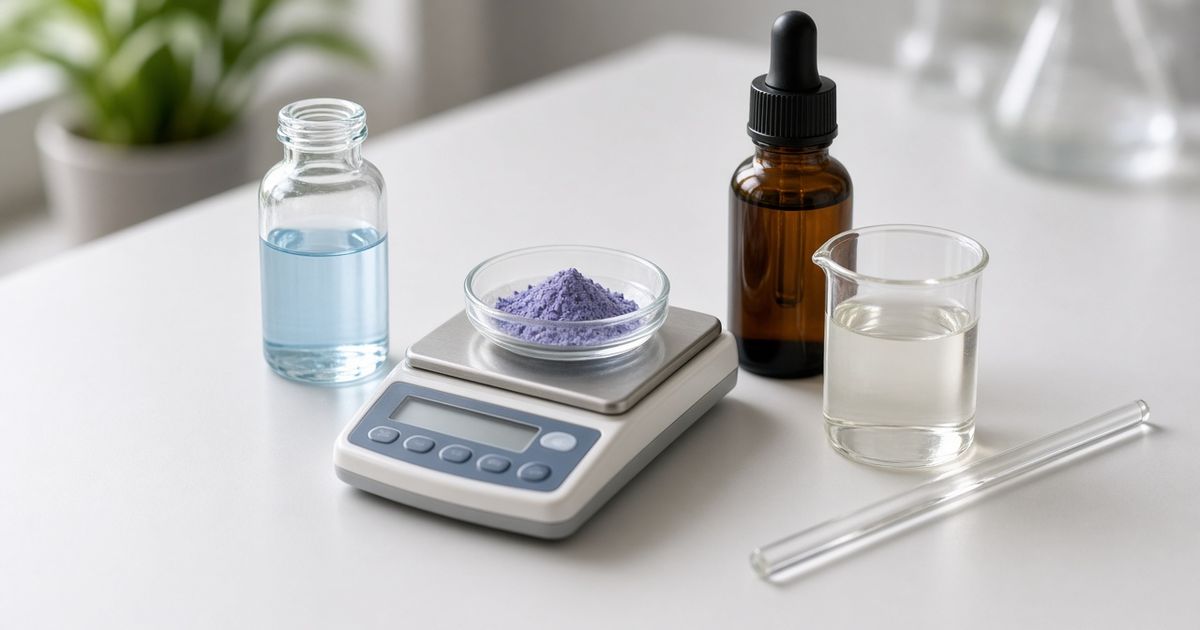
GHK-Cu is the copper complex of a three-amino-acid peptide, glycyl-L-histidyl-L-lysine, and on an ingredient label it appears as Copper Tripeptide-1. In its dry form it is a fine blue to violet powder that dissolves in water and is used in very small amounts. That last point is where most homemade copper peptide serums go wrong: the useful range is measured in hundredths of a percent, so weighing, dissolving and protecting the peptide matter more than any clever ingredient combination. This guide explains what the powder is, what the published research does and does not say, how to dose it accurately at home or in a small lab, which ingredients to keep away from it, and how to build a simple, stable 100 g serum around it.
What GHK-Cu Powder Is
GHK was first isolated from human plasma, where it naturally binds copper(II) ions. The copper complex is what cosmetic chemists buy as GHK-Cu powder (Copper Tripeptide-1). The CAS number listed for the material is 89030-95-5. Because the copper ion gives the complex its color, a correctly prepared solution has a clear blue tint. A green, brown or cloudy solution is a sign that something in the formula has pulled the copper out of the peptide or that the peptide has degraded.
A widely cited review by Pickart and Margolina in the International Journal of Molecular Sciences (2018) summarizes laboratory and gene-expression data on GHK-Cu and discusses why the molecule became popular in skin care (PubMed 29986520). Much of that evidence comes from cell culture and animal models, not from finished cosmetic products, so it is fair to describe GHK-Cu as a well-studied peptide rather than as an ingredient with a guaranteed visible outcome. In a cosmetic serum its role is to support the look of smooth, conditioned, comfortable skin as part of a balanced formula.
Powder Versus Ready Solution
Copper peptide is sold both as pure powder and as pre-diluted liquid. The powder is the concentrated, shelf-stable option: it keeps well when sealed, cool and dry, and it gives the formulator full control over the final level. The trade-off is that you must dissolve it yourself and weigh tiny amounts. A ready solution is easier to pour but already contains a vehicle and a set concentration, which you need to confirm on the certificate of analysis before you calculate a recipe. This article focuses on the powder. If you prefer liquids, the peptide solutions category groups the ready-to-use options, and the peptide powders category lists dry forms.
How Much GHK-Cu to Use
The product data for our powder gives a typical use level of 0.01 to 0.1% of the pure powder in the finished formula, based on supplier technical information for Copper Tripeptide-1. In a 100 g batch that means 0.01 to 0.1 g, or 10 to 100 milligrams. Most leave-on facial serums sit around 0.05%, which is the level used in the recipe below. Going higher does not make a formula better; it increases cost, intensifies the blue color and raises the chance of a reaction with other ingredients. Always check the certificate of analysis that ships with your lot, because purity and moisture content vary between batches.
Why a Stock Solution Makes Dosing Accurate
Few kitchen or hobby scales weigh 0.05 g reliably. A 0.01 g scale has an error of at least plus or minus 0.01 g, which is twenty percent of the amount you want. The practical answer is a stock solution. Weigh 0.50 g of GHK-Cu powder on a 0.01 g or better scale and dissolve it in 9.50 g of distilled water. You now have 10.00 g of a 5% stock, and every 1.00 g of that stock carries 0.05 g of peptide. Weighing 1.00 g is easy and accurate on any decent scale. Prepare the stock in a clean glass vial, use it the same day, and do not store an unpreserved peptide solution, because water without preservative is an open invitation to microbial growth.
pH and Stability
Copper complexes are sensitive to pH. Most supplier guidance for Copper Tripeptide-1 places the working range for the finished product between roughly pH 5.0 and 7.0, and many formulators aim for 5.5 to 6.5. Strongly acidic conditions can release copper from the peptide, which is often visible as a color shift. Measure pH with a calibrated meter rather than paper strips, because strips are hard to read against a blue liquid. Adjust in small steps using a dilute solution of lactic or citric acid to lower pH, or a dilute sodium hydroxide solution to raise it, and stir well between additions.
Heat is the second factor. Add GHK-Cu during the cool-down phase, below 40 °C, and avoid holding it at high temperature. Store the finished serum in an opaque or amber airless or dropper bottle, away from direct light, and make small batches so each one is used within a few months.
Ingredients to Keep Away From Copper Peptide
Strong Chelators
Chelating agents such as disodium EDTA, tetrasodium EDTA, sodium phytate and gluconolactone are added to many formulas precisely because they bind metal ions. In a copper peptide serum that is a problem, because they compete with the peptide for the copper. Leave them out of a GHK-Cu formula, or keep them in a separate product.
Low-pH Acids and Pure Ascorbic Acid
Exfoliating acids at low pH and L-ascorbic acid formulas typically run well below pH 4, outside the comfortable range for the copper complex. Ascorbic acid is also a reducing agent that can interact with copper ions. If you use both types of products, the common approach is to apply them at different times of day rather than combining them in one bottle.
Other Points to Test
Some formulators report color changes when copper peptides are combined with high levels of certain other actives in the same water phase. Because results depend on concentration and pH, the safe practice is a small test batch: make 20 g, keep it at room temperature and at 40 °C for two weeks, and check color, clarity, smell and pH. A stable formula stays clear blue and holds its pH within about half a unit.
Ingredients That Pair Well
Simple humectants and soothing ingredients suit a copper peptide serum. Glycerin adds slip and moisture. Low molecular weight hyaluronic acid provides light hydration and a slightly fuller serum texture without stickiness when used at 0.1 to 0.2%. D-panthenol, provitamin B5, is water-soluble, comfortable on skin and tolerant of the near-neutral pH that copper peptide prefers. For a facial routine, a few drops of a light emollient such as squalane oil applied after the serum helps seal in the water-based layer; keep the oil out of the serum itself so the formula stays a clear, single-phase solution.
Recipe: Copper Peptide Hydrating Serum, 100 g
A clear, light, water-based serum built around 0.05% Copper Tripeptide-1, the middle of the standard 0.01 to 0.1% range for the pure powder. All quantities are in grams and the batch totals exactly 100.00 g. Work with sanitized glass or stainless steel tools, gloves and distilled water, and weigh on a scale with 0.01 g resolution.
Phase A: Water Phase, Room Temperature
Distilled water 92.75 g, glycerin 4.00 g, low molecular weight hyaluronic acid 0.15 g, D-panthenol 1.00 g. Disperse the hyaluronic acid in the glycerin to form a smooth paste, which prevents lumps. Add the water slowly while stirring, then add D-panthenol. Let it hydrate for 30 minutes at 20 to 25 °C with occasional stirring until fully clear. No heating is needed.
Phase B: Cool-Down Phase, Below 40 °C
GHK-Cu 5% stock solution 1.00 g (0.50 g powder dissolved in 9.50 g distilled water, so 1.00 g of stock carries 0.05 g Copper Tripeptide-1), phenoxyethanol and ethylhexylglycerin preservative blend 1.00 g. Check that Phase A is at or below 40 °C. Add the stock solution and stir gently until the blue color is uniform, then add the preservative.
Phase C: pH Adjustment
Sodium hydroxide 10% solution 0.10 g. Stir for two minutes and measure with a calibrated pH meter. Target pH 6.0, with an acceptable window of 5.5 to 6.5.
Usage Levels in This Formula
Copper Tripeptide-1 0.05%. Low molecular weight hyaluronic acid 0.15%. D-panthenol 1.00%. Glycerin 4.00%. Phenoxyethanol and ethylhexylglycerin 1.00%. Sodium hydroxide 10% solution 0.10%. Water to 100%.
Packaging and Shelf Life
Fill into an amber dropper or airless bottle and label with the date. A homemade formula has not been through challenge testing, so regard about three months as a cautious working shelf life, and discard any batch that changes color, smell or clarity.
Important Note on Your Ingredients
This formula is calculated at standard industry usage levels for each ingredient. Final amounts, pH and results depend on the specific raw materials you use, their concentration and the batch, so always check the certificate of analysis (CoA) and technical data sheet (TDS) supplied with each ingredient and adjust if they recommend a different level. Make a small test batch first, observe it for two weeks for clarity, color, odor and pH, and patch test before regular use.
Patch Testing and Safe Use
Even gentle formulas can disagree with individual skin. Before using any new serum on the face, apply a small amount to the inner forearm or behind the ear once or twice a day for several days and watch for redness or itching. Copper peptides are cosmetic ingredients. They are not intended to diagnose or address any skin condition, and anyone with a skin problem or a known sensitivity to copper should speak with a dermatologist before use.
Common Mistakes With GHK-Cu Powder
The most frequent mistake is overdosing, usually because the formulator tried to weigh 0.05 g directly on an inaccurate scale. The stock solution method above prevents it. The second is adding the powder to a hot water phase or an already acidic base, which can shift the color to green. The third is combining copper peptide with EDTA or phytate out of habit, because those chelators appear in so many template formulas. The fourth is storing the serum in a clear bottle on a sunny shelf. Each of these shows up as a color change, which makes GHK-Cu unusually easy to troubleshoot: if the serum is still a clear, pale blue, the copper complex is most likely intact.
Where GHK-Cu Fits in a Product Line
Copper peptide works as a featured active in a simple hydrating serum, as a supporting ingredient in an eye gel, or in a light gel-cream. Brands often present it alongside other signal peptides in a separate product rather than in the same bottle. If you are planning a wider peptide range, our guide to a peptide serum formulation for the look of fine lines walks through combining several peptides in one formula, and the full peptides catalog lists the materials available.
Related Products and Guides
If you are building a copper peptide routine, related products worth comparing include the ready liquid Copper Tripeptide-1 solution, high molecular weight hyaluronic acid for a surface-hydrating film and the copper-free Palmitoyl Tripeptide-1. For a full face serum with several peptides, read our peptide serum recipe for wrinkles, and for scalp care see the guide to a DIY scalp serum for fuller-looking hair.
Sources
Pickart L, Margolina A. Regenerative and Protective Actions of the GHK-Cu Peptide in the Light of the New Gene Data. International Journal of Molecular Sciences, 2018. https://pubmed.ncbi.nlm.nih.gov/29986520/
Product data and use level: IngredientOS product page for GHK-Cu powder (Copper Tripeptide-1), supplier technical information and certificate of analysis.
Frequently asked questions
What color should a GHK-Cu serum be?
A correctly made serum at 0.05% is a clear, pale blue. A green or brown tint usually means the pH is too low, a chelator is present, or the peptide has been exposed to heat or light.
Can I mix GHK-Cu with vitamin C?
Pure ascorbic acid formulas are usually too acidic and can interact with copper ions, so most formulators keep the two in separate products and use them at different times of day.
How do I weigh such a small amount of powder?
Make a 5% stock solution by dissolving 0.50 g of powder in 9.50 g of distilled water, then use 1.00 g of the stock for each 0.05 g of peptide you need. Use the stock the same day.
How should I store the powder?
Keep it tightly sealed in its original container, cool, dry and away from light. Follow the storage conditions and retest date on the certificate of analysis for your lot.
Try it with a 1 g sample pack
Neat peptide powders in 1 g packs, INCI on every page, shipped from Florida.
Shop peptide powders