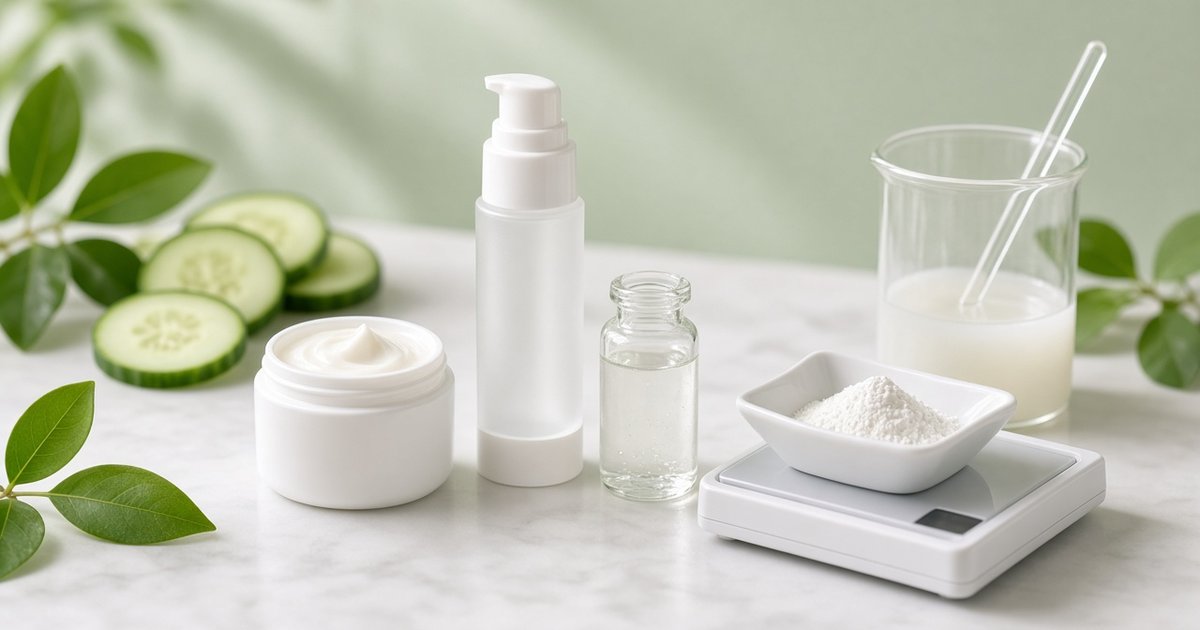
An acetyl tetrapeptide-5 eye cream is a light emulsion for the under-eye area that carries this water-soluble peptide in its cool-down phase, usually next to humectants and a little caffeine. The original manufacturer material is a solution with 0.1% peptide that its maker recommends at 1 to 10% of the formula, added below 40 °C into a product with a pH between 3.0 and 7.5. This guide explains what the peptide is, what the published data does and does not show, and how to build a 100 g cream that stays stable.
Most guides on this peptide stop at a gel. A cream is a different project, because an oil phase, an emulsifier and heat all enter the picture, and each of them affects how a delicate peptide survives the process. Everything below is cosmetic formulating: the goal is an eye contour that looks less puffy, smoother and more rested, not a product that changes any medical condition.
What Acetyl Tetrapeptide-5 Is
Acetyl Tetrapeptide-5 is a synthetic four-amino-acid peptide with the sequence acetyl-beta-alanine, histidine, serine, histidine, a molecular weight of roughly 490 Da and the CAS number 820959-17-9. It was developed by the Spanish company Lipotec, now part of Lubrizol, which sells its original solution under the trade name Eyeseryl. In an ingredient list it always appears as Acetyl Tetrapeptide-5, which is the name you print on your own label, whichever grade you buy.
The original solution is a clear liquid. Lipotec documents give its INCI as Water (Aqua), Butylene Glycol, Acetyl Tetrapeptide-5, with the peptide at 1 g per liter, which is 0.1%. Butylene glycol makes up about half of that liquid and acts as the carrier. That detail matters for a cream: at a 10% use level you add around 5% butylene glycol to your formula without noticing, which changes the skin feel and lowers the amount of glycerin you need.
On our site the same INCI is sold in two forms. Acetyl Tetrapeptide-5 Solution is the ready liquid in our peptide solutions section, and Acetyl Tetrapeptide-5 powder is the neat peptide for teams that want to set their own concentration. The use level for each lot comes from its certificate of analysis, so read the CoA before you weigh anything.
What the Published Data Shows
The evidence behind this peptide comes from the manufacturer, and it is fair to read it that way. Lipotec describes three lines of in vitro work: inhibition of glycation in a model where fructose inactivates the enzyme superoxide dismutase, a dose-dependent reduction of permeability in an endothelial cell assay, and a lower tendency for fluid to accumulate. Glycation, the cross-linking of collagen by sugars, is one reason the skin under the eyes looks less elastic with age, which is why the peptide is positioned for that area.
Two small panel tests are reported in the same literature. In one, 20 women aged 18 to 65 applied a cream with 10% of the solution under the eyes twice a day for 60 days, and skin elasticity measured with a Cutometer was reported 30% higher after 30 days. In the other, 17 people aged 34 to 54 used a cream with only 1% of the solution twice daily for 28 days, and the manufacturer reports less eye-bag volume in 70% of them, measured by fringe projection, plus a slight lightening of dark circles by chromametry. These studies are not published in peer-reviewed journals and have not been independently repeated, so a finished product should not borrow their numbers as its own promise.
What this means in practice is simple. The data gives you a reasonable dose window and a story about the look of puffiness and tired under-eyes. Any claim you make on a finished eye cream has to come from testing that cream, not from the raw material brochure.
Why a Cream Instead of a Gel
Gels are the default format for this peptide because they are clear, cooling and quick to make, and our product pages already describe a simple eye gel. A cream earns its place when the eye area also feels dry or tight, which is common in winter, in air-conditioned offices and in mature skin. A small amount of light emollient smooths the look of fine dry lines and gives concealer a softer base, while the peptide still sits in the water phase where it dissolves.
The trade-off is complexity. A cream needs an emulsifier, it is usually made hot, and the more oil it contains, the heavier it feels on thin skin and the more likely it is to migrate into the eyes. The answer is a low-oil emulsion, around 8 to 12% oil phase, with a mild emulsifier and no fragrance.
A 100 g Acetyl Tetrapeptide-5 Eye Cream
The example below is a starting point for a bench batch, not a finished commercial formula. It assumes a peptide solution that matches the original 0.1% format. If your lot certificate gives a different active content or a different recommended level, follow the certificate and adjust the water to keep the total at 100 g.
Water Phase, Heated
Weigh 69.2 g of distilled water, 3 g of glycerin, 0.5 g of caffeine and 0.1 g of disodium EDTA into a beaker, then sprinkle in 0.2 g of xanthan gum while stirring so it hydrates without lumps. Caffeine dissolves in water to about 2% at room temperature, so 0.5% is far below the point where it could crystallize in a cool bathroom, and warming it with the water phase makes it dissolve faster. You can source it as cosmetic caffeine powder.
Oil Phase, Heated
In a second beaker weigh 4 g of cetearyl alcohol (and) cetearyl glucoside as the emulsifier, 4 g of caprylic/capric triglyceride and 2 g of squalane. This gives a 10% oil phase that spreads easily and absorbs quickly. Heat both beakers to about 70 to 75 °C, pour the oil phase into the water phase and homogenize for two to three minutes, then switch to slow stirring as the cream cools.
Cool-Down Phase, Below 40 °C
Once the emulsion is below 40 °C, add 5 g of Acetyl Tetrapeptide-5 solution, 1 g of D-panthenol, 10 g of hyaluronic acid liquid and 1 g of phenoxyethanol (and) ethylhexylglycerin, stirring gently after each addition. Lipotec notes that its solution stays stable at 70 °C for two hours, but adding it during cool-down is the safer habit and is what the manufacturer recommends.
Check the pH last and bring it to between 5.5 and 6.5 with a few drops of citric acid or sodium hydroxide solution. That range sits comfortably inside the 3.0 to 7.5 window the manufacturer gives and suits caffeine, panthenol and the emulsifier. Fill into an airless pump or a soft tube rather than a jar, so fingers do not dip into the product.
Pairing It with Other Actives
Acetyl Tetrapeptide-5 has a narrow job, the look of puffiness and the elasticity of the under-eye, so many brands give it a partner. When the brief also mentions crow's feet, an expression-line peptide such as Acetyl Octapeptide-3 Solution can join it in the cool-down phase. When the brief is dark circles and tired-looking eyes, the ready Hesperidin Methyl Chalcone, Dipeptide-2 and Palmitoyl Tetrapeptide-7 eye complex covers a different angle, and the two are often used together.
For a full night-serum approach around the eyes and face, our peptide serum recipe for wrinkles shows how several signal peptides share one water phase. If you plan to work from neat powders instead of solutions, the guide to cosmetic peptide powders explains how to weigh and pre-dissolve tiny amounts accurately.
What to Keep Away
Keep strong oxidizers, very low pH exfoliating acids and high-salt systems out of the same formula, since peptides and many polymer thickeners dislike them. Fragrance and essential oils are a poor fit for an eye product in general. Retinoids and strong acids belong in a separate face product, not in a cream that sits next to the lash line.
Working with the Powder Instead
If you buy the neat powder, you control the concentration yourself, which is useful for brands that want to match a specific supplier specification. Because the original solution contains 0.1% peptide, 10 g of solution in a 100 g cream delivers 0.01 g of peptide, a quantity no ordinary kitchen or jewelry scale can weigh. The practical route is a stock solution: dissolve a larger, accurately weighed amount of powder in distilled water with a little butylene glycol, then dose that stock into the cool-down phase. Your lot certificate is the reference for the final level, and the powder should be kept sealed, dry and cool between uses, because peptides pick up moisture from the air.
Stability, Testing and Claims
Run the first batch through a simple stability check: samples at room temperature, at 40 °C and in a refrigerator for at least four weeks, watching for separation, a change in color, smell or viscosity, and pH drift. Test the cream in its final pack, since airless pumps and tubes protect it differently. A preservative challenge test on the finished product is the standard step before selling it.
Keep the wording cosmetic. Phrases such as under-eyes that look less puffy, a smoother-looking eye contour and a more rested look describe appearance and are appropriate. Words that promise to remove bags, drain fluid or fix a condition move a product toward drug territory in the United States, and puffiness that appears suddenly or on one side is a reason to see a doctor, not to try a new cream.
Frequently asked questions
What percentage of acetyl tetrapeptide-5 goes into an eye cream?
The original 0.1% solution is recommended at 1 to 10% of the formula, which equals about 0.001 to 0.01% pure peptide. For any other grade, use the level on the certificate of analysis for your lot.
Can I heat acetyl tetrapeptide-5 with the water phase?
It is best added during cool-down below 40 °C. The manufacturer reports that its solution tolerates 70 °C for two hours, but there is no benefit to heating it, so most formulators add it last.
Is acetyl tetrapeptide-5 the same as Eyeseryl?
Eyeseryl is the trade name Lipotec uses for its solution of Acetyl Tetrapeptide-5. Other suppliers sell the same INCI peptide, and every grade is labeled Acetyl Tetrapeptide-5 in the ingredient list.
Does acetyl tetrapeptide-5 work with caffeine and hyaluronic acid?
Yes, both are common partners. Caffeine and hyaluronic acid are water-soluble and comfortable in a pH range of about 5.5 to 6.5, which also suits the peptide.
Try it with a 1 g sample pack
Neat peptide powders in 1 g packs, INCI on every page, shipped from Florida.
Shop peptide powders