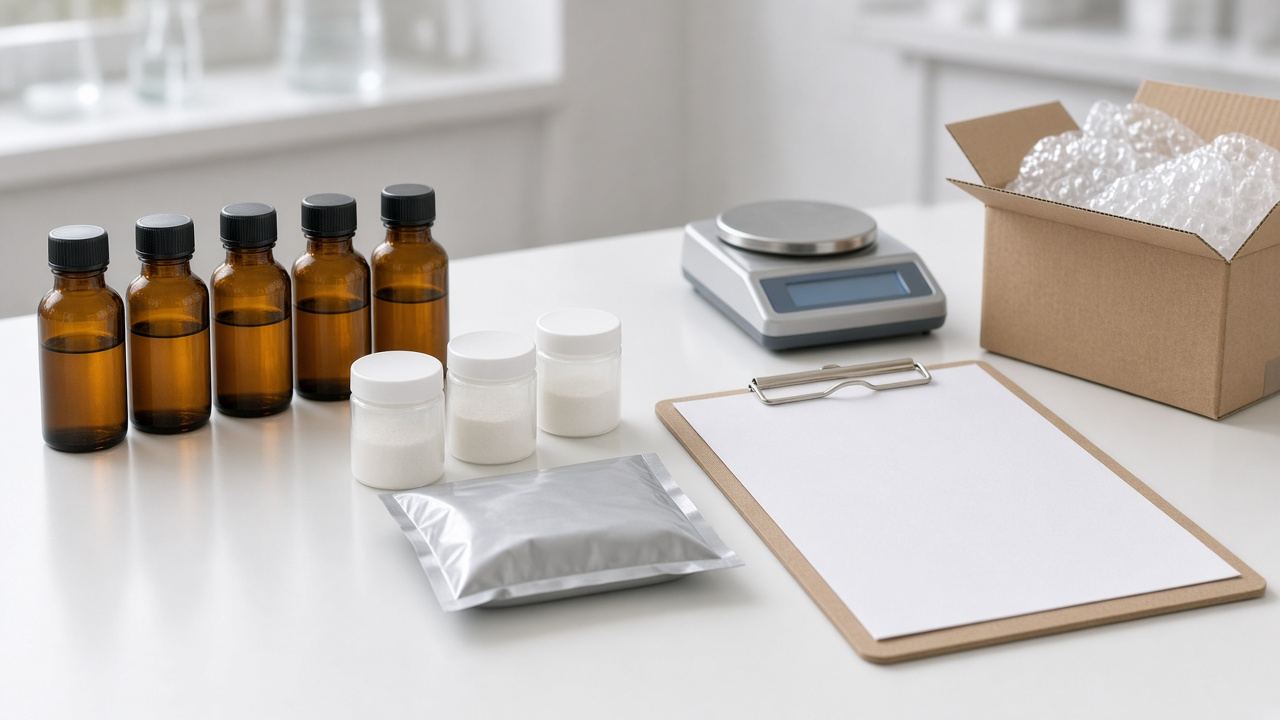
Buying peptide cosmetic ingredients wholesale means ordering signal, neurotransmitter-affecting and carrier peptides in working quantities, usually from grams to kilograms, from a supplier that can document every lot. The safest purchase is the one where the INCI name, the CAS number, the actual peptide content and the batch on the certificate all match the material in your hands.
Price per gram matters, but in peptides it is easy to compare the wrong numbers. A 1 g vial of neat powder and a 30 mL bottle of a 500 ppm solution can both be sold as the same peptide, and they are worlds apart in cost per active milligram. This guide is written for brands, private-label makers and contract labs moving from bench samples to repeat orders, and it covers how to identify what you are buying, which documents to request, how to compare offers fairly and what a sensible first order looks like.
Know Exactly Which Peptide You Are Buying
INCI Name First, Trade Name Second
Peptides are sold under a confusing mix of trade names, nicknames and generic descriptions, so the INCI name is the only label that settles what an ingredient is. Argireline is Acetyl Hexapeptide-8, CAS 616204-22-9. SNAP-8 is Acetyl Octapeptide-3, CAS 868844-74-0. Matrixyl is Palmitoyl Pentapeptide-4, CAS 214047-00-4, while Matrixyl 3000 is a blend of Palmitoyl Tripeptide-1 and Palmitoyl Tetrapeptide-7 in a glycerin, water and butylene glycol vehicle. GHK-Cu is labeled Copper Tripeptide-1, a point our GHK-Cu INCI name guide explains in detail. Ask every supplier to quote the INCI and CAS on the offer itself, not only in the catalog, so the quote and the delivered lot can be checked against each other.
Original Grades and Generic Equivalents
Many peptides were introduced by a single ingredient house and are now also made by other manufacturers. A generic Acetyl Hexapeptide-8 with the same INCI and CAS can be a perfectly good material, but it is not the trademarked original, and its supplier should not describe it as one. The honest question to ask is whether a lot is the branded grade or an equivalent, and who manufactured it. On our own catalog we state this openly: we do not present every SKU as a trademarked original, and we stand behind the specification of the lot we ship.
Cosmetic Grade, Not Research Chemical
Some online peptide sellers label their products for research use only or for laboratory use, often with dosing language aimed at injection or oral use. Those listings are not cosmetic raw materials, and they rarely come with an INCI name or an SDS written for cosmetic manufacturing. For a skincare line you want a material sold for formulation use in cosmetics, with cosmetic documentation, so that your safety assessor and your label both have something to stand on.
The Documents That Should Come With Every Lot
Certificate of Analysis
The certificate of analysis is the core document of any wholesale peptide purchase. It should carry the product name, INCI, lot number, manufacture and retest or expiry dates, and the tested results against specification: appearance, identity, purity by HPLC and, for powders, water content. Check that the lot number printed on the CoA is the same one on the container label. A CoA without a lot number, or one that is clearly a generic template, tells you very little about the material you received.
Purity Versus Peptide Content
Two figures are often confused on peptide paperwork. HPLC purity tells you what share of the peptide-related material is the target sequence. Net peptide content tells you how much of the powder by weight is peptide at all, after the counterions left from synthesis, such as acetate or trifluoroacetate, and residual water are accounted for. A powder can be 98% pure by HPLC and still contain noticeably less than 98% peptide by weight. If your formula relies on a precise dose, ask which of the two numbers the supplier is quoting and dose from the one that reflects active weight. Our cosmetic peptide powders guide shows how to correct a weighed amount for purity.
SDS, TDS and Supporting Data
The safety data sheet covers handling, storage and transport, and you will need it for your own workplace safety file. The technical data sheet gives the use level, solubility, pH range and processing temperature the manufacturer recommends, which is where most formulation questions get answered. For larger orders it is reasonable to ask for the HPLC chromatogram and a mass spectrometry identity result behind the CoA figures. Under the Modernization of Cosmetics Regulation Act of 2022, the brand that markets a finished cosmetic in the US carries the responsibility for safety substantiation, facility registration and product listing, so the paper trail you collect now is the paper trail your regulatory file will use later.
Comparing Wholesale Offers Fairly
Normalize to Cost per Gram of Active
Solutions and powders cannot be compared on sticker price. A ready peptide solution is mostly water, glycols or glycerin, and its peptide content may be stated in ppm or as a percentage. To compare, convert every offer to cost per gram of actual peptide, then compare that figure alongside what the format saves you. Our Acetyl Octapeptide-3 solution, for example, lists its INCI as Water, Acetyl Octapeptide-3 and Caprylyl Glycol, so it is ready to dose by weight, while the Palmitoyl Pentapeptide-4 powder has to be dissolved first and gives you control of the vehicle. Neither is cheaper in every case; the right answer depends on your batch size and how many products share the same peptide.
Minimum Order, Pack Size and Price Breaks
Wholesale pricing usually steps down as the pack size grows, and the steps are often steep for peptides because synthesis and purification costs fall with scale. Before committing to a large pack, check how long the material lasts once opened and how much of it you will realistically use before the retest date. A kilogram bought at a good unit price is not a saving if half of it expires on the shelf. Ask for the price ladder in writing, including the size at which the next break applies, so you can plan the second order before the first is finished.
Lead Time, Freight and Duties
A low factory price can be offset by long ocean transit, customs clearance, duties and the working capital tied up while goods travel. For a brand in North America, stock that ships domestically in one or two business days often costs less in total than a cheaper lot that arrives weeks later. Ask every supplier where the material ships from, how it is packed, and who is responsible for import paperwork, then add those costs to the unit price before comparing.
Storage, Handling and Shelf Life
Powders
Lyophilized peptide powders are sensitive to moisture and heat. Most technical sheets ask for cool, dry storage in a tightly closed container, and many recommend refrigeration; follow the temperature printed on the CoA or TDS for that specific lot. Let a refrigerated container reach room temperature before opening it so condensation does not form on the powder, weigh quickly, and reseal straight away. For a large pack, splitting it into smaller sealed portions on arrival reduces the number of times the bulk material is exposed to air.
Solutions and Blends
Peptide solutions are usually supplied with a preservative or a glycol that supports their stability, and they are easier to handle than powders, but they still have a defined shelf life and storage temperature. Blends such as the Palmitoyl Tripeptide-1 and Palmitoyl Tetrapeptide-7 liquid also contain a thickener and a surfactant, which are part of the INCI you will print on your label. Store solutions away from direct light and heat, keep the cap closed between uses, and record the opening date on the container.
Planning a First Wholesale Order
Start With Samples on the Same Lot
The smoothest path from development to production is to test a sample from the same manufacturer, and ideally the same lot or specification, that you will buy in bulk. Switching supplier between the pilot batch and the production batch is one of the most common reasons a peptide serum behaves differently at scale, through a change in pH, clarity or texture. Many catalog items, including our GHK-Cu powder, are offered in gram sizes for exactly this reason, so a formula can be finalized before a larger quote is requested.
Build the Order Around Your Formulas
List every product in your launch range, the peptide dose in each, and the batch sizes you expect for the first six to twelve months. Multiply through to get the grams of each peptide you will actually consume, then choose pack sizes that cover that need with a reasonable margin before the retest date. Peptides that appear in several products, such as Acetyl Hexapeptide-8 solution in both a serum and an eye cream, are the ones worth buying in a larger size first. If you are still deciding between two similar actives, our comparison of Acetyl Octapeptide-3 and Acetyl Hexapeptide-8 can help settle the choice before you commit to volume.
How to Request a Quote From Us
IngredientOS has supplied peptides, actives, oils and extracts to formulators since 2011, first in Europe and now from a Florida warehouse that serves North America, with sizes that run from working samples to factory lots. Browse the full cosmetic peptides range, including peptide powders and ready solutions, note the SKU of each item, and email sales@ingredient-os.com with the quantities you need; CoA and SDS requests go to the same address. You can also reach the team through our contact page, which links to our Telegram chat, and buyers outside the US can use the international quote form.
Sources
European Commission CosIng database entries for Acetyl Hexapeptide-8, Acetyl Octapeptide-3, Palmitoyl Pentapeptide-4, Palmitoyl Tripeptide-1, Palmitoyl Tetrapeptide-7 and Copper Tripeptide-1. Ingredient manufacturer technical data sheets for the peptide grades referenced, covering use level, solubility and storage. US Modernization of Cosmetics Regulation Act of 2022 and FDA guidance on cosmetic facility registration, product listing and safety substantiation. IngredientOS product specifications for the INCI and CAS values quoted.
Frequently asked questions
What should a wholesale peptide CoA include?
The product name, INCI, lot number, manufacture and retest dates, and test results against specification, including appearance, identity and HPLC purity, plus water content for powders. The lot number should match the container label.
Is HPLC purity the same as peptide content?
No. HPLC purity is the share of peptide-related material that is the target sequence, while net peptide content is the share of the powder's weight that is peptide after counterions and water. Dose from the figure that reflects active weight.
Should I buy peptide powder or solution in bulk?
Compare both on cost per gram of actual peptide. Solutions are quicker to dose and handle, while powders take less space, give you control of the vehicle and suit brands that use one peptide in several products.
Can I get samples before placing a bulk order?
Yes. Many of our peptides are sold in gram or 10 mL sizes, so you can finalize a formula on the same material before requesting a larger quote by email.
Try it with a 1 g sample pack
Neat peptide powders in 1 g packs, INCI on every page, shipped from Florida.
Shop peptide powders