The INCI name for GHK-Cu is Copper Tripeptide-1. It is the name you print on an ingredient list, while GHK-Cu, copper peptide and glycyl-histidyl-lysine copper are trade and research names for the same blue copper complex. The copper-free peptide has its own INCI name, Tripeptide-1, and confusing the two is the most common labeling slip with this ingredient.
Getting the name right matters more than it seems, because a supplier certificate, a CAS number and a finished label all have to describe the same molecule. Below we go through what each part of the name means, which CAS number belongs to which material, how the related Tripeptide-1 names differ, and how to place Copper Tripeptide-1 correctly on a US label.
What the GHK-Cu INCI Name Tells You
Reading Copper Tripeptide-1 Piece by Piece
INCI, the International Nomenclature of Cosmetic Ingredients, names small peptides by the number of amino acids and a sequence number assigned when the ingredient is registered. Tripeptide means three amino acids, here glycine, histidine and lysine in that order, written Gly-His-Lys or GHK. The number 1 is a registration number, not a measure of strength or purity, which is why Tripeptide-10 Citrulline is a completely different peptide rather than a stronger version. The word Copper at the front tells you the peptide is supplied bound to a copper(II) ion, one copper per peptide.
Where the Name Is Recorded
The name comes from the International Cosmetic Ingredient Dictionary published by the Personal Care Products Council, and the same entry appears in the European Commission's CosIng database under reference number 55687. CosIng lists its function as skin conditioning, meaning it helps keep skin in good condition. That is the role a cosmetic label can describe, and it is a useful anchor when you write product copy around the ingredient.
CAS Numbers: Which One Belongs on Your Paperwork
The Copper Complex and the Free Peptide
Two CAS numbers circulate for GHK-Cu, and they do not describe the same thing. CAS 89030-95-5 identifies the copper complex, molecular formula C14H22CuN6O4 or C14H23CuN6O4 depending on how the source draws the charge, at roughly 403 g/mol. CAS 49557-75-7 identifies the free tripeptide GHK, C14H24N6O4, at about 340 g/mol. Some catalogues print the second number for a copper product because older references linked it to the INCI entry. Copper makes up close to 16% of the complex by weight, so a material without it is a different ingredient in practice, not a cheaper grade of the same one.
A Quick Check on Arrival
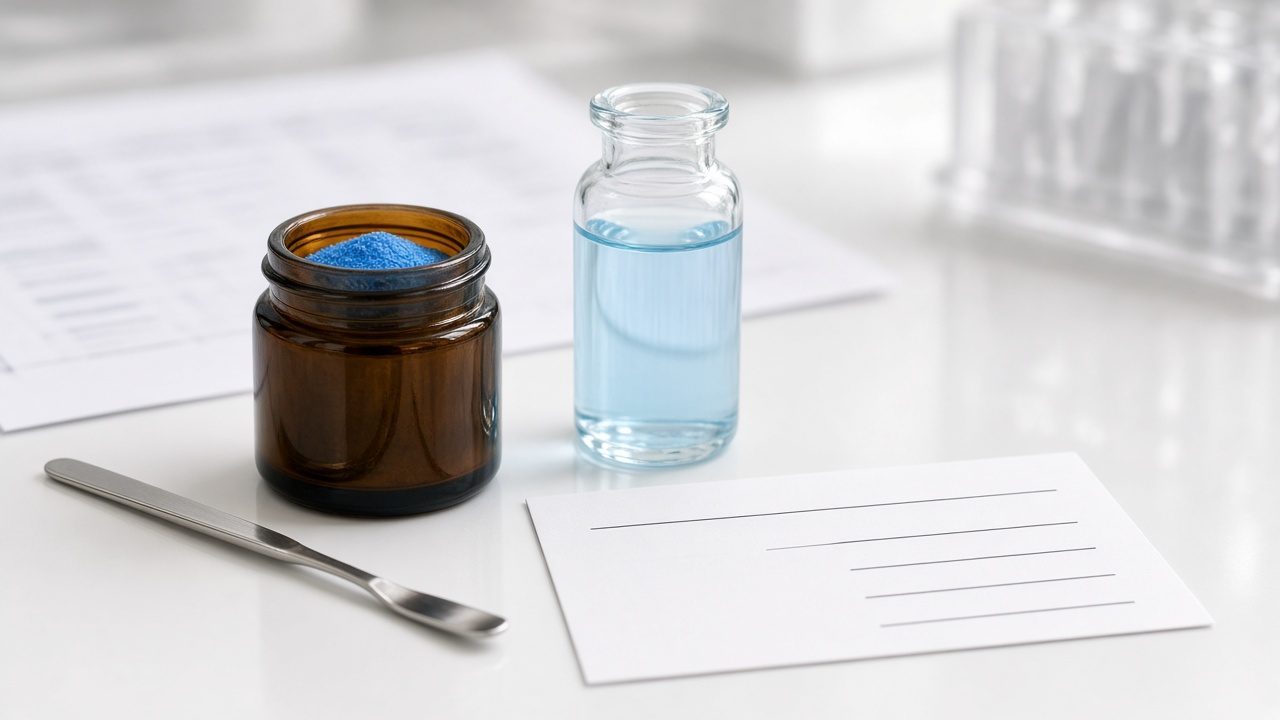
The copper complex is a blue to blue-violet powder that dissolves in water to a clear blue solution, while free GHK is white to off-white. If a powder sold as GHK-Cu arrives white, or the CoA shows CAS 49557-75-7 with no copper assay, ask the supplier which material you actually have before it goes into a batch. Our GHK-Cu powder is listed with INCI Copper Tripeptide-1 and CAS 89030-95-5 and is described as a blue powder, and the lot CoA is the document that should match your label.
Related Names That Are Not GHK-Cu
Tripeptide-1
Tripeptide-1 is the plain GHK peptide without copper. It is sold as its own ingredient, often in solution, for formulas where the brand wants the peptide but not the blue tint or the handling limits copper brings. If your formula contains Tripeptide-1 solution and no copper complex, the label says Tripeptide-1, not Copper Tripeptide-1. Adding a separate copper salt to a batch does not turn the label into Copper Tripeptide-1 either; each ingredient you weigh in is declared under its own name.
Palmitoyl and Biotinoyl Versions
Attaching a fatty acid or a vitamin to the same three amino acids creates new INCI entries. Palmitoyl Tripeptide-1, also written Pal-GHK and once listed as Palmitoyl Oligopeptide, carries a 16-carbon palmitic acid chain that makes it more oil-friendly, and it is the peptide paired with Palmitoyl Tetrapeptide-7 in well-known blends. Our Palmitoyl Tripeptide-1 card lists CAS 147732-56-7. Biotinoyl Tripeptide-1 links biotin to GHK and is used mainly in scalp and lash products; see the Biotinoyl Tripeptide-1 card. Neither contains copper, and neither should be labeled with the GHK-Cu INCI name.
Bis(Tripeptide-1) Copper Acetate
A separate entry, Bis(Tripeptide-1) Copper Acetate, describes two peptide units sharing one copper ion with an acetate counter-ion, and it is listed with CAS 130120-57-9. It sounds close but is a distinct ingredient with a different ratio of peptide to copper. If a supplier document uses this name, label with it, and do not copy dosing advice written for Copper Tripeptide-1 without checking the ratio. Research papers and drug references also use names such as prezatide copper for GHK-Cu salts; those are not INCI names and do not belong on a cosmetic label.
Putting Copper Tripeptide-1 on a US Label
Order and Placement
In the US, cosmetic ingredients are declared by the names in the International Cosmetic Ingredient Dictionary, in descending order of predominance. Ingredients present at 1% or less may follow in any order after those above 1%. GHK-Cu powder is typically used at 0.01 to 0.1% of the finished formula according to the supplier data on our powder card, so Copper Tripeptide-1 will sit in the lower part of the list, usually among the other actives, preservatives and fragrance components. If you work from a ready solution, every component of that solution is declared too, so a water, Copper Tripeptide-1 and preservative solution adds each of those names to your list.
Trade Names and Front-of-Pack Wording
The ingredient list should use Copper Tripeptide-1, and you can still call the product a copper peptide serum or mention GHK-Cu in marketing text, since that is how shoppers search. Keep the wording cosmetic: smoother-looking skin, a more even-looking tone and a firmer-looking feel are appropriate, while claims about wounds, scars or tissue regeneration move a product outside cosmetics in the US. Some brands put the trade name in parentheses after the INCI name in marketing copy, but the ingredient declaration itself should stay with the dictionary name.
Matching the Label to the CoA
Before artwork goes to print, put the CoA next to the draft label. The INCI name, the CAS number and the appearance on the certificate should all point to the copper complex, and for a solution the certificate should state the peptide content so your declared percentage is defensible. This is also the stage to confirm that the supplier carrier and preservative, if any, are on your list. Our cosmetic peptide powders guide covers how to convert a CoA purity figure into milligrams per batch.
Choosing a Grade Under the Right Name
Powder or Solution
Both grades carry the same INCI name, so the choice is about handling, not labeling. Powder gives you control over dose and fits brands that weigh milligram quantities from a stock solution. A ready liquid such as our Copper Tripeptide-1 solution, listed at pH 5, is faster for small batches and avoids weighing fractions of a gram. Every grade sits in the peptides section, and the powders are grouped in peptide powders.
Formulation Notes That Follow From the Name
Because Copper Tripeptide-1 is a copper complex, anything that pulls the copper away changes what is in your bottle. Strong chelators such as EDTA, very low pH and pure ascorbic acid are the usual problems, and the color shifting from blue toward green or colorless is the visible sign. Water-soluble, added during cool-down below about 40 °C and kept in a mildly acidic to neutral serum, it behaves predictably. The full working method, including a 100 g recipe and the compatibility list, is in our GHK-Cu powder serum guide.
Sources
European Commission CosIng database, entry Copper Tripeptide-1, reference 55687, function skin conditioning. Personal Care Products Council, International Cosmetic Ingredient Dictionary and Handbook. US Code of Federal Regulations, 21 CFR 701.3, designation of ingredients. PubChem compound records for the GHK copper complex and the free GHK tripeptide. Pickart L. and colleagues, original isolation of the GHK tripeptide from human plasma, 1973, and later reviews of its copper-binding chemistry.
Frequently asked questions
What is the INCI name for GHK-Cu?
Copper Tripeptide-1. It is listed in the International Cosmetic Ingredient Dictionary and in CosIng under reference 55687, with the function skin conditioning.
Is Tripeptide-1 the same as Copper Tripeptide-1?
No. Tripeptide-1 is the GHK peptide without copper, while Copper Tripeptide-1 is the peptide bound to a copper(II) ion. They are separate ingredients and are labeled under separate names.
Which CAS number should GHK-Cu have?
CAS 89030-95-5 is the copper complex. CAS 49557-75-7 is the free GHK peptide, so if a GHK-Cu certificate shows that number, confirm with the supplier that the material contains copper.
Can I write GHK-Cu in the ingredient list?
The ingredient declaration should use the INCI name Copper Tripeptide-1. GHK-Cu can appear in the product name or marketing text, as long as the wording stays cosmetic.
Try it with a 1 g sample pack
Neat peptide powders in 1 g packs, INCI on every page, shipped from Florida.
Shop peptide powders