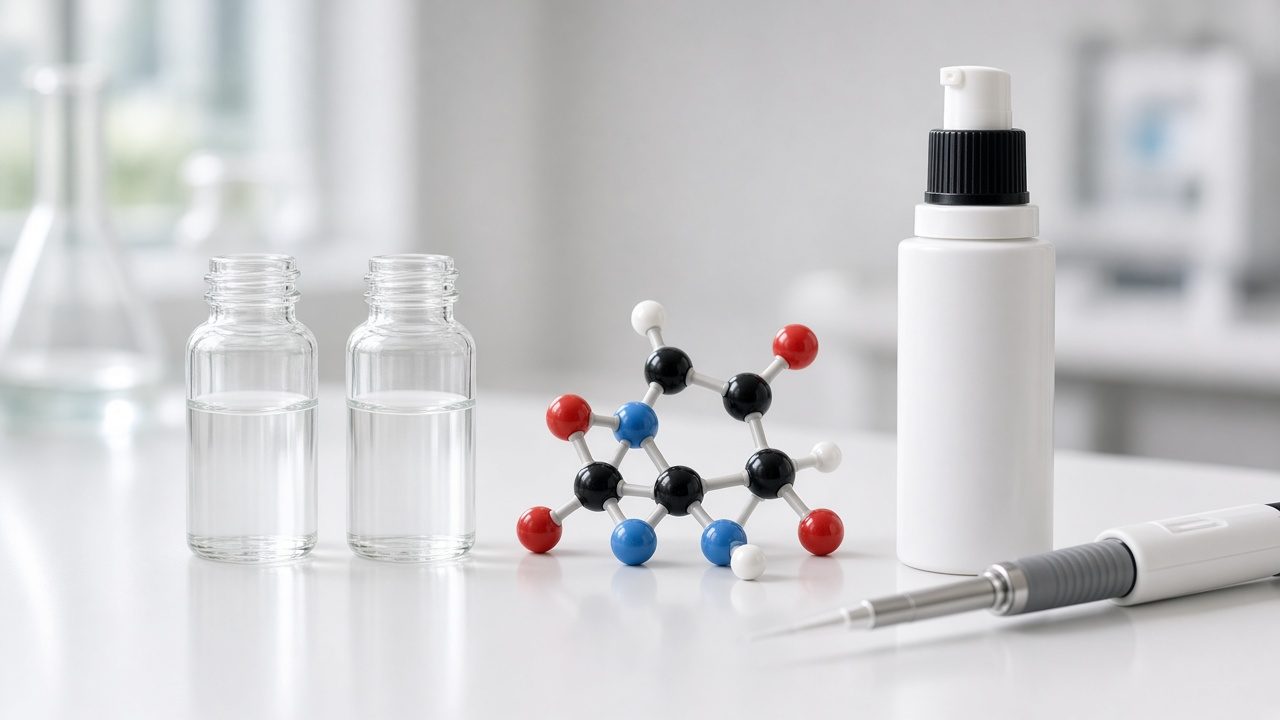
Acetyl Octapeptide-3 is Acetyl Hexapeptide-8 with two extra amino acids on the end, so the honest answer to acetyl octapeptide-3 vs acetyl hexapeptide-8 is that you are choosing between two versions of one idea, not two different actives. The longer peptide, known in the trade as SNAP-8, looks about twice as strong in the manufacturer's cell test, while the shorter one, Argireline, has far more published human data and costs less per batch.
That changes how you should pick between them. Instead of asking which one wins, it is more useful to ask what the extra length buys you in a real formula, what it costs, and when it makes sense to carry both. This guide goes through the chemistry, the evidence behind each number you see quoted online, dosing, and the label side.
Same Family, Different Length
The Sequences Side by Side
Acetyl Hexapeptide-8 is Ac-Glu-Glu-Met-Gln-Arg-Arg-NH2, CAS 616204-22-9, with a molecular weight of about 889 Da. Acetyl Octapeptide-3 is Ac-Glu-Glu-Met-Gln-Arg-Arg-Ala-Asp-NH2, CAS 868844-74-0, at about 1,075 Da. The first six residues are identical, and the alanine and aspartic acid added at the end extend the copy of SNAP-25, the nerve-ending protein both peptides imitate. Lipotec, now part of Lubrizol, developed both, launching the octapeptide as an elongation of its hexapeptide.
Why the INCI Names Look Unrelated
The numbers in the two names do not line up because INCI numbering is assigned in order of registration, not by structure. The hexapeptide was first listed as Acetyl Hexapeptide-3 and later renamed Acetyl Hexapeptide-8, and older technical sheets for the octapeptide used the name Acetyl Glutamyl Heptapeptide-1 before Acetyl Octapeptide-3 became standard. If a supplier document or an old label shows one of those earlier names, it is the same molecule, and your ingredient list should use the current INCI.
How Each One Acts on Expression Lines
Competing for a Place in the SNARE Complex
A facial muscle contracts when a nerve ending releases acetylcholine, and the release depends on three proteins, SNAP-25 among them, that lock together to dock the vesicle onto the membrane. Both peptides mimic the start of SNAP-25 and compete with it for a place in that assembly, which leaves the complex looser and lets fewer vesicles empty. Neither peptide cuts or destroys any protein, which is the line between a cosmetic peptide and a neurotoxin, and it is why the effect described for both is a softer-looking contraction rather than a blocked one.
What the Two Extra Amino Acids Change
The added Ala-Asp tail mirrors more of the native SNAP-25 sequence, and Lipotec's rationale is that a longer mimic competes more effectively for the same binding site. In its catecholamine release assay in chromaffin cells, the concentration needed to cut release by half, the IC50, was 55 micromolar for the octapeptide against 110 micromolar for the hexapeptide. That two-to-one ratio is the source of the claim that the octapeptide is the more potent of the two. It is a cell result, though, and it says nothing yet about how much of either peptide reaches the nerve endings through skin.
Reading the Evidence Behind the Numbers
The Manufacturer's 28-Day Panel
The figure quoted on almost every product page is a 63% reduction in wrinkle depth. In Lipotec's SNAP-8 dossier, 17 women applied a cream with 10% of the octapeptide solution twice a day for 28 days, and silicone replicas from the eye area were read by confocal microscopy. The average reduction was 34.98%, and 63.13% was the best single result, not the mean. The same graph places Argireline at 27.05% and placebo at 2.99%, but the dossier notes the Argireline value comes from an earlier test run in October 2001, so it is a historical comparison rather than a head-to-head study.
Lab Data on Nerve Signaling
Lipotec also measured glutamate release from cultured neurons, a standard stand-in for acetylcholine release. The Argireline sheet reports a dose-dependent drop of up to 32% at 2 mM, and the octapeptide was tested at 0.75 and 1.5 mM, with about 43% inhibition at the higher dose quoted in a 2020 Frontiers in Chemistry review by Errante and colleagues, which traces the figure back to Lipotec's own material. Because both data sets come from the same company and similar methods, they are useful for ranking the two peptides, but they are not independent confirmation.
The Independent Record
Here the hexapeptide is clearly ahead. Beyond the original 2002 paper by Blanes-Mira and colleagues in the International Journal of Cosmetic Science, a 2013 study in the American Journal of Clinical Dermatology followed 60 Chinese subjects for four weeks and reported a subjective improvement rate of 48.9% for Argireline against 0% for placebo, and there is a steady stream of permeation and delivery research. For the octapeptide we found no placebo-controlled human study outside the supplier dossier; published papers mostly concern analytical methods and delivery systems such as microneedle patches. The record for the hexapeptide is also mixed, with small trials that disagree, so neither peptide should be sold on a fixed percentage.
Getting Through the Skin
Both molecules are well above the roughly 500 Da size often used as a rule of thumb for passive skin penetration, and the octapeptide is about 186 Da heavier. In practice that means the extra potency seen in cells may be partly offset by slower delivery. Formulators who want to give either peptide the best chance usually lean on penetration-friendly bases, such as light serums with humectants and gentle solvents, and apply them where expression lines form, around the eyes and on the forehead, rather than counting on a rich cream to carry them.
Acetyl Octapeptide-3 vs Acetyl Hexapeptide-8 at the Bench
Solution Strength and Use Levels
The branded solutions of both peptides are made at the same strength, 0.5 g of peptide per liter, which is 0.05%. Lipotec recommends 3 to 10% of the octapeptide solution and 2 to 10% of the hexapeptide solution in a finished product. At 10%, the level used in the octapeptide panel, a formula carries about 50 ppm of peptide, and at 5% about 25 ppm. Our Acetyl Octapeptide-3 Solution lists Water (Aqua), Acetyl Octapeptide-3 and Caprylyl Glycol with a supplied pH of 2.0 to 5.0, and the active content for each lot is on its certificate of analysis, so check the CoA before you copy any dose from a branded sheet.
Phase, Heat and pH
Both peptides are water-soluble and go in at the end, below 40 °C, after an emulsion has formed and cooled. The Argireline sheet gives a working range of pH 3.0 to 8.0 and lists oxidants, electrophiles and tannins as incompatibilities; the octapeptide sheets we reviewed give no separate range, and because the two share six of eight residues, formulators generally handle them the same way. A finished serum around pH 5 to 6.5 suits both. Add the peptide solution with gentle stirring, then check pH and clarity, since a strong electrolyte or a thickener added afterward is the most common cause of haze.
Powder Grades and Batch Cost
If you work from neat powder, the math is identical for both: matching 5% of a 0.05% solution means 25 mg of active peptide per kilogram of finished product, best dosed from a weighed stock in distilled water. Our Acetyl Hexapeptide-8 Powder is the usual starting point for brands that prefer to weigh their own peptide, and our cosmetic peptide powders guide covers milligram weighing and stock solutions. Per batch, the octapeptide is usually the pricier line item, which is why many brands use it at a moderate level next to the hexapeptide rather than replacing it outright.
Choosing One, or Using Both
When the Octapeptide Makes Sense
Pick Acetyl Octapeptide-3 when the product is positioned as a premium eye or forehead serum, when the brief calls for the stronger in vitro profile, or when you want an ingredient list that stands apart from the many formulas built on the hexapeptide alone. Our INCI-named Acetyl Octapeptide-3 solution, with a supplied pH of 4.0 to 6.0, and the solution above both fit a clear water-gel or a light serum.
When the Hexapeptide Is Enough
Pick Acetyl Hexapeptide-8 when cost per unit matters, when you want the larger body of published work behind your story, or when the formula already carries several actives and needs a dependable base peptide. The Acetyl Hexapeptide-8 Solution is the ready liquid, and the Amplified Solution is the higher-strength grade for serums that want more peptide in fewer grams.
Combining Them in One Serum
Many formulators use both at moderate levels, for example 3 to 5% of each solution, so the label carries the familiar name and the longer relative. No published study has tested that pair together, so regard it as formulation practice. Because both act on the same target, the bigger step up usually comes from adding a peptide with a different mechanism, which is why our Pentapeptide-18 vs Acetyl Hexapeptide-8 comparison is worth reading before you finalize a blend. Every grade discussed here sits in our peptide solutions section.
Labels and Claims
Our solutions are generic peptides sold under their INCI names, not the branded Lipotec raw materials, so the dossier figures above describe the branded grades and should not be printed as results for your product. Trade names on a finished label may also need the owner's permission. Keep copy cosmetic: smoother-looking forehead lines, softer-looking crow's feet and a more relaxed-looking expression are fine, while comparing the serum to injections or saying it stops muscle movement takes the product outside cosmetics in the US. If you want to quote numbers, run your own panel on the finished formula.
Frequently asked questions
Is Acetyl Octapeptide-3 the same as SNAP-8?
Yes. SNAP-8 is Lipotec's trade name for Acetyl Octapeptide-3, the eight-amino-acid peptide with CAS 868844-74-0. Older documents sometimes call it Acetyl Glutamyl Heptapeptide-1.
Is Acetyl Octapeptide-3 stronger than Acetyl Hexapeptide-8?
In the manufacturer's cell assay it needed about half the concentration, 55 versus 110 micromolar, to cut release by 50%. Independent human studies comparing the two directly have not been published.
Can I use SNAP-8 and Argireline together?
Yes. Both are water-soluble and added below 40 °C, and 3 to 5% of each solution is a common starting point. Since they share a target, combining them is formulation practice rather than a tested synergy.
What concentration of Acetyl Octapeptide-3 solution should a serum use?
The manufacturer recommends 3 to 10% of a 0.05% solution, and its 28-day panel used 10%. Always confirm the active content on the CoA of your lot.
Try it with a 1 g sample pack
Neat peptide powders in 1 g packs, INCI on every page, shipped from Florida.
Shop peptide powders