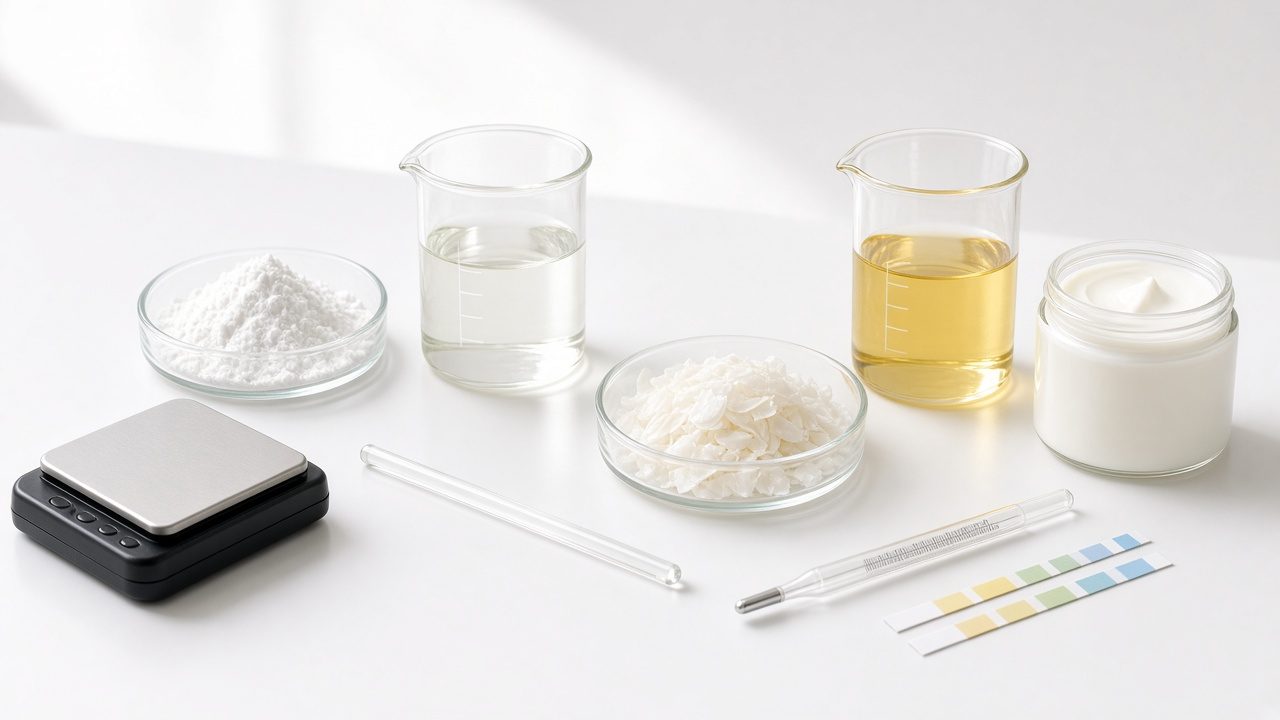
Kojic dipalmitate vs kojic acid comes down to solubility and stability. Kojic acid is a small water-soluble molecule that brightens well but tends to yellow or brown in water-based formulas, while kojic dipalmitate is its oil-soluble palmitic acid diester, far more color-stable, but it must be melted into a hot oil phase and watched for recrystallization.
If you build serums, toners and gels, kojic acid is usually the practical choice, kept at or below 1% and at a mildly acidic pH. If you build creams, lotions, balms or makeup, the dipalmitate is easier to live with on the shelf. The rest of this guide explains why, with use levels, pH, process temperatures, pairing advice and the regulatory points that decide which one fits a given market.
Two Ingredients, One Parent Molecule
Kojic acid
Kojic Acid, INCI Kojic Acid, CAS 501-30-4, is 5-hydroxy-2-(hydroxymethyl)-4H-pyran-4-one, a small pyranone produced by fermentation with fungi such as Aspergillus. It is a white crystalline powder that dissolves in water and ethanol. In the EU CosIng database its listed functions are antioxidant and bleaching, and brands use it in products that help the complexion look brighter and more even. Its two hydroxyl groups are also the source of its formulation trouble: the molecule chelates metal ions, especially iron, and oxidizes on exposure to light, air and heat, which shows up as a yellow to brown shift in the product.
Kojic dipalmitate
Kojic Dipalmitate, INCI Kojic Dipalmitate, CAS 79725-98-7, is the same core with both hydroxyl groups esterified by palmitic acid, a C16 fatty acid. Capping those groups removes most of the chelation and oxidation behavior, which is why the ester stays white in finished products. It also turns a water-loving molecule into an oil-loving one. The dipalmitate is a white to off-white powder or flake that is insoluble in water and dissolves in hot oils and polar esters. Because the two fatty chains roughly quadruple the molecular weight, a given percentage of the ester delivers much less kojic acid core than the same percentage of free kojic acid, which is one reason ester use levels run higher.
Solubility Decides Which Phase You Use
Kojic acid goes into the water phase. It dissolves readily at room temperature, so in a serum or gel you can add it to the water before or after the gelling agent hydrates, then check pH. Because it is sensitive to heat, it is best added during cool-down, below about 40 °C, rather than boiled with the water phase of an emulsion.
Kojic dipalmitate goes into the oil phase and behaves almost the opposite way. It needs heat to dissolve fully, and supplier processing notes consistently call for melting it into a polar ester such as isopropyl myristate or isopropyl palmitate, or a light triglyceride like Caprylic/Capric Triglycerides, at around 75 to 80 °C, stirring until the oil is completely clear, and only then emulsifying with the hot water phase. Adding it to a partly cooled emulsion, or using too little ester, is the usual cause of the fine sparkles or grains that appear in a cream after a few weeks. Those crystals are undissolved or re-formed ester, and they mean the solvent level, the use level or the process needs adjusting.
That split also explains where each ingredient fails. A water-clear serum cannot carry the dipalmitate without a solubilizer system, and even then it is hard to keep uniform; a study at North-West University that formulated kojic dipalmitate in a hydrous gel reported inconsistent assay results and attributed them to the ester being lipophilic and poorly dispersed in the gel. An anhydrous balm, on the other hand, has no water to dissolve kojic acid at all.
Stability, Color and pH
Color is the reason most formulators switch. Literature on kojic acid emulsions describes yellowing to brown discoloration, especially in high-water formulas, under light exposure and in contact with iron. Kojic acid is generally most stable at a low pH, around 4 to 5, and loses stability as the formula approaches neutral. Practical habits that help are a chelating agent such as disodium EDTA or sodium phytate, opaque or airless packaging, avoiding iron contamination from equipment and raw materials, and adding the active late and cool.
Kojic dipalmitate is described by suppliers as stable to light, heat and metal ions and usable over a wide pH range. Published figures vary: some supplier data quote roughly pH 4 to 9, others a narrower 5 to 8, and a guide on the ester notes that hydrolysis back toward kojic acid becomes a risk at the extremes. Aiming the finished product at about pH 5 to 6.5 keeps you inside every range quoted. Stable is not the same as indestructible, though. Some formulation work reports that the ester degrades under oxidative stress and at elevated storage temperatures, so an oil-soluble antioxidant such as Mixed Tocopherols 50 in the oil phase and a standard stability program at 40 °C are still worth the effort.
Use Levels and What the Rules Say
Kojic acid concentration
For kojic acid the number that matters is 1%. The EU Scientific Committee on Consumer Safety concluded in opinion SCCS/1637/21, adopted in March 2022 with a June 2022 corrigendum, that kojic acid is safe in cosmetic products at concentrations up to 1%. Commission Regulation (EU) 2024/996 then added it to Annex III as entry 375, limited to face and hand products at a maximum of 1% in the ready-to-use product. Non-compliant products could not be placed on the EU market from 1 February 2025 and could not be made available from 1 November 2025. In the United States, the Cosmetic Ingredient Review expert panel concluded in its 2010 report (Burnett and colleagues, International Journal of Toxicology) that kojic acid is safe in cosmetics at up to 1%, and it re-opened that review in 2022 in light of the EU restriction. Supplier sheets that recommend 1 to 3% predate these opinions or target other markets, so for anything sold in Europe, and as a sensible ceiling elsewhere, plan around 1% or less in a face or hand product.
Kojic dipalmitate concentration
Supplier documentation for the dipalmitate typically gives a range of about 1 to 5%, with 2 to 3% a common choice in face creams. Above that range recrystallization becomes harder to control. Note what the regulation does not say: the SCCS opinion explicitly excluded kojic acid esters, including kojic dipalmitate, because no data were submitted, and the Annex III entry is written for Kojic Acid by name and CAS number. That gap is not an approval. If you sell in the EU, confirm the status of the ester and any hydrolysis back to free kojic acid with your safety assessor before you fix a level, and always follow the range on the certificate of analysis for the lot you buy.
Which One Fits Your Product
Water-based serums, toners and gels
Choose kojic acid. A simple approach is a hydrating gel base of water, glycerin and a little sodium hyaluronate, kojic acid at up to 1% added in cool-down, a chelator, a broad-spectrum preservative and a final pH near 4.5 to 5. Expect some color drift over shelf life even with good practice, and decide in advance how much you will accept before a batch is rejected. Packaging that blocks light buys real time.
Creams, lotions, balms and makeup
Choose kojic dipalmitate. It slots into the oil phase of an oil-in-water cream, a body lotion, a lip or under-eye balm, or a tinted base without bringing color instability with it. Its main cost is process discipline: enough polar ester, full melting at about 80 °C, emulsification while hot and steady stirring during cooling. Check a thin film of the product under a magnifier after one and four weeks of storage; if sparkle appears, raise the ester share or lower the active.
Using both in one formula
Some brands pair the two, kojic acid in the water phase and the dipalmitate in the oil phase of the same emulsion. It can work, but it gives you the color sensitivity of kojic acid and the crystallization risk of the ester at once, so it is a choice for experienced labs rather than a first project. For most launches, picking one and building the formula around its needs is simpler and more stable.
Compatibility and Pairing
Both forms sit comfortably next to other tone-focused actives. Niacinamide in the water phase is a common partner for either, as long as the formula pH stays in the range both tolerate. Alpha Arbutin is another frequent companion, and it has its own Annex III limits in the EU of 2% in face cream and 0.5% in body lotion. Licorice root extracts are often combined with the dipalmitate in creams. Vitamin C derivatives are a familiar pairing too; if you are choosing between them, our comparison of aminopropyl ascorbyl phosphate and other vitamin C derivatives covers which forms suit water and which suit oil.
The incompatibilities are mostly kojic acid's. Keep it away from iron and copper sources, which includes copper peptides such as GHK-Cu in the same phase, since chelation produces color. Strongly alkaline ingredients push it out of its stable pH zone. The dipalmitate has fewer conflicts, but very low or very high pH and long hot holds are worth avoiding to protect the ester bonds. Browse the full cosmetic actives section for other brightening and antioxidant options that can share a formula.
Buying, Storage and Documentation
Ask for the certificate of analysis on every lot. For kojic acid, check assay, appearance, melting range and heavy metals, including iron, since trace metals feed discoloration. For kojic dipalmitate, check assay by HPLC and the free kojic acid content if the supplier reports it, because a high free acid level reintroduces the color problem you bought the ester to avoid. Store both powders sealed, dry, cool and dark, and reseal promptly after weighing. A small pack, such as 10 g of the dipalmitate or a short run of kojic acid, is enough to run a stability pilot before you commit to a larger size.
If you work with peptides alongside brightening actives, our guide to peptide cosmetic ingredients wholesale explains how to plan sample-to-bulk buying across a whole line.
Labeling and Claims
Both are cosmetic ingredients when the finished product is presented for appearance: a brighter-looking, more even-looking complexion and a softer look of dark spots with regular use. Describe what the product does for how skin looks, list Kojic Acid or Kojic Dipalmitate by INCI name in descending order of concentration, and avoid wording that implies a change to skin function or a condition. Products that combine brightening actives often recommend daytime sun protection on the label as general advice; keep that as a usage note rather than a product claim.
Frequently asked questions
Is kojic dipalmitate stronger than kojic acid?
Not on a weight basis. The ester carries two fatty chains, so each gram contains far less kojic acid core. Its advantage is color stability and oil solubility, which is why it is used at higher levels, typically about 1 to 5%.
What is the maximum concentration of kojic acid?
In the EU, Regulation (EU) 2024/996 limits kojic acid to 1% in face and hand products only, following SCCS opinion SCCS/1637/21. The CIR expert panel in the US also assessed it as safe at up to 1%.
Can I put kojic dipalmitate in a water-based serum?
It is insoluble in water, so a clear water serum is not a good carrier. Use it in the oil phase of creams, lotions, balms or makeup, melted into a polar ester at about 75 to 80 °C.
Why does my kojic acid serum turn yellow?
Kojic acid oxidizes with light, air and heat and reacts with iron and other metals. Keep the pH near 4 to 5, add a chelator, add the active in cool-down and use opaque or airless packaging.
Try it with a 1 g sample pack
Neat peptide powders in 1 g packs, INCI on every page, shipped from Florida.
Shop peptide powders