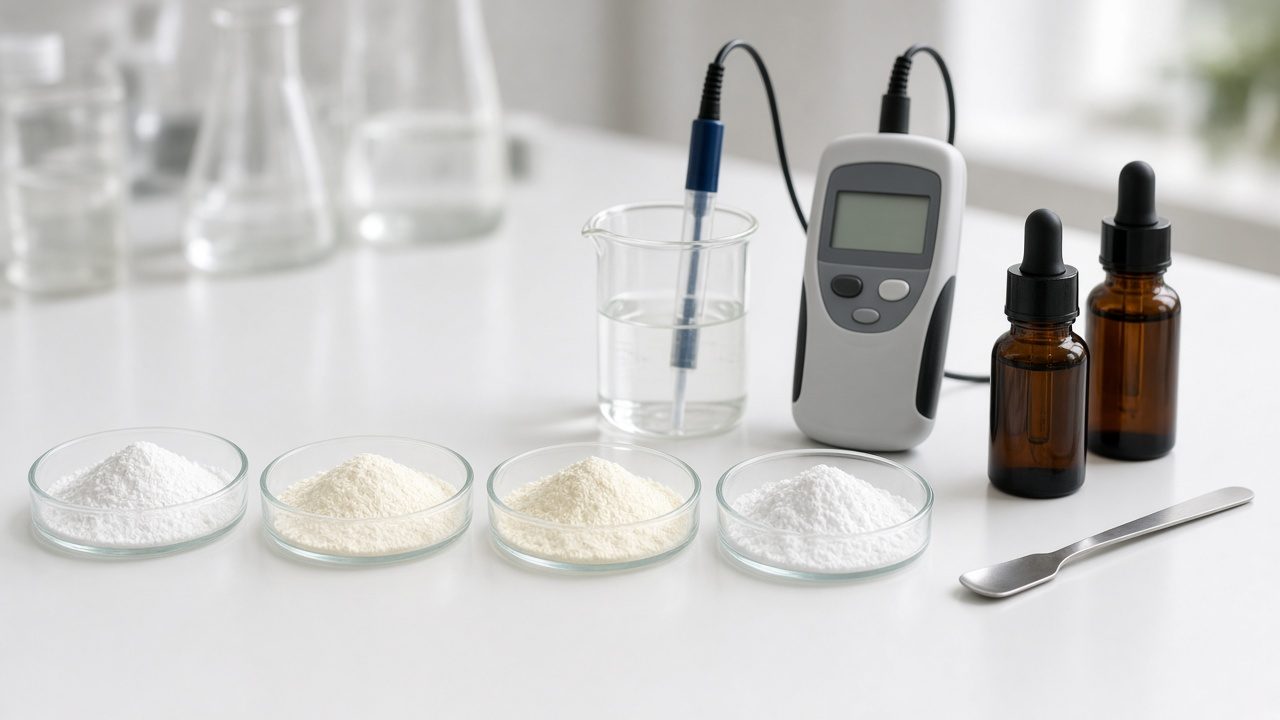
Aminopropyl ascorbyl phosphate is a water-soluble vitamin C derivative that ships as an acidic powder, which sets it apart from MAP and SAP, the neutral-pH phosphate salts it is most often compared with. Suppliers suggest 0.5 to 3% in leave-on products, and the choice against other derivatives comes down to the pH you want to formulate at, the phase you are working in, and how much evidence you need behind the ingredient.
Most comparison pages rank vitamin C forms by a vague idea of strength and then recommend a serum. That is not much help when you are holding a jar of powder and a formula sheet. This guide compares the derivatives the way a formulator meets them: identity, solubility, pH window, how the skin is thought to release ascorbic acid, and what the published evidence actually covers.
What Aminopropyl Ascorbyl Phosphate Is
Identity and Trade Name
The INCI name is Aminopropyl Ascorbyl Phosphate, often shortened to AAP or APPA. Chemically it is L-ascorbic acid carrying a 3-aminopropyl phosphate group at the 2-position, with the formula C9H16NO9P, a molecular weight of about 313 and CAS number 220644-17-7, as recorded in the FDA substance registry. The best-known commercial grade is Vitagen from MacroCare, and several generic grades share the same INCI name. Our Aminopropyl Ascorbyl Phosphate is supplied as a dry powder, so you weigh it per batch rather than pouring a solution.
What the Supplier Sheets Say
Published supplier data describe a white to pale yellow powder that dissolves in water. A 1% solution in water reads strongly acidic, roughly pH 1.6 to 3.8 depending on the sheet, and one producer states that the material is most stable in formulas below pH 4. Recommended dosage is given as 0.5 to 2% by a Vitagen distributor and 0.5 to 3% by a generic producer. The same generic sheet advises dissolving the powder in three to five times its weight of water and adding it to an emulsion once it has cooled to 50 to 55 °C. A Vitagen distributor sheet, on the other hand, reports good activity retention at pH 7 and 50 °C. Those two claims do not sit together comfortably, which is exactly why your own stability test matters more than any brochure.
How It Compares With the Other Phosphate Derivatives
Magnesium Ascorbyl Phosphate
Magnesium Ascorbyl Phosphate, or MAP, is the magnesium salt of ascorbyl 2-phosphate and the older, better documented relative. It is stable in water at near-neutral pH, which is its main attraction, and it is usually formulated somewhere around pH 6 to 7. A 1996 study by Kameyama and colleagues in the Journal of the American Academy of Dermatology tested a 10% MAP cream on pigmented skin and is still the reference most suppliers quote. The practical difference from AAP is the starting pH: MAP raises nothing to fight against, while AAP will pull a lightly buffered water phase sharply acidic as soon as it dissolves.
Sodium Ascorbyl Phosphate
Sodium ascorbyl phosphate, sold for years as Stay-C 50, behaves much like MAP in the bottle: water-soluble, happiest at a neutral to slightly alkaline pH, and resistant to the browning that ruins fresh ascorbic acid serums. It is popular in serums for oily-looking skin. We do not stock it, but it is worth knowing because many retail serums use it and customers will ask how AAP differs. In short, SAP and MAP are salts built to live near neutral, and AAP is an acid-form derivative that needs you to decide its final pH deliberately.
All Three Rely on the Skin
Phosphate derivatives are thought to release ascorbic acid when phosphatase enzymes in the skin cleave the phosphate group. That conversion is slow and incomplete, and it has been measured far less than the marketing suggests. In a widely cited 2001 study in Dermatologic Surgery, Pinnell and coworkers found that applying MAP or ascorbyl 2-glucoside did not raise skin levels of L-ascorbic acid in their model. That does not mean the derivatives do nothing, since they can still act as antioxidants in the formula and on the skin surface, but it does mean a 2% derivative cannot be read as 2% vitamin C.
How It Compares With Pure Ascorbic Acid
The pH Rule for L-Ascorbic Acid
L-Ascorbic Acid Powder remains the benchmark because it needs no conversion. The same Pinnell study found that it only penetrated well when the formula pH was below about 3.5, and that skin levels rose with concentration up to around 20%. The price is instability: in water it oxidizes and browns within weeks unless you protect it with low pH, antioxidant partners, airless packaging or an anhydrous base. Many formulators avoid the problem by mixing a fresh batch or making a water-free powder booster.
Where AAP Sits Between Them
AAP is often presented as a middle path: more stable in water than ascorbic acid and claimed by its producers to penetrate better than MAP. Independent clinical trials comparing it head to head with either are scarce, so read penetration rankings on consumer blogs with caution, and note that some pages wrongly describe AAP as oil-soluble. What you can rely on is the physical behavior you see at the bench: a water-soluble powder, an acidic solution, and a color and odor you can track during storage.
The Oil-Soluble Alternatives
Tetrahexyldecyl Ascorbate
When the formula has no water phase, the phosphate family is out of the picture. Tetrahexyldecyl Ascorbate, or THDA, is ascorbic acid esterified with four branched fatty chains, which makes it a liquid that mixes straight into oils, silicones and the oil phase of an emulsion. It suits facial oils and anhydrous balms where AAP would never dissolve.
Ascorbyl Palmitate
Ascorbyl Palmitate is the classic fat-soluble ester. Its most reliable role is as an antioxidant that protects oils from going rancid, often alongside vitamin E acetate. It is itself prone to oxidation, so it is a weaker choice when vitamin C is the headline of the product rather than a supporting antioxidant.
The Newer Water-Soluble Options
Ascorbyl glucoside and 3-O-ethyl ascorbic acid are widely used in Asian brightening serums and complete the picture, although we do not carry them. A glyceryl-bound form is another route: our 3-Glyceryl Ascorbate links ascorbic acid to glycerin, which gives it humectant character and makes it easy to drop into toners and clear gels. Each of these trades some directness for stability, and each has its own preferred pH, so the right comparison is always against the supplier sheet for the exact grade you buy.
Choosing by Formula Type
Clear Acidic Serum
If your serum is meant to sit around pH 4, perhaps because it already contains an AHA or ferulic acid, AAP fits naturally, since its own acidity works with the target rather than against it. Dissolve it in part of the water, add it at cool-down, then adjust the final pH with a small amount of a mild base such as sodium hydroxide solution or arginine while watching the meter.
Neutral Emulsion or Gel
For a cream or lotion at pH 5.5 to 7, MAP or a glyceryl derivative is usually the simpler choice, because it does not need neutralizing and puts less strain on the thickener. If you still want AAP in a neutral system, plan the neutralization step and run the stability test described below before scaling up. Electrolytes and acidic actives can thin carbomer gels, so a salt-tolerant thickener such as a sclerotium or xanthan blend gives you more room.
Water-Free Products
Oil serums, balms and silicone primers call for THDA, with ascorbyl palmitate as a supporting antioxidant. A water-free powder booster that the user mixes into a serum can take pure ascorbic acid instead.
Partners and Compatibility
Vitamin C derivatives combine well with niacinamide, hyaluronic acid, panthenol and humectants. The old warning that niacinamide and vitamin C cancel each other out referred to pure ascorbic acid heated with niacinamide, not to derivatives at room temperature. Keep any derivative away from strong oxidizers and from copper-rich actives in the same phase, since metal ions speed up the breakdown of the ascorbyl group. If you are building a serum around another water-phase active, the pH notes in our adenosine serum guide and the humectant choices in our hydroxyethyl urea serum guide carry over well. More water-phase ingredients are collected in the cosmetic actives section.
A Stability Test Worth Running
Make two small batches of the same base, one with AAP and one with MAP at the same percentage, adjusted to the pH you intend to sell. Store a sample of each at room temperature and at 40 °C, and record color, odor, pH and viscosity on day one, after two weeks and after four weeks. Yellowing, a drifting pH or a thinning gel tells you which derivative suits that base. If you have access to HPLC through a contract lab, an assay of the derivative at the start and end of the test is the only way to know how much survives, and it is worth doing before you print a percentage on a label.
Labeling and Claims
On the ingredient list the names are Aminopropyl Ascorbyl Phosphate, Magnesium Ascorbyl Phosphate, Sodium Ascorbyl Phosphate and so on, placed by concentration. In the US a vitamin C serum is a cosmetic, so keep the copy on appearance: a brighter, more even-looking tone, a fresh and radiant look, antioxidant support for the formula. Claims about fading a skin condition, blocking pigment production or protecting against the sun move the product toward drug territory, whichever derivative you choose.
Buying and Storage
Ask for the INCI name, assay, appearance and the pH of a 1% solution on every certificate of analysis, and compare cost per gram of derivative rather than per jar. Store the powder tightly closed in a cool, dry place away from light, reseal it quickly after weighing because it can pick up moisture, and keep the lot number with every batch record.
Sources
FDA Global Substance Registration System, Aminopropyl Ascorbyl Phosphate (UNII 290O2PQ83R): formula, molecular weight and CAS number. https://precision.fda.gov/ginas/app/ui/substances/290O2PQ83R
Golden Wing, Aminopropyl Ascorbyl Phosphate product sheet: appearance, 1% solution pH, recommended dosage and processing temperature. http://golden-wing.com.cn/html/Productsshow_2022.html
Pinnell SR, Yang H, Omar M et al. Topical L-ascorbic acid: percutaneous absorption studies. Dermatologic Surgery 2001;27(2):137-142. Kameyama K, Sakai C, Kondoh S et al. Inhibitory effect of magnesium L-ascorbyl-2-phosphate (VC-PMG) on melanogenesis in vitro and in vivo. Journal of the American Academy of Dermatology 1996;34(1):29-33. Product data: IngredientOS vitamin C derivative cards and supplier certificates of analysis.
Frequently asked questions
Is aminopropyl ascorbyl phosphate better than magnesium ascorbyl phosphate?
Not across the board. AAP is an acidic powder suited to formulas around pH 4, while MAP is a salt that is most stable near neutral pH and has a longer published record. Pick by the pH and base of your product, then confirm with a stability test.
How much aminopropyl ascorbyl phosphate should I use?
Supplier sheets suggest 0.5 to 2% or 0.5 to 3% in leave-on products. Start in the lower half of that range, check the assay on your lot certificate of analysis and adjust after testing color and pH stability.
Is aminopropyl ascorbyl phosphate oil-soluble?
No. It is a water-soluble powder that goes into the water phase. For oils and anhydrous balms, use an oil-soluble ester such as tetrahexyldecyl ascorbate instead.
Can I combine it with niacinamide?
Yes. Vitamin C derivatives and niacinamide sit well together in the water phase at room temperature. Keep copper-containing actives and strong oxidizers out of the same phase.
Try it with a 1 g sample pack
Neat peptide powders in 1 g packs, INCI on every page, shipped from Florida.
Shop peptide powders