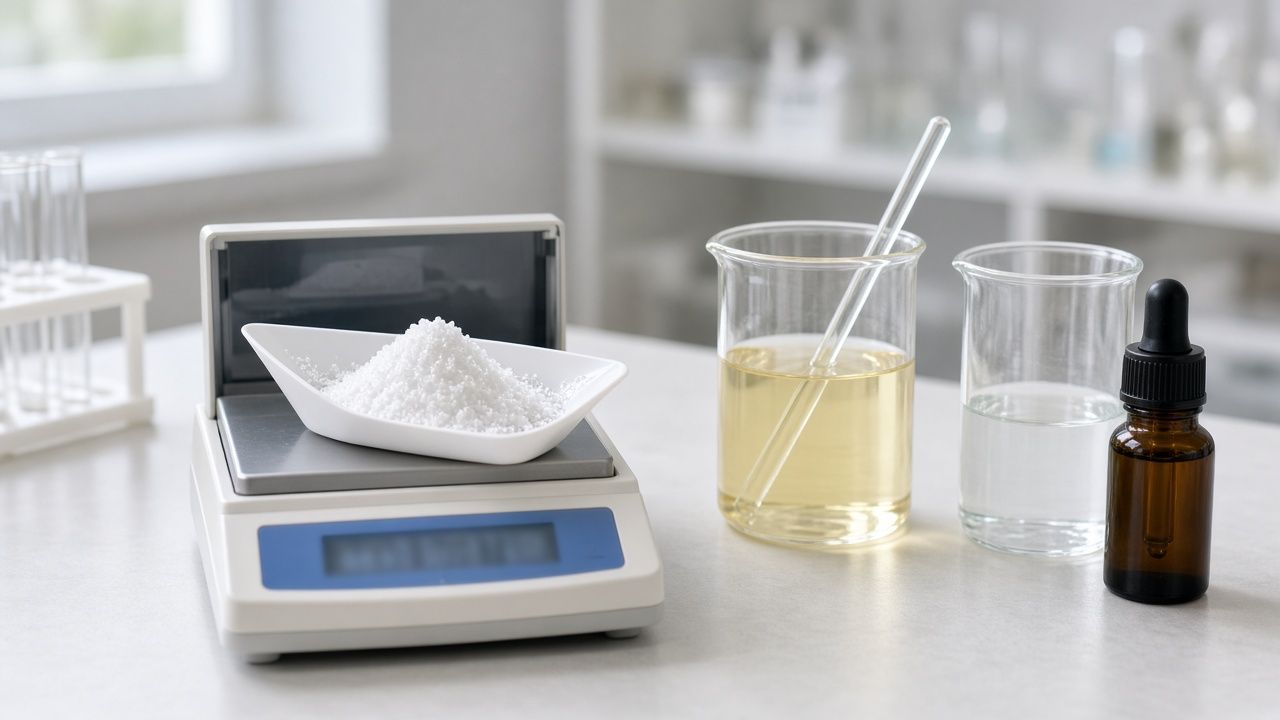
An adenosine serum is a water-based leave-on product that carries adenosine, a small nucleoside, at roughly 0.04 to 0.1% of the formula. At that level it is one of the most studied smoothing actives in skincare, it dissolves in water with a little warmth, and it sits comfortably next to niacinamide, peptides and hyaluronic acid.
The ingredient looks almost too simple on paper: a white powder used at less than a tenth of a percent. Most formulation mistakes with it come from that low dose, from weighing errors to adding it in a way that leaves crystals behind. This guide covers what adenosine is, what the human studies actually tested, how to dissolve and dose it, which pH and partners suit it, and a full 100 g serum you can scale.
What Adenosine Is and Why Serums Use It
A Molecule the Skin Already Knows
Adenosine is built from the base adenine and the sugar ribose, and it is present in every human cell as part of energy and signaling chemistry. Its INCI name is simply Adenosine and its CAS number is 58-61-7. In the European Commission's CosIng database it is listed with the function skin conditioning, which is the role a cosmetic label can describe. Skin cells carry adenosine receptors, and that is the reason researchers became interested in applying it topically rather than any promise that it rebuilds skin.
What the Human Studies Tested
The best-known clinical work comes from L'Oreal Recherche. In a blind, randomized, placebo-controlled study published by Abella in the International Journal of Cosmetic Science in 2006, 126 women aged 45 to 65 applied an adenosine cream, an adenosine dissolvable film or a placebo to the eye area twice a day for two months (PubMed 18489289). Optical skin profile measurements showed smoother-looking skin around the eyes from week three, and the cream also improved the look of frown lines between the brows. A related paper by Legendre and colleagues in the Journal of Cosmetic Science in 2007 described the film format itself (PubMed 17520154).
Later Korean work by Kang and colleagues looked at adenosine delivered with dissolving microneedle patches together with an adenosine cream in 21 women over ten weeks (PubMed 30375189). That study is about a patch system, so it tells you little about a plain serum. Read all of these the same way: they tested specific finished products, and a new serum made with the same ingredient is a new product whose results are not guaranteed by someone else's trial.
Regulatory Context for Your Label
Korea's Ministry of Food and Drug Safety includes adenosine at 0.04% among the ingredients notified for its functional anti-wrinkle cosmetics, which is why so many Korean creams and essences list it and why 0.04% is the most common reference dose. In the US there is no such category. An adenosine serum sold here is a cosmetic, and its copy should stay on appearance, such as smoother-looking skin and softer-looking fine lines, not on changing the structure of the skin.
Use Level: Why Less Than 0.1% Is Enough
Working From the Card
Our Adenosine card lists a use level of 0.04 to 0.1% in leave-on products. In a 100 g batch that means 40 to 100 mg of powder, which is the whole problem in practice: a kitchen scale that reads in 0.1 g steps cannot weigh it. Use a milligram balance, or make a stock solution and dose that instead. Going above the range does not make a serum work faster, it only raises cost and the chance of crystals forming as the product cools or sits in a cold warehouse.
A Stock Solution for Small Batches
For repeat development work, dissolve 1.00 g of adenosine in 99.00 g of warm distilled water with a preservative suited to the final formula, and keep it closed and labeled. Every 10 g of that 1% stock delivers 0.1 g of adenosine, so a 0.08% serum needs 8 g of stock per 100 g. Check the stock for crystals before each use, and if it has clouded in a cool room, warm it gently until clear. The water in the stock replaces part of the water phase, so subtract it from the formula.
Dissolving Adenosine Without Leftover Crystals
Warm Water, Then Cool-Down
Adenosine is a white crystalline powder that is only slightly soluble in cold water and dissolves much more easily in warm water, which matches the handling note on our card. The reliable method is a premix: weigh the powder into a portion of the formula water heated to about 50 to 60 °C, stir until the liquid is completely clear, let it cool, and add it to the batch during cool-down. At the final dose of a serum it stays dissolved; the premix is only there to get it into solution quickly.
Checking the Batch
Hold the finished serum against a dark background and look for sparkle or fine sediment at the bottom. If you see either, the premix was too concentrated or too cold. Leave a sample in a refrigerator overnight as a quick stress test, because crystals that appear at 4 to 8 °C are the ones customers will find after shipping in winter. Adenosine is not soluble in oils, so it does not belong in an anhydrous oil serum or a pure oil phase.
pH, Stability and Compatible Partners
A Comfortable pH Window
Adenosine is chemically sturdy for a cosmetic active, with no color change or odor to warn you of a problem, so the pH is set by the rest of the formula. Very acidic conditions can split the bond between the adenine and the ribose over time, so a cautious target is a mildly acidic to neutral serum, around pH 5.5 to 6.5. That window also suits niacinamide and most cosmetic peptides, which is why the three appear together so often.
Good Combinations
Adenosine pairs naturally with humectants because hydrated skin looks smoother on its own. Low molecular weight hyaluronic acid and glycerin give that effect immediately, and D-panthenol adds a comfortable feel. For a second smoothing active, signal peptides such as Palmitoyl Pentapeptide-4 work in the same pH range; our peptide serum recipe guide explains how to dose peptide solutions. Eye products often combine adenosine with caffeine, and the Acetyl Tetrapeptide-5 eye cream guide shows a base built for that thinner skin. More supporting ingredients are collected in the cosmetic actives section.
What to Keep in a Separate Product
Strong exfoliating acids at low pH and high-strength L-ascorbic acid serums sit far below the pH window above, so they are better used in a separate step or at a different time of day. Retinol and retinal are not chemically incompatible with adenosine, and Korean products often pair them, but a combined formula then needs the light protection, antioxidant system and pH that the retinoid demands.
Recipe: Adenosine Smoothing Serum, 100 g
A clear, lightweight serum with adenosine at 0.08%, niacinamide at 4% and a signal peptide solution at 4%. All amounts are in grams and the batch totals exactly 100.00 g.
Phase A: Water Phase, Room Temperature
Distilled water 71.22 g, glycerin 3.00 g, niacinamide 4.00 g, low molecular weight hyaluronic acid 0.20 g, xanthan gum 0.10 g. Pre-mix the hyaluronic acid and xanthan gum into the glycerin to a smooth slurry, add the water slowly while stirring, then dissolve the niacinamide. Let it hydrate for 30 minutes until uniform.
Phase B: Adenosine Premix
Distilled water 15.00 g heated to 50 to 60 °C, adenosine 0.08 g. Stir until fully clear, then let it cool to below 40 °C.
Phase C: Cool-Down, Below 40 °C
Adenosine premix from Phase B, Palmitoyl Pentapeptide-4 solution 4.00 g, D-panthenol 1.00 g, phenoxyethanol and ethylhexylglycerin preservative blend 1.00 g. Add each to Phase A one at a time, stirring gently between additions so the peptide solution does not foam.
Phase D: pH Adjustment
Citric acid 10% solution 0.40 g. Stir for two minutes and measure with a calibrated pH meter. Target pH 6.0, with an acceptable window of 5.5 to 6.5. Add the citric acid in small portions, and if you need less to reach the target, make up the difference with water so the batch still totals 100.00 g.
Usage Levels in This Formula
Adenosine 0.08%. Niacinamide 4.00%. Low molecular weight hyaluronic acid 0.20%. Xanthan gum 0.10%. Glycerin 3.00%. D-panthenol 1.00%. Palmitoyl Pentapeptide-4 solution 4.00%. Phenoxyethanol and ethylhexylglycerin 1.00%. Citric acid 10% solution 0.40%. Water to 100%.
Important Note on Your Ingredients
This formula is calculated at standard industry usage levels for each ingredient. Final amounts, pH and results depend on the specific raw materials you use, their concentration and the batch, so always check the certificate of analysis (CoA) and technical data sheet (TDS) supplied with each ingredient and adjust if they recommend a different level. Make a small test batch first, watch it for two weeks for clarity, color, odor and pH, and patch test before regular use. Fill into an airless pump or dropper bottle and regard about three months as a cautious working shelf life for a homemade batch without challenge testing.
How to Use an Adenosine Serum
Apply three to four drops to clean skin morning and evening, before moisturizer, and pat a little around the eye area if the formula is gentle enough for it. In the studies above the products were used twice a day for weeks, so consistency matters more than quantity. During the day, follow your routine with a broad-spectrum sunscreen, since daily sun protection is one of the most consistently supported habits for the look of aging skin according to the American Academy of Dermatology. Results from cosmetic serums vary from person to person and build gradually.
Buying Adenosine for Formulation
Because the dose is tiny, a small pack covers a lot of product: 1 g of powder is enough for more than ten 100 g batches at 0.08%. Ask for the INCI name, CAS 58-61-7 and the assay on the certificate of analysis, and confirm the appearance on arrival, since the material should be a white crystalline powder. Store it tightly closed in a cool, dry place. If you are planning a wider launch, our wholesale buyer's guide explains how to compare lot documents and cost per gram across suppliers.
Sources
Abella ML. Evaluation of anti-wrinkle efficacy of adenosine-containing products using the FOITS technique. International Journal of Cosmetic Science, 2006. https://pubmed.ncbi.nlm.nih.gov/18489289/
Legendre JY et al. Formulation, characterization, and efficacy of an adenosine-containing dissolvable film for a localized anti-wrinkle effect. Journal of Cosmetic Science, 2007. https://pubmed.ncbi.nlm.nih.gov/17520154/
Kang G et al. Combinatorial application of dissolving microneedle patch and cream for improvement of skin wrinkles, dermal density, elasticity, and hydration. Journal of Cosmetic Dermatology, 2019. https://pubmed.ncbi.nlm.nih.gov/30375189/
European Commission CosIng database, entry Adenosine. Korea Ministry of Food and Drug Safety, notified functional cosmetic ingredients. Product data: IngredientOS Adenosine card and supplier certificates of analysis.
Frequently asked questions
What percentage of adenosine should a serum contain?
Between 0.04 and 0.1% in leave-on products, which is 40 to 100 mg per 100 g. The 0.04% level is the most common reference because Korea lists adenosine at that dose for its functional anti-wrinkle cosmetics.
Is adenosine water-soluble?
Yes, but only slightly in cold water. Dissolve the powder in a portion of warm water, about 50 to 60 °C, until clear, then add it to the serum at cool-down. It does not dissolve in oils.
Can adenosine be used with niacinamide and peptides?
Yes. All three are water-soluble and comfortable around pH 5.5 to 6.5, and they are often combined in smoothing serums.
Why does my adenosine serum have crystals?
The powder was not fully dissolved or the premix was too concentrated and cooled too quickly. Use more warm water in the premix, confirm it is clear before adding it, and keep the final dose within 0.04 to 0.1%.
Try it with a 1 g sample pack
Neat peptide powders in 1 g packs, INCI on every page, shipped from Florida.
Shop peptide powders