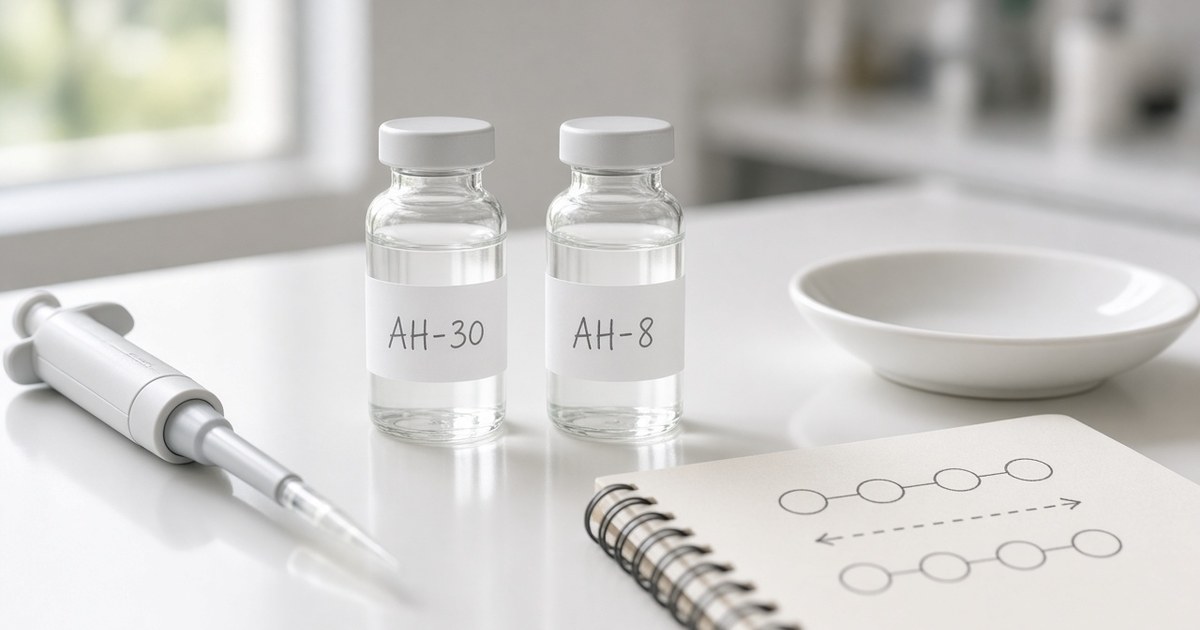
Acetyl hexapeptide-30 vs acetyl hexapeptide-8 is a comparison of two different six-amino-acid actives, not two strengths of the same molecule. Acetyl hexapeptide-8, long sold under a familiar trade name, is the SNARE-complex mimic with a published sequence and a larger independent literature trail. Acetyl hexapeptide-30, historically sold under another Lipotec trade name, is a separate peptide whose sequence is still unpublished and whose story comes almost entirely from supplier literature about a post-synaptic agrin and MuSK pathway.
For a formulator that means you choose them for different reasons. One gives you a well-known INCI, powder options and more published background. The other gives you a different mechanism narrative and a fixed ready-solution dose. Many brands carry both in one serum because the marketed pathways sit at different points on the expression-line story. This guide stays at the bench: chemistry and naming, how each is described to work, what the evidence actually is, use levels and pH, when to pick one or both, and how to word the label.
Two Different Hexapeptides, Not Interchangeable Grades
Acetyl Hexapeptide-8: Sequence, CAS and History
Acetyl hexapeptide-8 is Ac-Glu-Glu-Met-Gln-Arg-Arg-NH2, CAS 616204-22-9, with a molecular weight of about 889 Da. It was developed by Lipotec, now part of Lubrizol, and was first listed under an earlier INCI number before the current name became standard. The chemistry is public, powder grades exist, and the molecule is the same one discussed in our acetyl octapeptide-3 vs acetyl hexapeptide-8 and pentapeptide-18 vs acetyl hexapeptide-8 comparisons. On our site the ready liquids are the Acetyl Hexapeptide-8 Solution and the Acetyl Hexapeptide-8 Liquid, with neat powder available as expression-line peptide powder.
Acetyl Hexapeptide-30: INCI, Unpublished Sequence and CAS Status
Acetyl hexapeptide-30 is also a synthetic six-amino-acid acetylated peptide from the same supplier family, but the amino acid sequence has not been published. Independent peptide encyclopedias that searched PubMed and related indexes report no verified CAS number for the neat peptide. Commercial ready solutions list Water (Aqua), Acetyl Hexapeptide-30, Arginine and Caprylyl Glycol as the INCI, matching our Acetyl Hexapeptide-30 Solution and Acetyl Hexapeptide-30 Liquid. Arginine buffers the vehicle and caprylyl glycol helps preserve it. Because the sequence is undisclosed, you cannot treat AH-30 as a drop-in molecular twin of AH-8, and you cannot convert a solution percentage into a neat-peptide percentage without the CoA for your lot.
Why the Names Look Similar but Are Not the Same
INCI hexapeptide numbers are registration order, not structural cousins. Sharing the word hexapeptide only tells you that each chain is six amino acids long. It does not imply a shared sequence, a shared target or a shared dose. Brands sometimes confuse the two because both sit in expression-line serums and both come from Lipotec-era dossiers. On the ingredient list they must appear as separate INCIs, and on the bench they must be dosed from their own sheets.
Mechanisms as Marketed, and What the Evidence Supports
Acetyl Hexapeptide-8 and the SNAP-25 / SNARE Story
Supplier and review literature describe acetyl hexapeptide-8 as a fragment that mimics part of SNAP-25 and competes for a place in the SNARE complex that docks neurotransmitter vesicles at the nerve ending. The cosmetic framing is a softer-looking contraction of expression muscles rather than a blocked one, which is why copy should stay on the look of lines, not on muscle paralysis. The pre-synaptic framing is the reason many multi-peptide briefs still start with this molecule before adding partners that claim a different step.
Acetyl Hexapeptide-30 and the Agrin-MuSK Story
Lipotec and Lubrizol literature describe acetyl hexapeptide-30 as acting on the post-synaptic side, interfering with the agrin and MuSK signal that helps cluster acetylcholine receptors on the muscle membrane. That is supplier literature, not an independent PubMed consensus. It is useful as a formulation narrative because it sits downstream of the SNARE story attributed to acetyl hexapeptide-8, which is why the two are often combined rather than substituted. Treat the pathway language as marketing-science from the raw-material owner until you have your own finished-product data.
Evidence Honesty: Reviews Versus Supplier Dossiers
Acetyl hexapeptide-8 has the clearer public trail. Reviews in journals such as the Journal of Drugs in Dermatology and MDPI outlets discuss the peptide among topical expression-line actives, and there are permeation and delivery papers beyond the original supplier work. Results across small human panels are mixed, so no fixed wrinkle-reduction percentage belongs on a finished label unless you measured it on your own formula. Acetyl hexapeptide-30, by contrast, has little to no independent peer-reviewed record under the INCI name, and databases that looked for sequence and clinical listings report empty results. If a competitor page quotes dramatic percentages for AH-30 without naming a study design, treat those figures as unverified. Our own acetyl hexapeptide-30 serum formulation guide stays on process for the same reason.
Acetyl Hexapeptide-30 vs Acetyl Hexapeptide-8 at the Bench
Solubility, Cool-Down and Finished pH
Both actives are handled as water-soluble peptide solutions added late. For acetyl hexapeptide-30 the supplier formulation guide asks for cool-down addition below 40 °C and a finished pH between 5.5 and 8.0, with most brands landing near 5.5 to 6.5 so the serum also suits panthenol, niacinamide and other peptides. Acetyl hexapeptide-8 solutions are likewise added below 40 °C after an emulsion or gel has cooled; branded sheets commonly allow a working window around pH 3 to 8, and a finished serum near pH 5 to 6.5 is the practical overlap. Gentle stirring beats high shear once either peptide is in, and a strong electrolyte or a late thickener addition is the usual cause of haze.
Use Levels: Solution Percentages Are Not Peptide Percentages
For acetyl hexapeptide-30 the original supplier recommends 5% of the ready solution in the finished product. That figure is solution percent, not neat peptide, and the peptide content of commercial vehicles is not always public, so confirm every lot on the CoA. For acetyl hexapeptide-8, commercial solution guidance discussed across our sibling posts commonly sits in a 3 to 10% range of the branded-style solution, with some sheets listing a slightly wider window starting near 2%. Again that is solution percent. Powder grades of acetyl hexapeptide-8 let you weigh neat peptide into a stock, which AH-30 does not offer in the same transparent way when the sequence and assay are unpublished. Never swap the two at the same percentage and expect an equivalent peptide load.
Vehicles and What Each Solution Brings
A clear water-gel or light serum is the usual first vehicle for either peptide because haze and color drift show early. Acetyl hexapeptide-30 solutions bring arginine into the formula, which adds a small ionic load that can thin some carbomer gels overnight, so check viscosity after 24 hours or choose a more salt-tolerant thickener. Acetyl hexapeptide-8 solutions often list water, the peptide and a glycol preservative without arginine, but each pack still needs its own CoA. Both sit comfortably with glycerin, propanediol, hyaluronic acid and panthenol. Strong acids, strong oxidizers and long heating are poor partners for either. More ready liquids for expression-line work live in our peptide solutions section.
When to Choose One, the Other, or Both
When Acetyl Hexapeptide-8 Is Enough
Choose acetyl hexapeptide-8 when you want the familiar INCI, access to powder as well as solution, and a larger body of published discussion behind the story. It is also the better first pick when cost per unit matters or when the brief already carries several actives and needs one dependable expression-line peptide. Brands that already sell an AH-8 serum can keep that SKU as the workhorse and introduce AH-30 later as a premium multi-peptide line rather than replacing the known name overnight.
When Acetyl Hexapeptide-30 Earns a Place
Choose acetyl hexapeptide-30 when the brief asks for a post-synaptic agrin-MuSK narrative that competitors built only on SNARE mimics do not use, or when you want a second hexapeptide on the label without duplicating acetyl octapeptide-3. The fixed 5% solution recommendation simplifies dosing once the CoA is checked. It is less suitable as a solo hero if your marketing team needs peer-reviewed papers to quote, because that record is thin. Build the process first with the serum guide linked above, then decide whether the multi-peptide story is worth the extra line item.
Combining Them for a Multi-Peptide Expression-Line Serum
Many formulators use both because suppliers describe them at different points on the pathway: pre-synaptic for acetyl hexapeptide-8 and post-synaptic for acetyl hexapeptide-30. A practical starting point is the supplier 5% of the AH-30 solution plus a moderate level of an AH-8 solution inside the 3 to 10% guidance range, each added separately in cool-down with a clarity and pH check between additions. No independent head-to-head study proves synergy for that pair, so regard the combination as formulation practice backed by mechanism narratives rather than by a shared clinical trial. If you want a third angle that is neither SNARE nor agrin-MuSK, the enkephalin-pathway discussion in pentapeptide-18 vs acetyl hexapeptide-8 is the next read, and the SNAP-8 elongation angle sits in acetyl octapeptide-3 vs acetyl hexapeptide-8.
Labels and Cosmetic Claim Wording
List each peptide under its current INCI. Do not print historical trade names on a finished pack unless you have the right to use them, and do not imply that a generic solution is the branded dossier grade. Keep claims cosmetic: smoother-looking forehead lines, softer-looking crow's feet and a more rested-looking expression with regular use are appropriate. Avoid language about relaxing or blocking muscles, stopping acetylcholine, or matching injectable procedures. Supplier efficacy numbers belong to the supplier's test products. If you want percentages on a page or a carton, run a perception or instrumental panel on the finished formula you actually sell.
When the two peptides share a label, say that the serum combines two expression-line hexapeptides with different marketed mechanisms, not that one replaces the other. Point shoppers who want process detail to the AH-30 serum guide and point formulators who are still choosing among SNARE-family options to the octapeptide and pentapeptide comparisons. Ready packs for both molecules ship from the peptide solutions catalog with INCI and CoA visibility on each card.
Frequently asked questions
Are acetyl hexapeptide-30 and acetyl hexapeptide-8 the same peptide?
No. Both are six-amino-acid acetylated peptides used in expression-line cosmetics, but they are different molecules. Acetyl hexapeptide-8 has a published sequence and CAS 616204-22-9. Acetyl hexapeptide-30 has an unpublished sequence and no verified peptide CAS in public listings.
Can I use acetyl hexapeptide-30 and acetyl hexapeptide-8 together?
Yes. Brands often combine them because suppliers describe pre-synaptic SNARE activity for acetyl hexapeptide-8 and a post-synaptic agrin-MuSK story for acetyl hexapeptide-30. Add each solution separately below 40 °C and keep each within its own recommended use level.
What use level should I start with for each solution?
The original supplier recommends 5% of the acetyl hexapeptide-30 ready solution in the finished product. Acetyl hexapeptide-8 commercial solutions are commonly discussed in a 3 to 10% range. Confirm active content on the CoA for every lot before you lock a dose.
Which peptide has stronger published evidence?
Acetyl hexapeptide-8 has more independent reviews and human-study discussion. Acetyl hexapeptide-30 relies mainly on supplier literature, and independent searches have not found peer-reviewed studies under the INCI name, so finished-product claims should stay modest.
Try it with a 1 g sample pack
Neat peptide powders in 1 g packs, INCI on every page, shipped from Florida.
Shop peptide powders