
SKU: VV25051604
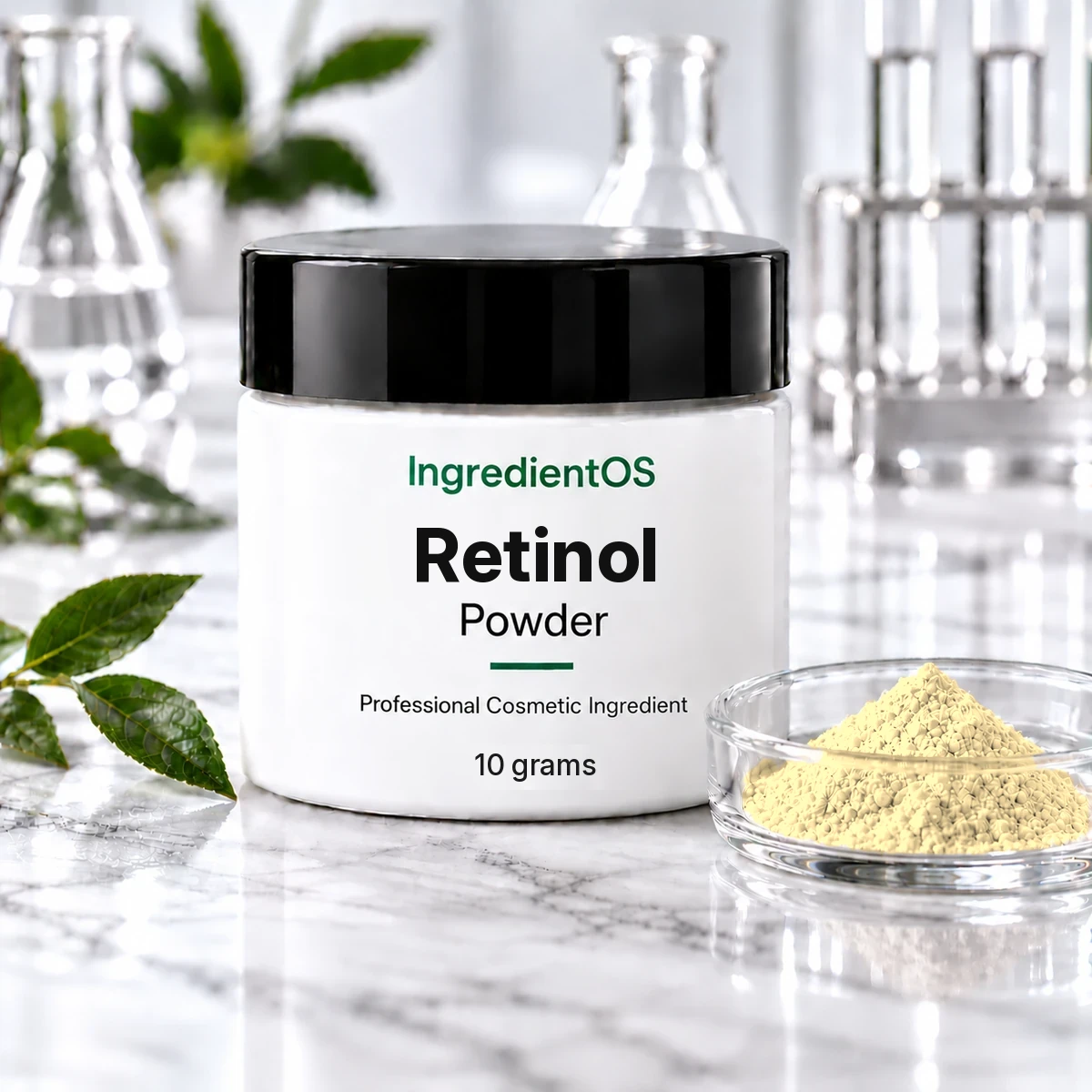
Retinol Powder
$9.99In stock
INCI: Retinol. CAS 68-26-8. If the CoA lists an encapsulated blend, use the blend INCI and CAS "Mixture".
Usage Rate: Calculate from the retinol content on the CoA. EU maximum (Regulation (EU) 2024/996): 0.3% retinol equivalent in face and other leave-on or rinse-off products, 0.05% in body lotion.
Packaging
Powder sizes (metric · US)
Ships from FloridaSecure checkoutUsually ships in 1–2 business daysFree US shipping on $50+
ApplicationLeave-on creams and serums (oil phase, cool-down)
AppearanceLight yellow powder. Confirm on CoA.
pH5.0–6.5
Description
What Retinol Powder is
Retinol is the alcohol form of vitamin A, CAS 68-26-8, and one of the most researched ingredients in cosmetic skin care. This listing is the powder, light yellow in color, sold by the gram. Some retinol powders on the market are encapsulated blends in which retinol sits inside a carrier; if the CoA for your lot lists such a blend, use the blend INCI and CAS, which then reads Mixture, and base your calculations on the retinol content it states. The CoA, not this page, is the final reference.
Properties
Retinol is oil-soluble and practically insoluble in water. It is also one of the most sensitive actives a lab handles: light, oxygen, heat and some metal ions degrade it, and the yellow color often fades as it does. In finished products it is valued for the look of smoother texture, more even tone and refined pores over weeks of use. Brands usually present it in evening routines and combine it with soothing and moisturizing ingredients to keep the experience comfortable.
Applications
Night creams, serums in oil or emulsion form, eye creams with low retinol content, body lotions and hand creams are the typical uses. Many lines pair it with Bakuchiol, often marketed as a plant-based companion, and with Ceramide NP for a barrier-friendly feel. Other forms of vitamin A and related actives are in our cosmetic actives catalog.
How to use it
Dissolve or disperse the powder in the oil phase or in a compatible ester such as caprylic/capric triglyceride, at the lowest temperature that works. In emulsions, add the premix during cool-down, below 40 °C, under gentle mixing and, ideally, a nitrogen blanket or minimal air incorporation. Add an antioxidant such as tocopherol and a chelator. Calculate the level from the retinol content on the CoA. The EU limits retinol equivalents in face products to 0.3 percent and in body products to 0.05 percent; follow the rules of your own market.
Protecting stability
Retinol products live or die by packaging and process. Airless pumps or aluminum tubes protect better than jars. Work under yellow or dimmed light, keep mixing times short, and fill the same day. Run stability at room temperature and in a warm cabinet and measure the retinol content if you can, or at least track color and odor. Clear consumer instructions, such as evening use and gradual introduction, support a good experience.
Compatibility
Retinol works with emollients, squalane, ceramides, niacinamide, panthenol and hyaluronic acid. Avoid combining it in the same product with strong acids, benzoyl peroxide or oxidizers. Keep iron and copper traces low, since metals speed up degradation; a chelator helps. Copper peptides are better placed in a separate product.
Characteristics
Form: light yellow powder, as stated on the lot CoA. INCI: Retinol, or the blend INCI if the CoA lists an encapsulated blend. CAS: 68-26-8 for retinol. Solubility: oil-soluble. Addition point: oil phase premix, cool-down.
Original recipe: night cream, 100 g
Phase A: distilled water 70.80 g, glycerin 4.00 g, disodium EDTA 0.10 g, xanthan gum 0.20 g. Phase B: cetearyl olivate and sorbitan olivate 4.50 g, cetyl alcohol 1.50 g, squalane 6.00 g, caprylic/capric triglyceride 6.00 g. Heat A and B to 75 °C, emulsify and cool. Phase C below 40 °C: Retinol Powder premixed in caprylic/capric triglyceride 2.00 g at a level calculated from the CoA, here 0.10 g of retinol content, tocopherol 0.50 g, panthenol 1.00 g, niacinamide 2.00 g in a little water, preservative 1.00 g, water 0.30 g. Fill into airless pumps.
Storage
Store sealed, cool, dry and dark, ideally in the fridge, and reseal under minimal air exposure. Ships from Florida in gram packs.
Product Specifications
INCIRetinol. CAS 68-26-8. If the CoA lists an encapsulated blend, use the blend INCI and CAS "Mixture".
Usage RateCalculate from the retinol content on the CoA. EU maximum (Regulation (EU) 2024/996): 0.3% retinol equivalent in face and other leave-on or rinse-off products, 0.05% in body lotion.
SolubilityOil-soluble per our record. Dissolve or disperse in the oil phase or a compatible ester; add during cool-down below 40 °C.
StorageStore tightly closed, cool and dry, protected from light, air and heat. Reclose quickly after use. Respect the supplier shelf life.
TDS / CoA available on request. Contact us
Frequently Asked Questions
Is this retinol oil-soluble?
Yes. Our record lists it as oil-soluble. Dissolve or disperse it in the oil phase or a compatible ester.
How do I calculate the level?
Calculate from the retinol content printed on the CoA, and stay within the limits of your market.
Why does retinol need special handling?
It degrades with light, air and heat, so add it during cool-down, protect it from light and use airless or opaque packaging.


