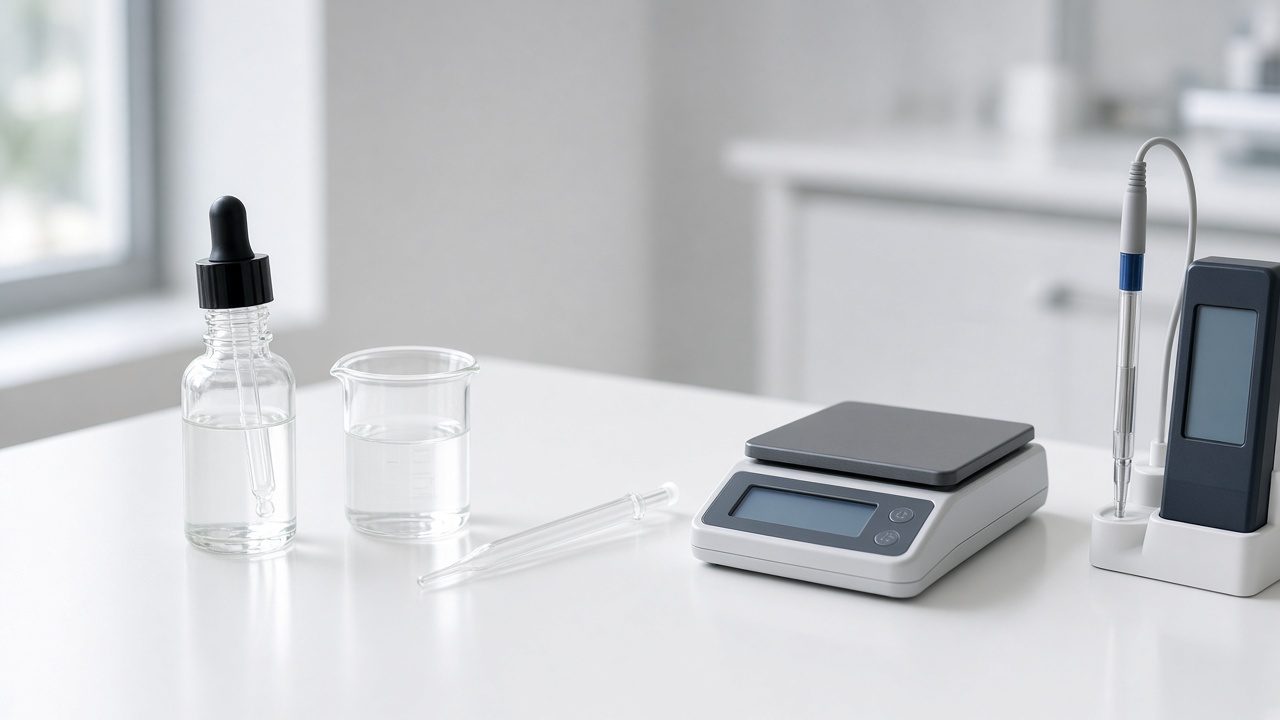
A Matrixyl Morphomics serum is a water-based leave-on formula that carries Sederma's N-Prolyl Palmitoyl Tripeptide-56 Acetate at the manufacturer's recommended 2% of the finished product. The raw material is a water-soluble liquid, so it suits gel serums and light emulsion serums equally well, and it is added late in the process, between room temperature and 50 °C according to the supplier leaflet. Keep the finished serum in the pH 4.0 to 6.0 window given on our product card and you have the core of the formula.
This article is for formulators and indie brands planning a serum around this peptide. It walks through what the material actually is, what the supplier studies did and did not test, two worked starting formulas, sensible partner ingredients, and the label wording that keeps the product on the cosmetic side of the line.
What Matrixyl Morphomics Is
The peptide behind the trade name
Matrixyl Morphomics is a trade name from Sederma, part of Croda. The active molecule is a palmitoylated tripeptide of lysine, histidine and glycine with an extra proline grafted onto the lysine, which Sederma abbreviates as Pal-K(Pro)-HG. Its INCI name is N-Prolyl Palmitoyl Tripeptide-56 Acetate. It belongs to the same family of matrikine-inspired peptides as the older Matrixyl grades, but it is a different molecule from the palmitoyl pentapeptide in classic Matrixyl and from the peptide pair in Matrixyl 3000, so it is not a stronger version of either one.
What arrives in the drum
The commercial material is a colorless to light yellow liquid. The full INCI on the original Matrixyl Morphomics card is Water (Aqua), Pentylene Glycol, Caprylyl Glycol, N-Prolyl Palmitoyl Tripeptide-56 Acetate, and the peptide itself is present at only about 20 to 50 ppm. Pentylene glycol and caprylyl glycol serve as the carrier and help keep the solution stable, which also means a 2% dose adds a small amount of both glycols to your serum. A distributor data sheet gives the specific gravity as 0.990 to 1.010, so for bench work one gram and one milliliter are practically interchangeable.
If your brief does not require the branded name on the label or in marketing, our own-name IO Anti-Wrinkle Peptide Liquid is the lower-cost grade of the same type of material. Both sit in the peptide actives section, and keeping them as separate raw material codes in your records prevents a marketing claim from naming a material that is not actually in the batch.
What the Supplier Studies Show
Laboratory work
The peptide was described in a 2019 paper in the International Journal of Cosmetic Science (PubMed 31596957). Researchers screened 120 peptides on normal human dermal fibroblasts and picked N-Prolyl Palmitoyl Tripeptide-56 Acetate because it raised collagen and fibronectin production at gene or protein level. Using proteomics, they also reported changes in pathways linked to collagen and actin, and higher transcription of FOXO and sestrin genes, which Sederma markets under its own longevity-gene wording. These are cell culture and skin explant results, useful for understanding the mechanism but not something to quote to consumers as a skin outcome.
Clinical panels, and why the vehicle matters
The supplier's clinical work used a cream, not a serum. Two female panels with mean ages of 64 and 58 and one male panel with a mean age of 59 applied a cream containing 2% Matrixyl Morphomics twice a day for six weeks against a placebo cream. Sederma reports instrumental measurements showing smaller-looking frown lines, marionette lines and crow's feet compared with placebo, for example an average 22.7% drop in measured marionette line volume from baseline on 26 women. Because the test product was an emulsion, a serum built at the same 2% is reasonable but has not itself been tested, so keep any claim on your serum to cosmetic appearance language, and run your own consumer perception test if you want numbers on the label.
Building the Serum
Use level and order of addition
Use 2% of the finished formula, which is the level Sederma recommends and the level used in its studies. There is little reason to push higher: the peptide concentration is already set by the supplier, and doubling the dose doubles your raw material cost without any published data behind it. The supplier leaflet allows addition anywhere between room temperature and 50 °C. Our card recommends adding it below 40 °C at the end of the process, which is the safer habit in a workshop where batch temperatures are not always tightly controlled.
pH and the water phase
Aim for a finished pH of about 5.0 to 5.5, inside the 4.0 to 6.0 working range listed on the card. Adjust the pH before you add the peptide where possible, and if you must correct afterwards use dilute citric acid or sodium hydroxide solution in small steps rather than concentrated acids or bases. Avoid pairing it in the same phase with strongly acidic exfoliating acids at low pH, strong oxidizers or a high level of free ethanol, all of which work against the stability of a lipopeptide in solution.
Starting formula one: gel serum
This is an example starting point for 100 g, to be tested for stability and preservation before any launch. Water 88.4 g, glycerin 3 g, pentylene glycol 2 g, sodium hyaluronate powder 0.3 g, xanthan gum 0.2 g, panthenol 1 g, Matrixyl Morphomics 2 g, phenoxyethanol and ethylhexylglycerin 1 g, sodium gluconate 0.1 g, and citric acid or sodium hydroxide solution as needed for pH. Disperse the hyaluronate and xanthan gum in the glycerin, add to the water with stirring and let it hydrate fully. Add panthenol and sodium gluconate, check pH, then stir in the peptide liquid and the preservative at room temperature. A high molecular weight hyaluronic acid gives this gel a smooth, slightly cushioned slip on the skin.
Starting formula two: light emulsion serum
For a milky serum with a little more comfort, try this example for 100 g. Water 83.9 g, glycerin 3 g, ammonium acryloyldimethyltaurate/VP copolymer 1 g, squalane 4 g, caprylic/capric triglyceride 4 g, panthenol 0.5 g, tocopherol 0.5 g, Matrixyl Morphomics 2 g, phenoxyethanol and ethylhexylglycerin 1 g, sodium gluconate 0.1 g. Disperse the polymer in water with glycerin, then slowly add the oils under good mixing to form a cold-process emulsion. Add tocopherol, panthenol and sodium gluconate, check that the pH sits around 5.5, and finally add the peptide and the preservative. There is no heating step, which makes the peptide addition temperature a non-issue.
Partner Ingredients That Make Sense
Other peptides
Multi-peptide serums are common, and Morphomics is usually positioned for vertical lines and facial contours while other peptides cover different angles. The Matrixyl 3000 peptide solution is a frequent companion when a brief wants two members of the Matrixyl family, and an expression-line peptide such as Argireline Amplified is often added to target the look of frown and forehead lines from another direction. Our comparison of Dermaxyl vs Matrixyl explains how the family members differ, and the peptide serum recipe for wrinkles shows how to balance several peptides in one water phase.
Hydration and support
Glycerin, hyaluronic acid, panthenol and niacinamide all sit comfortably alongside the peptide in a pH 5 to 6 water phase. Most common gums and carbomers are fine, as are the usual emulsifiers and broad-spectrum preservative blends. Treat strong vitamin C at very low pH and high levels of alpha hydroxy acids as candidates for a separate product rather than the same bottle, so each active can sit at its own ideal pH.
Storage, Stability and Testing
Store the raw material tightly closed, cool and away from light, and many formulators keep peptide liquids in the fridge once opened. Note the lot number from the certificate of analysis on your batch record, and copy the label INCI from that document. For the finished serum, run at least a basic stability check at room temperature and at elevated temperature, watch for changes in pH, viscosity, color and odor, and do a preservative efficacy test before you sell. A peptide that is present at parts per million cannot be checked by eye, so documentation and good weighing are what prove it is in the bottle.
Label and Claim Wording
On the ingredient list the material appears in descending order of its components, so water and pentylene glycol from the raw material merge with the rest of the formula and N-Prolyl Palmitoyl Tripeptide-56 Acetate appears near the end. Marketing can say the serum contains 2% Matrixyl Morphomics and that it helps smooth the look of fine lines and wrinkles or gives a more lifted-looking contour. Avoid words such as repair, heal, regenerate collagen in the skin or replace injections, which move a product toward drug territory, and present Sederma's study figures as supplier data on the raw material, not as results of your own serum.
Frequently asked questions
How much Matrixyl Morphomics should I use in a serum?
Use 2% of the finished serum, the level Sederma recommends and used in its clinical study. Higher levels add cost without published support.
When do I add Matrixyl Morphomics to the formula?
Add it near the end of the process. The supplier allows room temperature up to 50 °C, and we recommend adding it below 40 °C after the pH has been adjusted.
What pH works for a Matrixyl Morphomics serum?
A finished pH of about 5.0 to 5.5 works well, inside the 4.0 to 6.0 working range listed for the raw material.
Can I combine Matrixyl Morphomics with other peptides?
Yes. It is often paired with Matrixyl 3000 or Argireline Amplified in one water phase, since each peptide targets a different look of lines.
Try it with a 1 g sample pack
Neat peptide powders in 1 g packs, INCI on every page, shipped from Florida.
Shop peptide powders