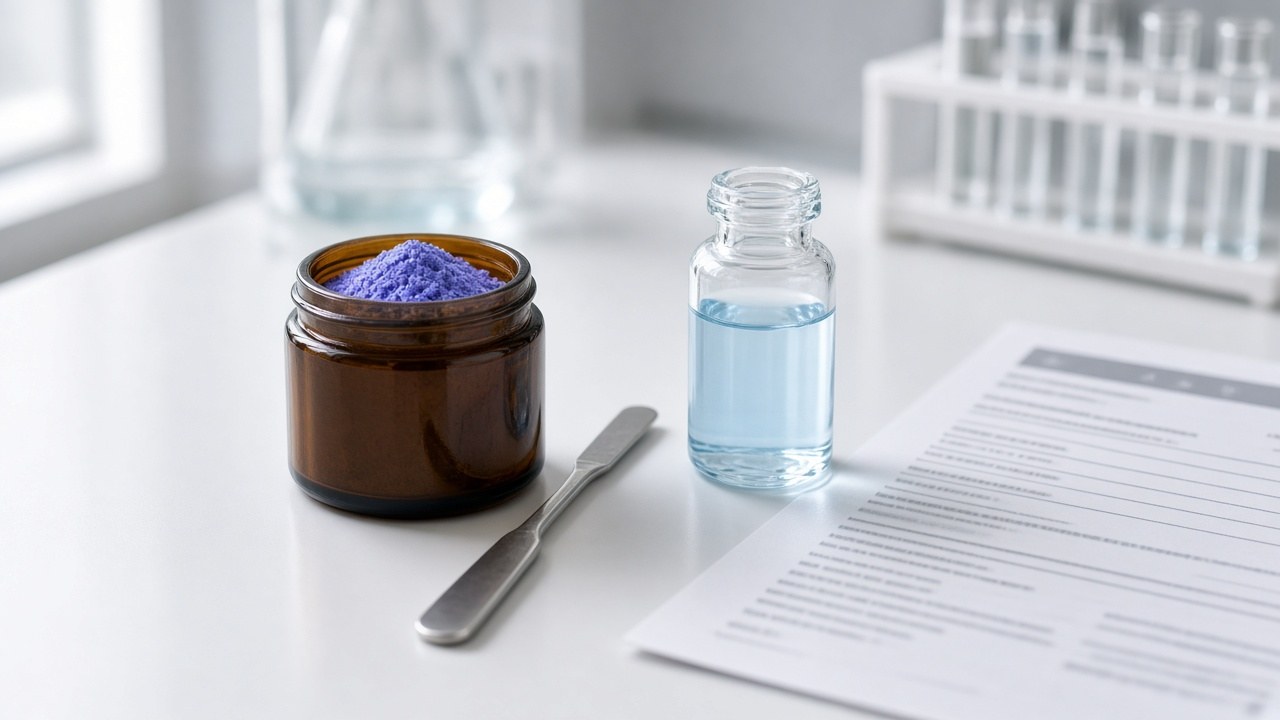
A GHK-Cu CoA is the lot-specific certificate that records whether the powder in your jar is the copper complex of glycyl-histidyl-lysine, how clean its HPLC signal is, and how much copper it actually contains. HPLC assay and copper content answer different questions, so a high purity figure alone does not prove you received the 1:1 blue complex. This guide walks through the fields on a cosmetic raw-material certificate, using the published document for lot BLP-GHKCU-260918-P of GHK-Cu powder as a worked example, so you can match the paperwork to the material before you weigh it into a serum.
What a GHK-Cu CoA Actually Is
A certificate of analysis belongs to one manufacturing lot. It should carry the product name, the INCI name, the CAS number, the lot or batch number, the dates of manufacture and analysis, and a table of tests with a specification, a result, a method and a pass or fail status. The technical data sheet describes how that grade is meant to be used, including the recommended use range and the working pH window, and the safety data sheet covers handling. The query also appears as ghk cu coa or ghk-cu with coa, sometimes with usa when the buyer wants a US-origin lot; you are still checking one numbered batch, not a catalog photograph. The published certificate for lot BLP-GHKCU-260918-P states that the material is a cosmetic formulation active only, which is the right frame if you are buying from the peptide powders section for a topical serum or cream.
First Checks: Name, CAS, Lot Number and Dates
INCI and CAS must describe the copper complex
The INCI name for GHK-Cu is Copper Tripeptide-1, the name that belongs on a US ingredient list, while GHK-Cu and copper peptide are the everyday names for the same complex. The certificate for lot BLP-GHKCU-260918-P lists Copper Tripeptide-1, CAS 89030-95-5 and a molecular weight of 401.9 g/mol, with the sequence written as Gly-His-Lys bound to copper in a 1:1 complex. Those three lines should agree with each other and with the label on the pack.
A second CAS number, 49557-75-7, identifies free GHK without copper, which has its own INCI name, Tripeptide-1, and a molecular weight near 340 g/mol. Some catalogues print the free-peptide number on a copper product because older references mixed the two entries. If a document sold as a GHK-Cu CoA shows CAS 49557-75-7 and no copper assay, stop and ask which material you actually have. Our GHK-Cu INCI name guide explains how those names come apart on a label; the CoA is where they have to match the lot in your hand.
The lot number and the dates have to match the pack
A useful certificate names one lot and is valid only for that lot. The example document is written for BLP-GHKCU-260918-P, manufactured on 18 September 2026, analysed on 3 October 2026 and given an expiration date of 18 September 2028. It records the United States as the country of origin and gives storage as 2 to 8 C, dry, sealed and protected from light. When the jar, the invoice and the PDF show different lot numbers, you do not yet have a CoA for the goods you received.
Appearance Is a Fast Identity Screen
The copper complex is blue. The specification on lot BLP-GHKCU-260918-P calls for a blue to purple powder, and the recorded result is a blue powder by visual inspection. After dissolving, the certificate asks for solubility of at least 100 mg/ml as a clear blue solution, and this lot complied. Free GHK without copper is white to off-white, so a powder sold as GHK-Cu that arrives white, or that dissolves to a colorless liquid at a level that should show a tint, has already failed a basic check. Color does not tell you the copper percentage, but it is a fast way to catch a mix-up with the free tripeptide.
HPLC Assay Is Not the Same as How Much of the Powder Is Peptide
On the example certificate, assay is reported as HPLC, area percent, against a specification of at least 98.0 percent. The lot result is 98.6 percent, and the line is marked pass. Area percent means the main peak is compared with the other peaks the detector can see at that wavelength, not with the entire mass of the powder. Water, a counter-ion such as acetate or chloride, and inorganic residue do not appear in that chromatogram, so they cannot lower the HPLC figure even when they add weight on the balance. A headline purity of 98 or 99 percent is therefore an incomplete answer to how much GHK-Cu is in this gram: the HPLC line does not measure copper or moisture, and a powder of free GHK can still look clean on the chromatogram. Read the assay next to identity, copper content and water.
Copper Content Tells You Whether the Complex Is Plausible
Copper is a separate measurement. On lot BLP-GHKCU-260918-P it is determined by ICP-OES, the specification is 10.0 to 16.0 percent, and the result is 14.2 percent. For a salt-free 1:1 complex with the stated molecular weight of 401.9 g/mol, copper is about 15.8 percent of the molecule by weight, because the atomic weight of copper is 63.55. An as-is result a little below that theoretical figure is expected when the powder also holds water or a counter-ion. This lot reports 2.4 percent water by Karl Fischer titration against a limit of 5.0 percent, which already accounts for part of the gap between 14.2 percent and 15.8 percent.
A window such as 10.0 to 16.0 percent exists because cosmetic lots are not all anhydrous, salt-free solids of identical composition. A missing copper line, a result far outside the window, or a figure that cannot be reconciled with identity and water should prompt a question. Total copper by ICP-OES also cannot prove, by itself, that every copper ion is bound to GHK rather than present as a free copper salt mixed with free peptide. This certificate pairs copper content with HPLC and mass spectrometry identity of the 1:1 complex, a blue appearance and a clear blue solution.
Identity by HPLC and Mass Spectrometry
The identity line on lot BLP-GHKCU-260918-P asks the material to conform by HPLC and mass spectrometry, with a molecular ion at 401.9, and the result is confirmed. That number matches the molecular weight printed in the header. Palmitoyl Tripeptide-1, also called Pal-GHK, and Biotinoyl Tripeptide-1 share the GHK sequence and do not contain copper; they have different INCI names, different CAS numbers and different masses. A CoA that cannot show an identity method is asking you to take the product name on trust.
Water, pH and Solubility
Water by Karl Fischer titration on this lot is 2.4 percent against a limit of 5.0 percent. Moisture dilutes as-is copper and peptide content, and it is the main enemy of a neat peptide powder in storage. The certificate tells you to keep the pack at 2 to 8 C, dry, sealed and protected from light. Let a cold container reach room temperature before you open it so condensation does not form on the powder, then close it again before returning it to the refrigerator. The same document reports the pH of a 1 percent solution in water at 25 C as 6.8, inside a specification of 6.0 to 8.0. That is the pH of the raw material in water, not automatically the target for every finished serum. The technical data sheet for the same lot gives a working range of 5.5 to 7.5 for the complex in a formula and warns against strong chelators that can strip copper. Dissolve the powder fully in formula water and add the premix during cool-down below 40 C, keeping the finished product in a mildly acidic to near-neutral window rather than in a low-pH ascorbic acid system.
Microbiology and Heavy Metals on a Cosmetic Lot
The example certificate includes a short microbiological panel and a heavy metals screen because the powder is a raw material for topical products. Total aerobic count is reported as less than 10 CFU/g against a limit of less than 100 CFU/g by USP 61, yeasts and molds as less than 10 CFU/g against that same 10 CFU/g limit, and specified pathogens as absent by USP 62. Heavy metals, expressed as lead, are less than 5 ppm against a limit of 10 ppm by ICP-MS. Those lines support an incoming-goods file. They are not a substitute for preservative challenge testing on the finished serum.
How to Use the CoA When You Weigh a Batch
The technical data sheet for lot BLP-GHKCU-260918-P recommends 0.01 to 0.1 percent of the pure powder in the finished product, also written as 100 to 1000 ppm. The certificate translates the same range into 0.01 percent as 100 ppm, 0.05 percent as 500 ppm and 0.1 percent as 1000 ppm, and notes that typical finished cosmetic use sits in the low hundreds of ppm. Those figures apply to this neat powder grade. A ready GHK-Cu solution is a diluted material, so you cannot copy a powder percentage onto a solution without reading the active content on that SKU's own CoA.
Most cosmetic benches weigh the powder as-is and stay inside the data-sheet range after checking that assay and copper content have passed. This lot's HPLC assay of 98.6 percent against a 98.0 percent minimum does not call for a large correction on a 100 g lab batch. If your quality system works on an anhydrous basis, use the water result to make that correction explicitly. Weigh on a scale that reads to 0.001 g, dissolve the powder completely in distilled water until the premix is a clear blue, then add it below 40 C. Our guide to using GHK-Cu powder in a DIY serum walks through that dissolving step in more detail. Strong chelators such as disodium EDTA can bind copper, and copper can interact with ascorbic acid, so most formulators keep those pairings out of the same product. If a formula shifts from blue toward green or brown during storage, take the color change as a sign to stop and review the base. Humectants such as glycerin and a hyaluronic ingredient, along with other non-copper peptides from the peptide powders section, are the more usual partners.
Problems That Should Stop You Before You Open the Jar
The most common problem is a document that does not belong to the lot on the pack: a recycled PDF, a specification sheet with no results column, or a certificate whose lot number or dates do not match the label. The next is a wrong identity, such as CAS 49557-75-7 on a product sold as GHK-Cu, a white powder, or an HPLC assay with no copper line at all. Be equally careful with a copper result far from its window, water above its limit, or a pH of the 1 percent solution outside specification. Lot BLP-GHKCU-260918-P is marked pass on every line and was released against internal specification BLP-SPEC-GHKCU-98.
What to File With the Batch Record
Keep the CoA, the technical data sheet and the safety data sheet for the same lot together, and write the lot number on every record that uses the material. For this example that means filing the certificate for BLP-GHKCU-260918-P, noting the analysis date of 3 October 2026 and respecting the 18 September 2028 expiry and the 2 to 8 C storage instruction. Write Copper Tripeptide-1 on the finished product's ingredient list exactly as the certificate gives it, and keep the CAS line consistent with the same document. If you later switch from the powder to a solution, start a new file, because the two SKUs do not share a CoA.
Sources
Analytical figures and specifications come from the IngredientOS Certificate of Analysis for GHK-Cu (Copper Tripeptide-1) Powder, lot BLP-GHKCU-260918-P, analysed on 3 October 2026, and from the matching Technical Data Sheet for the same lot. The theoretical copper content of about 15.8 percent is the arithmetic share of copper in a 1:1 complex at the stated molecular weight of 401.9 g/mol. Use-level, pH and process notes follow those two documents and the powder product page.
Frequently asked questions
What should a GHK-Cu CoA include?
A lot-specific GHK-Cu CoA should name the material as Copper Tripeptide-1, give CAS 89030-95-5 for the copper complex, report HPLC assay against a specification, report copper content by a method such as ICP-OES, and record appearance, water, pH, solubility and the lot dates. The published certificate for lot BLP-GHKCU-260918-P also includes identity by HPLC and mass spectrometry, a short USP microbial panel and a heavy metals screen.
Why is HPLC assay not enough on its own?
HPLC assay by area percent describes the share of the peptide-related chromatographic signal. It does not measure copper, water or a counter-ion. A powder can show a high HPLC figure and still be free GHK, listed as Tripeptide-1, rather than the copper complex, if copper was never bound.
Which CAS number belongs on a GHK-Cu CoA?
CAS 89030-95-5 identifies the copper complex. CAS 49557-75-7 identifies free GHK without copper. Our GHK-Cu INCI name guide explains how the two names and numbers come apart on a label.
How should I use the assay when I dose a serum?
Follow the use range on the technical data sheet for the grade you bought and confirm it against that lot's CoA. The data sheet for lot BLP-GHKCU-260918-P recommends 0.01 to 0.1 percent of the pure powder in the finished product. Weigh the powder as-is unless your quality system asks for an anhydrous correction, add it in cool-down below 40 C, and keep the finished product in the pH window given on the sheet, which is 5.5 to 7.5 for this grade.
Try it with a 1 g sample pack
Neat peptide powders in 1 g packs, INCI on every page, shipped from Florida.
Shop peptide powders