An acetyl hexapeptide-1 serum is a water-based product built around the peptide sold as Melitane, which mimics alpha-MSH, the skin's own signal for making melanin. That makes it a glow and tan-support peptide, not an expression-line peptide, so the serum it belongs in is a golden-glow face or body serum, or a brow, lash and hair-color serum. Pure powder is used at roughly 100 to 1,000 ppm, while the ready Melitane-type solution is dosed at 0.5 to 5%, always in the cool-down.
Most pages that rank for this peptide copy a wrinkle story that belongs to a different molecule, so a lot of homemade and indie serums end up with the wrong brief, the wrong partner actives and the wrong label claims. This guide sets the identity straight, then walks through dosing, pH, compatibility and a working serum frame.
What Acetyl Hexapeptide-1 Actually Is
Acetyl Hexapeptide-1 is a synthetic six-amino-acid peptide with the sequence Ac-Nle-Ala-His-D-Phe-Arg-Trp-NH2, a molecular weight of about 870 and CAS number 448944-47-6. The His-D-Phe-Arg-Trp core is the same motif that natural alpha-MSH uses to switch on the melanocortin-1 receptor, MC1R, on pigment cells, and the norleucine and D-phenylalanine swaps are classic tweaks that make such peptides more stable and more potent at that receptor.
The trade name Melitane comes from Lucas Meyer Cosmetics, now a Clariant business, which sells it as Melitane GL with the INCI Glycerin (and) Water (and) Dextran (and) Acetyl Hexapeptide-1. The manufacturer positions it for a glowing look, sun care companions and sunless tanning products, and describes it as an MC1R agonist that stimulates melanin synthesis and the branching of pigment cells. Our Melitan solution carries that same glycerin, water and dextran INCI, and the neat Acetyl Hexapeptide-1 Powder is the bare peptide for brands that prefer to weigh their own dose.
The Mix-Up With Acetyl Hexapeptide-8
The numbers 1 and 8 look interchangeable, and many ingredient websites and even some finished products handle them that way. Acetyl Hexapeptide-8 is Argireline, the SNARE-complex peptide used in expression-line serums. Acetyl Hexapeptide-1 works on a pigment receptor and has nothing to do with muscle signaling. Some Chinese supplier sheets for Hexapeptide-1 still carry wrinkle copy, and a 2023 study in Skin Health and Disease paired 0.02% acetyl hexapeptide-1 with 0.1% encapsulated retinol and described the peptide as an expression-line ingredient, although the measured results in that essence cannot be separated from the retinol.
For a formulator the practical rule is simple. If your serum brief is lines around the eyes or forehead, you want Acetyl Hexapeptide-8 Solution or its relatives. If your brief is a warmer, more even-looking glow, deeper-looking brows and lashes, or hair color that looks richer, Acetyl Hexapeptide-1 is the peptide that fits. Writing the wrong one on a claim sheet is one of the most common peptide errors we see in label reviews.
Where a Hexapeptide-1 Serum Makes Sense
Glow and Tan-Support Serums
The core use is a face or body serum sold around a sun-kissed, fresh-looking glow. It suits pre-season body serums, glow drops mixed into moisturizer, and gradual glow serums that sit next to a self-tanner. Because the peptide works through the skin's own pigment pathway rather than a surface dye, it complements dihydroxyacetone and erythrulose products instead of replacing them. Keep the copy to how skin looks, for example a warmer, more radiant-looking tone, and never suggest that the product protects from the sun or lets anyone skip sunscreen.
Brow, Lash and Hair-Color Serums
Lucas Meyer also lists Melitane for hair pigmentation, and the hair side has drawn more attention than the skin side. A 2019 case report in the Indian Journal of Pharmacology described a single patient who used a 5% Melitane lotion with oral supplements and reported darker-looking hair, while noting that controlled trials are still missing. In cosmetic terms that supports a scalp or brow serum sold around richer-looking color, not a promise to reverse graying. Our DIY scalp serum guide shows a water-alcohol base that this peptide can join.
Where It Does Not Belong
Leave it out of brightening and dark-spot serums. Products built on Nonapeptide-1, such as Nonapeptide-1 Solution or Melanostatine 5, block the same receptor that Hexapeptide-1 switches on, so combining them sends opposite signals in one bottle. Tranexamic acid, arbutin and high-dose niacinamide brighteners also pull against a glow-through-melanin story, even if they are chemically compatible.
How Much to Use
Dosing the Pure Powder
Supplier documents for neat Acetyl Hexapeptide-1 powder give use levels between 100 and 1,000 ppm, and some stop at 500 ppm. In percentage terms that is 0.01 to 0.1% of the finished serum, or 10 to 100 mg of peptide in a 100 g batch. Many brands start at the low end, around 100 to 200 ppm, run stability, and only then decide whether a higher dose earns its cost. Always correct for the peptide content stated on the certificate of analysis, since purity and the acetate counter-ion mean a gram of powder is not a gram of active peptide.
Dosing a Ready Solution
Melitane-type solutions are dosed by the solution, and the distributor range for Melitane GL is 0.5 to 5% of the formula. The peptide inside is a small fraction of that liquid, so 3% of solution and 3% of powder are wildly different doses. If you switch from solution to powder or back, recalculate from the peptide content on each lot's paperwork instead of swapping percentages one for one.
Making a Stock Solution
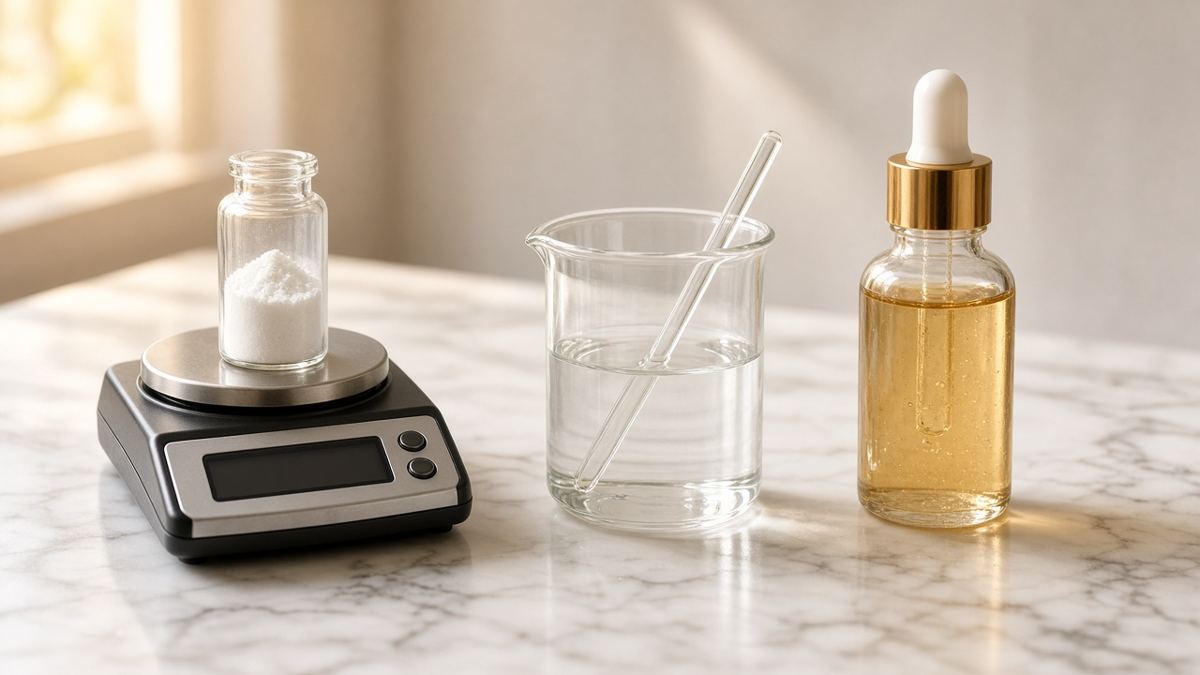
Weighing 10 mg directly into a full batch invites errors, so make a 0.1% stock first. Dissolve 100 mg of powder in 100 g of distilled water with a little of the batch preservative, stir gently until completely clear, and keep it cold. Published solubility for this peptide in water is well above that concentration, at 5 mg per milliliter or more depending on the supplier, so a 1 mg per milliliter stock dissolves easily. Ten grams of that stock then delivers 100 ppm in a 100 g serum. Our cosmetic peptide powders guide covers balances, weighing paper and storage for milligram work.
Building the Serum
Base, Phase and Temperature
A simple frame is water, a humectant such as glycerin, a light gel former and a broad-spectrum preservative, with the peptide added last. Hydrate the gum or the Hyaluronic Acid Liquid in the water phase, let any heated step cool to below 40 °C, and then stir in the peptide stock or the solution. Avoid holding the peptide hot for long, and avoid high-shear mixing once it is in.
pH and Compatibility
Our Melitan lot sheet gives a material pH of 5.0 to 8.0, and a finished serum in the mildly acidic range of about 5 to 6.5 is a comfortable target for both skin feel and peptide stability. Keep strong acids, retinoid-heavy systems, oxidizers and high salt loads out of the same bottle, and add each active separately, checking clarity and pH after each one. Good partners for a glow serum are glycerin, panthenol such as D-Panthenol, aloe and antioxidants like vitamin E, which support comfort and a fresh look without fighting the peptide.
A Working Glow Serum Frame
For a 100 g test batch, a typical skeleton is water to balance, 3 to 5% glycerin, 5 to 10% of a hyaluronic acid solution, 0.5 to 1% panthenol, a preservative at the supplier's level, and then either 10 g of the 0.1% peptide stock or 2 to 3% of a Melitane-type solution in the cool-down. A drop of a water-soluble golden mica or a light tint can match the glow positioning visually. Adjust the pH at the end and record it. Use these figures as a starting point for your own stability work, not a finished, tested formula.
Packaging, Stability and Claims
Peptides prefer cool, dark storage, so use an opaque or amber dropper or an airless pump. Before launch run a four-week check at room temperature, at 40 °C and in the fridge, watching clarity, color, odor and pH, and run a preservative challenge test on the final formula. Store the raw powder sealed and cold, as most suppliers recommend 2 to 8 °C for short term and frozen storage for long term.
On the label, stay with cosmetic language: a warmer, glowing look, a more even-looking tone, richer-looking brows and lashes. Do not say the serum protects from UV, prevents sunburn, reverses gray hair or changes how skin works, since those statements move a product out of cosmetics in the US. Raw peptides for this kind of build sit in our peptide powders section, and ready liquids, including Melitan, sit in the peptide solutions section.
Frequently asked questions
Is Acetyl Hexapeptide-1 the same as Argireline?
No. Argireline is Acetyl Hexapeptide-8, an expression-line peptide. Acetyl Hexapeptide-1, sold as Melitane, mimics alpha-MSH and is used for a glowing, warmer-looking tone and in hair-color serums.
What concentration of Acetyl Hexapeptide-1 should a serum contain?
Supplier sheets give 100 to 1,000 ppm of pure peptide, which is 0.01 to 0.1%. Ready Melitane-type solutions are dosed at 0.5 to 5% of the formula.
Can I combine Acetyl Hexapeptide-1 with Nonapeptide-1?
It is better not to. Nonapeptide-1 blocks the same receptor that Acetyl Hexapeptide-1 activates, so the two send opposite signals and belong in separate products.
Does an Acetyl Hexapeptide-1 serum replace sunscreen?
No. It is a cosmetic glow ingredient and offers no sun protection, so the label should never suggest it can stand in for sunscreen.
Try it with a 1 g sample pack
Neat peptide powders in 1 g packs, INCI on every page, shipped from Florida.
Shop peptide powders