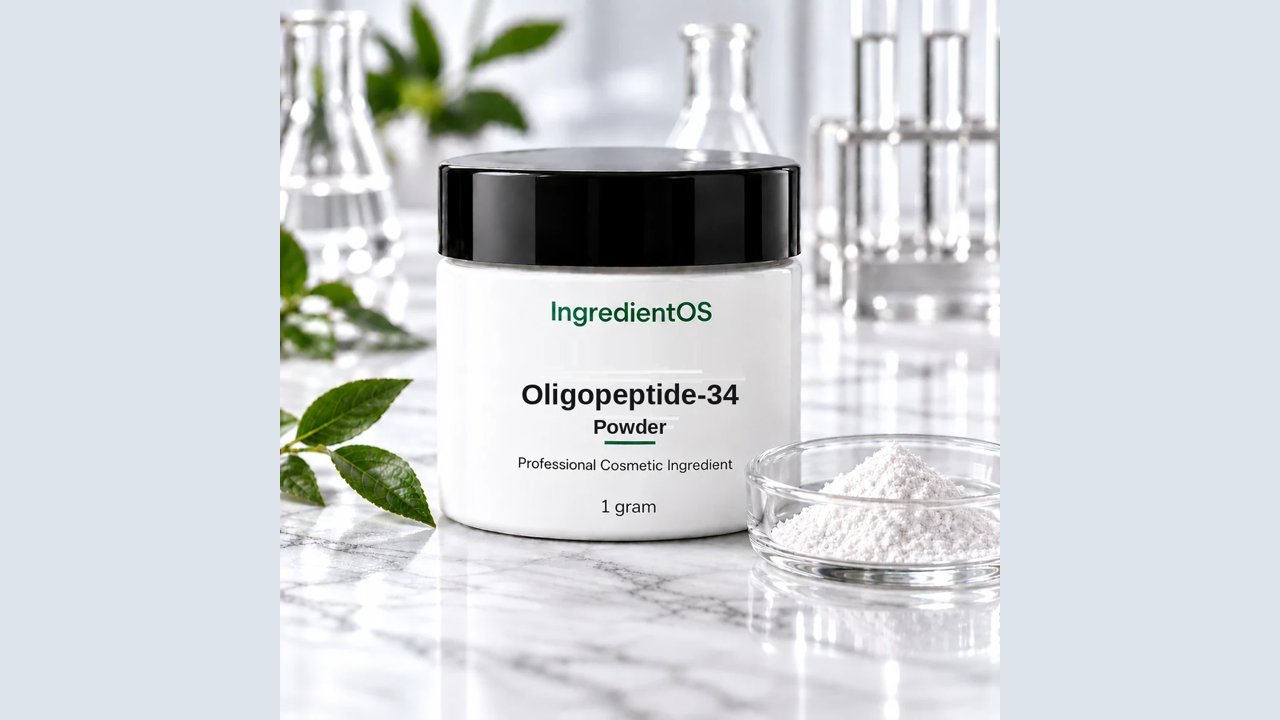
An oligopeptide-34 brightening serum is a light water-based serum that carries this 13-amino-acid peptide, dissolved first in a small premix and added during cool-down below 40 °C, in a finished pH of about 6.0 to 6.5. It is usually built alongside niacinamide or a stable vitamin C derivative to support a brighter, more even-looking complexion.
Oligopeptide-34 is less known than the expression-line peptides, which means fewer guides and more confusion online, including mismatched sequences on some supplier pages. This article sets out the verified identity of the peptide, how to handle the powder, which bases and partners suit it, and how to keep claims cosmetic.
Identity: sequence, CAS and trade name
The INCI name is Oligopeptide-34. Ingredient references give the sequence Ile-Trp-Ser-Leu-Asp-Thr-Gln-Tyr-Gly-Gly-Arg-Gly-Asp, written IWSLDTQYGGRGD, and a molecular formula of C64H94N18O22 with a molecular weight of about 1467.6. Our Oligopeptide-34 Powder lists CAS 2227218-62-2. The peptide was introduced by Caregen under the trade name CG-TGP2.
Some manufacturer listings online print a short palmitoylated hexapeptide sequence next to the same name and molecular formula. That sequence does not match the 13-residue formula, so regard it as a copy error and rely on the CoA for your lot. Oligopeptide numbers are not interchangeable either. Oligopeptide-10, Oligopeptide-76 and Oligopeptide-78 are different sequences with different roles.
How suppliers describe it
Supplier and reference literature describe oligopeptide-34 as reducing melanin synthesis in cultured melanocytes by lowering tyrosinase, TRP-1, TRP-2 and MITF, and as interfering with melanosome transfer to keratinocytes. Some sources also describe soothing and supportive effects in cell work. These are laboratory findings on the raw material, not results on human skin from a finished product, so they explain the positioning without supporting a claim on your label.
Handling the powder
Weighing and dissolving
The material is a white, water-soluble powder. Weigh it on a calibrated balance that reads to 0.001 g, dissolve it completely in a small portion of the formula water, and check that the premix is fully clear before it meets the rest of the batch. Our product page recommends exactly this order and adding the premix in cool-down, below 40 °C. If your batch is small, make a larger stock premix and dose from it, but prepare it fresh rather than storing it for weeks.
What the peptide dislikes
Keep it away from strong oxidizers and from high ionic strength systems, such as products very rich in salts. That has a practical consequence: if you plan to combine it with several electrolyte-type ingredients or a salt-sensitive gel, check viscosity and clarity after 24 hours. A mild, water-rich base is the safest home.
pH and base
Our product page lists a pH range of 6.0 to 7.5 for the material. A serum finished around pH 6.0 to 6.5 sits inside that window and also suits niacinamide, panthenol and sodium hyaluronate. Light textures fit a tone story: a water-thin essence, a gel serum with a low level of a clear thickener, or a fluid lotion. Sheet-mask liquids and ampoules are listed in the application notes as well, along with spot-look correctors and light day creams.
Pairing with other brightening actives
Niacinamide
Niacinamide is the natural first partner. It is stable in the same near-neutral pH, widely used for a more even-looking tone and inexpensive, so it carries the base while the peptide adds a modern story. Dissolve the niacinamide in the water phase and add the peptide premix after cool-down.
Stable vitamin C derivatives
Pure L-ascorbic acid needs a pH far below the comfort zone of this peptide, so it belongs in a separate product. Water-soluble derivatives such as magnesium ascorbyl phosphate work at near-neutral pH and fit the same serum; the sibling guide aminopropyl ascorbyl phosphate vs other vitamin C derivatives compares the options and their pH needs. Remember that phosphate salts add ionic load, which is exactly what the peptide prefers to avoid in large amounts, so test clarity and viscosity carefully.
Hydration partners
Sodium hyaluronate and glycerin give slip and a plump-looking finish without changing pH. Add each active separately and check clarity, odor and viscosity after each addition instead of premixing several actives in one beaker, as our product page advises.
A worked example of a serum architecture
A typical even-tone gel serum starts with water as the main phase, glycerin or propanediol as a humectant, niacinamide dissolved directly in that water, sodium hyaluronate for slip and a clear thickener chosen for tolerance to the electrolytes you plan to use. After the batch cools below 40 °C, the preservative goes in, then the oligopeptide-34 premix, and finally a pH check and adjustment toward 6.0 to 6.5. A soothing partner such as panthenol or allantoin fits easily and supports a comfortable feel, which matters for a product applied daily to the whole face. Fragrance is best left out of a first batch so that any odor change during stability testing can be traced to the actives rather than to the perfume.
Packaging is part of the formula. A brightening serum is often used morning and evening, so a dropper bottle is opened many times; an airless pump reduces air contact and is the safer choice for a peptide that dislikes oxidizers. Opaque or amber packaging also protects any vitamin C derivative in the same formula.
Use level
There is no single public figure for the neat powder. One manufacturer notes that commercial solutions are typically sold at 0.05% peptide, and that the dose for a finished product should be worked out from the solution or powder concentration. For powder bought from us, take the use level from the supplier documentation for your lot. Weighing into a stock premix makes small, precise additions practical.
Testing the finished serum
Run stability at room temperature, at 40 °C and in a fridge for several weeks, and watch color, odor, clarity, viscosity and pH. Test in the final pack, because droppers and pumps expose the serum to air differently. A preservative challenge test is the standard step before launch. For a brightening product, consider an instrumental or consumer perception test on the finished formula if you want to describe results.
Claims that stay cosmetic
Describe skin that looks brighter, more even and more radiant with regular use, and dark spots that look less noticeable. Avoid wording about blocking pigment production, about hormones or about removing spots, and do not quote laboratory melanin figures as consumer results.
Getting started
Start with a 1 g pack of Oligopeptide-34 Powder. Build a simple niacinamide gel, split it into two batches, add the peptide premix to one, and compare texture and stability over several weeks. Other dry peptides are listed in our peptide powders collection, and the general handling steps are covered in our cosmetic peptide powders guide.
Frequently asked questions
What is oligopeptide-34?
A synthetic 13-amino-acid peptide, Ile-Trp-Ser-Leu-Asp-Thr-Gln-Tyr-Gly-Gly-Arg-Gly-Asp, CAS 2227218-62-2, molecular weight about 1467.6. It was introduced under the trade name CG-TGP2 for products positioned around a brighter, more even-looking tone.
What pH should an oligopeptide-34 serum have?
Our product page lists pH 6.0 to 7.5 for the material. A finished serum around pH 6.0 to 6.5 suits it and also suits niacinamide.
Can oligopeptide-34 be used with vitamin C?
Pair it with a stable vitamin C derivative rather than pure L-ascorbic acid, which needs a much lower pH. Add each active separately and check clarity and odor after each addition.
How much oligopeptide-34 should I add?
There is no single public figure for the neat powder. Commercial solutions are often sold at 0.05% peptide, and the level for powder should come from the supplier documentation for your lot.
Try it with a 1 g sample pack
Neat peptide powders in 1 g packs, INCI on every page, shipped from Florida.
Shop peptide powders