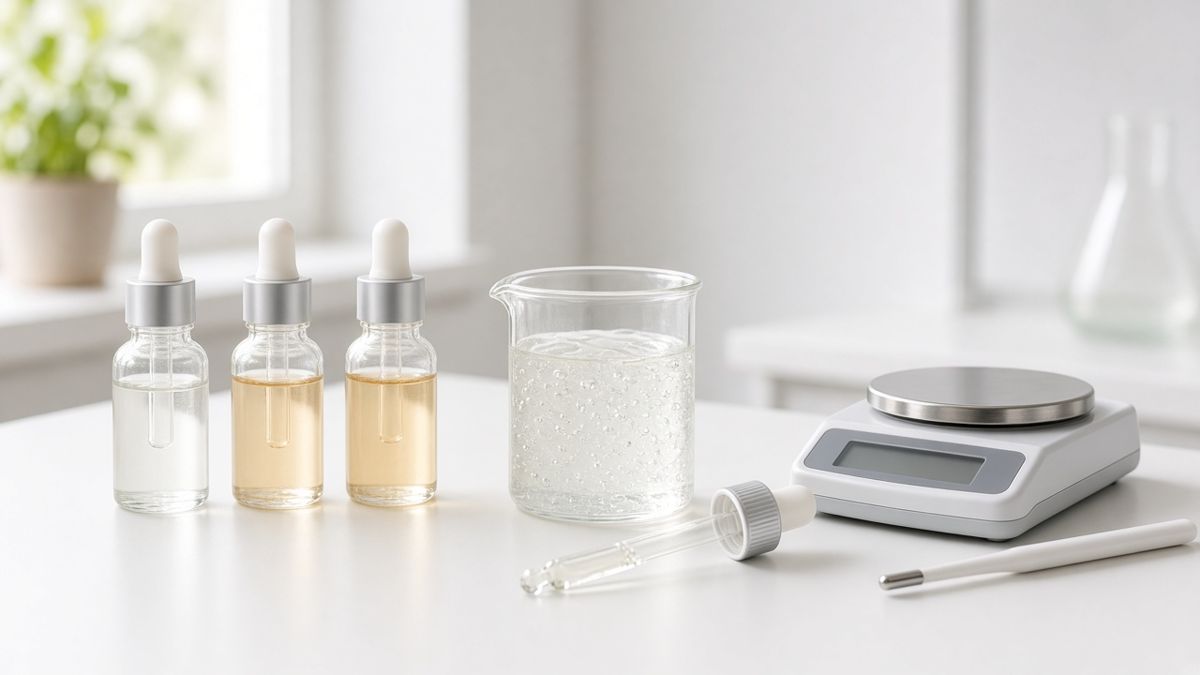
An exosome enriched formula is a serum, essence or cream that carries a liquid concentrate of extracellular vesicles, usually from plant callus culture, a bacterial ferment or milk, at roughly 0.3 to 5% of the finished product. The vesicle liquid goes into the water phase during cool-down below 40 °C, and the rest of the formula is built around keeping it cool, preserved and honestly labeled.
This guide is written for formulators and indie brands who want to add vesicles to a product line. It covers what the raw materials actually contain, how the terminology works, dose and process, which sources combine well, two example starting formulas, testing, and the wording that keeps a launch on the cosmetic side in the United States.
What Exosome Raw Materials Really Are
Exosome or extracellular vesicle
In biology, exosomes are small membrane-bound vesicles that cells release from their internal endosomal system. They are usually described as roughly 30 to 150 nm across and carry proteins, lipids and RNA between cells. The International Society for Extracellular Vesicles, in its MISEV2023 guidelines, recommends the broader term extracellular vesicles, abbreviated EVs, and discourages calling a preparation exosomes unless its endosomal origin has been demonstrated. That is why the INCI names on cosmetic vesicle liquids say Extracellular Vesicles rather than exosomes, even though the market still sells them under the exosome name.
What arrives in the bottle
Cosmetic vesicle liquids are mostly water and glycerin with a small vesicle fraction. Our Centella Cica Exosome Solution, for example, lists Water, Glycerin, Centella Asiatica Callus Extracellular Vesicles, and our Lactobacillus Exosome Solution lists Water, Glycerin, Lactobacillus Extracellular Vesicles. Because the carrier is mostly glycerin water, the liquids behave like any other water-soluble active in a batch. What differs is the source story, the color and the sensitivity to heat, and those three points drive almost every formulation decision below. All of our liquid grades sit together in the exosome solutions section.
Choosing a Vesicle Source
Plant callus vesicles
Callus is undifferentiated plant tissue grown in controlled culture, so callus vesicles come from a defined, repeatable source rather than field-grown leaves. Centella callus vesicles suit soothing, comfort and barrier-feel positioning and read clear to pale amber. The Rose Callus Exosome Solution, INCI Water, Glycerin, Rosa Damascena Callus Culture Extracellular Vesicles, fits floral and prestige radiance briefs. Neither is the same raw material as a conventional plant extract or a hydrosol, so a callus vesicle line on the label must match the vesicle liquid on the batch record.
Ferment and milk vesicles
Lactobacillus vesicles let a brand talk about microbiome-inspired comfort and balance without any human-derived material, and the liquid reads clear, which helps in transparent gels. Milk vesicles are a different case: the Milk Exosome Solution lists Water, Glycerin, Milk Extracellular Vesicles, can look faintly creamy in the bottle, is not vegan, and will haze a clear gel at higher use levels. Pick the source by the claim and the base first, and only then by price.
Why human-derived material is out of scope
Many clinic products are built on human stem cell conditioned media or human-derived exosomes. On December 6, 2019, the FDA published a public safety notification stating that there are no FDA-approved exosome products and that exosomes used to treat diseases and conditions are regulated as drugs and biological products. Plant and ferment vesicle liquids sold as cosmetic raw materials avoid the human-tissue sourcing question entirely, but they do not avoid the claims question, which is covered at the end of this article.
Use Level and Process
How much to add
Follow the range on each raw material sheet, because the vesicle content differs between products. On our cards, Centella and Lactobacillus vesicle liquids run at 0.5 to 3%, Rose Callus at 0.5 to 2%, Milk at 0.3 to 2%, and the PDRN Exosome Booster Solution, which combines Sodium DNA with Centella callus vesicles, at 1 to 5%. Light essences and gels usually start at the low end of a range, while night creams and ampoule-style serums move toward the top after a color and clarity check on the real base.
Temperature and order of addition
Add every vesicle liquid in cool-down below 40 °C, after the emulsion is formed or the gel is fully hydrated, and do not hold the batch at elevated temperature afterwards. A 2024 review in the journal Cosmetics on exosome and conditioned media products stresses that their biological components are sensitive to heat, time and storage conditions, which is why heating steps should be finished before the vesicles go in. Cold-process bases, such as gels thickened with xanthan gum or pre-neutralized polymers, make this easy because there is no hot phase at all.
pH, preservation and what to keep apart
Our vesicle cards ask you to confirm pH on the lot certificate of analysis rather than quoting one figure, so measure the liquid on arrival and aim the finished product at a mild, skin-friendly range of about pH 5.0 to 6.5. Adjust pH before adding the vesicles where you can. Use a broad-spectrum preservative system suited to a high-water, glycerin-rich base, since the carrier is an easy food source for microbes. Keep the vesicles out of the same bottle as low-pH exfoliating acids, strong oxidizers and high levels of free ethanol, all of which work against a membrane-bound particle.
Pairing Vesicles With Other Actives
Peptides and hydrators
Vesicle liquids sit comfortably beside water-soluble peptides, glycerin, panthenol and hyaluronic acid in a pH 5 to 6 water phase. A common build is a vesicle liquid for the source story plus a peptide for a specific line-smoothing angle, for example the Acetyl Octapeptide-3 Solution added in the same cool-down step. Our peptide serum recipe for wrinkles shows how to balance several peptides in one water phase, and the comparison of acetyl octapeptide-3 vs acetyl hexapeptide-8 helps you choose between the two best-known expression-line peptides.
Stacking two vesicle sources
Two vesicle sources can share one formula when each carries its own story, such as Lactobacillus vesicles for barrier comfort and Centella callus vesicles for soothing feel in a barrier cream. Avoid stacking two liquids that say the same thing, such as plain Centella vesicles on top of the PDRN booster that already contains them, unless you want more vesicle content without more DNA. Every added liquid is another INCI line, another cost and another lot to document.
Two Starting Formulas
Clear gel essence
This is an example 100 g starting point to be tested for stability and preservation before any launch. Water to 100 g (about 91.4 g), glycerin 3.0 g, xanthan gum 0.3 g, sodium hyaluronate 0.2 g, panthenol 1.0 g, sodium gluconate 0.1 g, Lactobacillus Exosome Solution 2.0 g, Rose Callus Exosome Solution 1.0 g, phenoxyethanol and ethylhexylglycerin 1.0 g, plus citric acid or sodium hydroxide solution as needed for pH. Disperse the gum and hyaluronate in glycerin, add to the water under stirring and let them hydrate. Add panthenol and sodium gluconate, set pH to about 5.5, then stir in both vesicle liquids and the preservative at room temperature.
Light night cream
For a richer base, try this example for 100 g. Water phase: water 78.4 g, glycerin 4.0 g, sodium gluconate 0.1 g. Oil phase: cetearyl olivate and sorbitan olivate 4.0 g, cetyl alcohol 1.5 g, squalane 5.0 g, caprylic/capric triglyceride 4.0 g. Heat both phases to 70 to 75 °C, emulsify, and cool under gentle stirring. Below 40 °C add tocopherol 0.5 g, Centella Cica Exosome Solution 1.5 g and phenoxyethanol and ethylhexylglycerin 1.0 g, then check that pH sits near 5.5. The heated emulsion step is finished long before the vesicle liquid goes in, which is the whole point of the order of addition.
Testing and Storage
Store the raw liquids tightly closed, cool and away from direct sun, and check whether a lot certificate calls for 2 to 8 °C storage, since refrigerated lots are marked on our documents. For the finished product, run at least a basic stability program at room temperature and at elevated temperature, and watch pH, viscosity, color, clarity and odor, because callus and milk liquids can shift the color of a white cream over time. A preservative efficacy test is essential with this much glycerin water in the formula. The vesicle fraction cannot be measured by eye, so lot numbers, weighing records and the supplier certificate are what prove the ingredient is in the bottle.
Label and Claim Wording
On the ingredient list, the water and glycerin from the vesicle liquid merge with the rest of the formula, and the vesicle line appears in its proper order, often near the end. Print the INCI exactly as the certificate of analysis gives it, for example Centella Asiatica Callus Extracellular Vesicles, and do not invent a human or stem cell origin the material does not have. Marketing can describe a serum that leaves skin feeling comfortable, looking smoother and more radiant, or that supports the look of a healthy barrier. Avoid words such as heal, repair, regenerate, treat or replace a clinic procedure, and do not reuse clinic before and after photos, because those claims move a product toward the drug and biologic categories the FDA notice describes. The broader cosmetic exosomes category collects the vesicle liquids together with related exosome-positioned actives if you want to compare grades before sampling.
Frequently asked questions
How much exosome solution goes into a serum?
Follow the raw material sheet. On our cards the vesicle liquids run from 0.3 to 2% for milk vesicles up to 1 to 5% for the PDRN and vesicle booster, with most plant and ferment grades at 0.5 to 3%.
When do I add exosomes to a formula?
Add them in cool-down below 40 °C, after the emulsion is formed or the gel is hydrated, and do not reheat the batch afterwards.
Why does the INCI say extracellular vesicles instead of exosomes?
Exosome is a biogenesis term for vesicles of endosomal origin. Scientific guidelines prefer extracellular vesicles unless that origin is proven, and cosmetic INCI names follow the same logic.
Are plant exosome formulas vegan?
Plant callus and Lactobacillus vesicle liquids contain no animal material in their INCI. Milk vesicles are animal-derived, so a formula that uses them is not vegan.
Try it with a 1 g sample pack
Neat peptide powders in 1 g packs, INCI on every page, shipped from Florida.
Shop peptide powders