
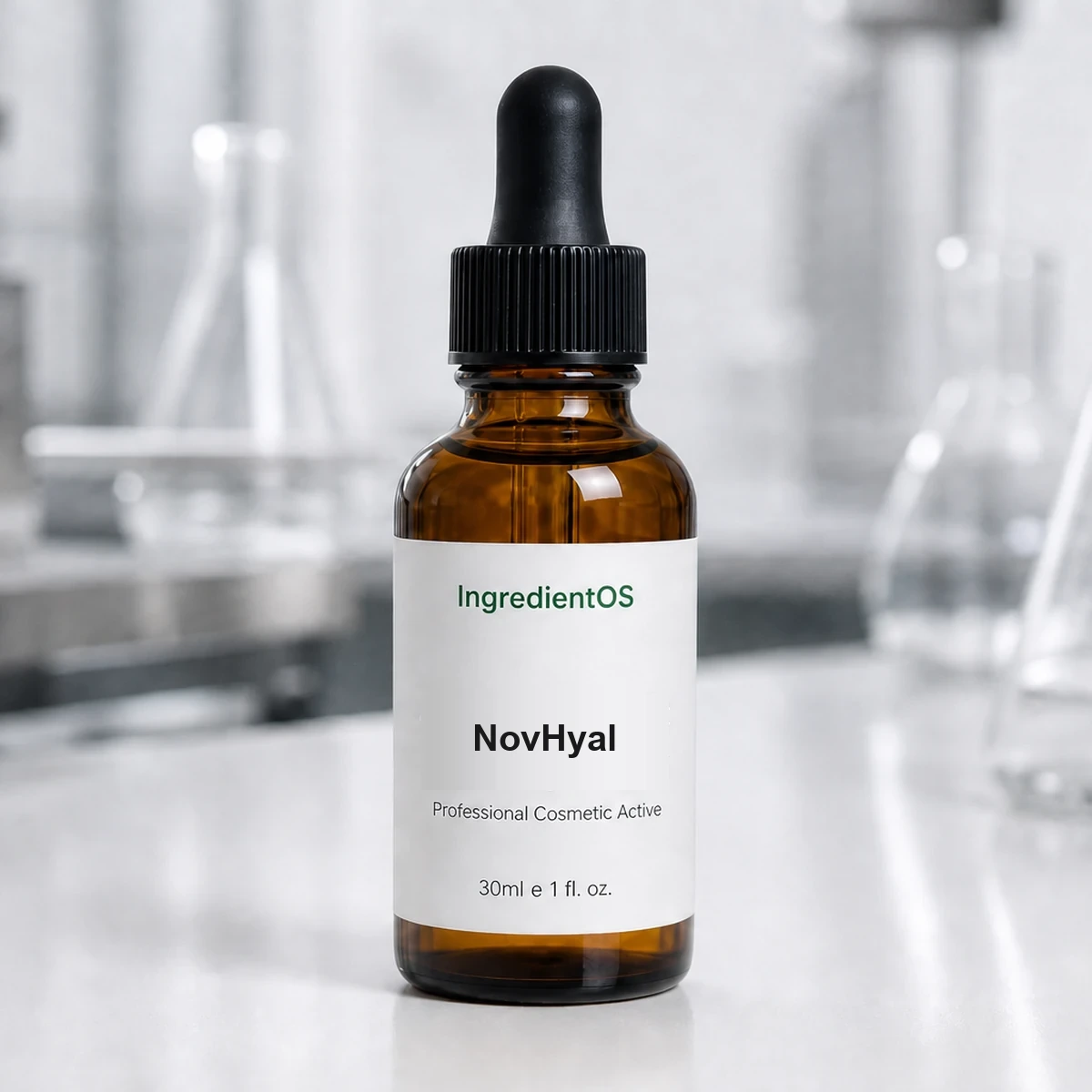
SKU: VG17052209
NovHyal
$15.99In stock
INCI: Glycerin, Aqua, Disodium Acetyl Glucosamine Phosphate
Usage Rate: 0.4-10%, usually 4-6%
Packaging
Liquid sizes — 0.33 oz (10 mL) sample through bulk (US · metric)
Ships from FloridaSecure checkoutUsually ships in 1–2 business daysFree US shipping on $50+
AppearanceLiquid active concentrate
pHto 7
Description
NovHyal at a glance
NovHyal is an appearance-focused cosmetic active that works on hyaluronic acid from the inside out. Instead of adding hyaluronic acid to the skin surface, it brings one of its building blocks, acetyl glucosamine, in a phosphate form. The INCI is Glycerin, Aqua, Disodium Acetyl Glucosamine Phosphate. The liquid is amber, comes from Switzerland, dissolves in water and has a pH of up to 7. The supplier gives a range of 0.4 to 10%, with 4 to 6% as the usual dose. It must be stored in a refrigerator.
Hyaluronic acid and its building blocks
Hyaluronic acid is a long chain made of two alternating sugars, glucuronic acid and N-acetyl glucosamine. The skin makes its own hyaluronic acid, which holds water in the deeper layers and gives volume and bounce. With age, the amount drops, and skin looks less plump and more lined. Topical hyaluronic acid works mostly on the surface. NovHyal takes a different approach: it supplies the building block in a form that the skin can use, supporting its own production.
What it does
The supplier describes a broad appearance-focused cosmetic profile. Products with NovHyal support the skin's own hyaluronic acid, a denser looking collagen network, firmer and more elastic skin, a smoother surface and wrinkles that look less deep and less pronounced, with a visible lifting effect. On the pack, keep claims visual: plumper, firmer and smoother looking skin, wrinkles that look reduced.
How to formulate
Dose
The usual range is 4 to 6%. Light products can start at about 1 to 2%, and intensive serums can go up to 10%. Below 0.4% the supplier does not expect a meaningful effect.
Process and pH
Add NovHyal to the water phase of a cold process product, or to an emulsion at cool-down below 40 °C. Keep the finished product at pH 5 to 7. It combines well with all water-soluble actives.
Partners
The obvious partner is hyaluronic acid itself, for example high molecular weight hyaluronic acid for a surface film, together with NovHyal for the skin's own production. A peptide such as palmitoyl tripeptide-38 adds a second appearance-focused cosmetic message. Find more appearance-focused cosmetic actives in the cosmetic actives section.
Product ideas
Plumping serums, firming day and night creams, eye creams, neck creams, sheet masks and ampoules are the main uses. A hyaluronic line with two levels of action, surface and skin's own, is a clear concept built around this active.
Sample recipe: plumping hyaluronic serum, 100 g
Distilled water 83.20 g, glycerin 3.00 g, propanediol 3.00 g, NovHyal 5.00 g, sodium hyaluronate 0.30 g, hydroxyethylcellulose 0.50 g, panthenol 1.00 g, preservative 1.00 g, citric acid solution 3.00 g. Hydrate sodium hyaluronate and the cellulose in water, add glycerin, propanediol and panthenol, then NovHyal and the preservative below 40 °C, and adjust to about pH 5.5 to 6.
Cold storage
The supplier asks for storage in a refrigerator at 4 to 10 °C in a closed container. Take out only the quantity needed for a batch and return the rest to cold storage quickly. Let the material reach room temperature before weighing, so no condensation enters the container.
Labeling and claims
On the ingredient list the active appears as Glycerin, Aqua and Disodium Acetyl Glucosamine Phosphate. Consumers know hyaluronic acid well, and a line explaining that this ingredient supports the skin's own hyaluronic acid makes the concept clear.
Testing
Plumping and wrinkle claims are best supported with skin replicas or 3D imaging before and after eight weeks, and with corneometer readings for hydration.
Storage
Keep refrigerated at 4 to 10 °C in a tightly closed container. A certificate of analysis comes with every lot.
Product Specifications
INCIGlycerin, Aqua, Disodium Acetyl Glucosamine Phosphate
Usage Rate0.4-10%, usually 4-6%
SolubilityWater-soluble
StorageStore tightly closed in a cool, dry place away from light and heat. Refrigerate opened material where practical; respect supplier shelf life.
TDS / CoA available on request. Contact us
Frequently Asked Questions
What is the INCI of NovHyal?
Glycerin, Aqua, Disodium Acetyl Glucosamine Phosphate.
How much should I use?
0.4 to 10%, with 4 to 6% as the usual range.
How should it be stored?
In a refrigerator at 4 to 10 °C, in a closed container.
Is it the same as hyaluronic acid?
No. It contains a building block of hyaluronic acid and is designed to support the skin's own production, so it works well together with hyaluronic acid.


