SKU: TM20051901
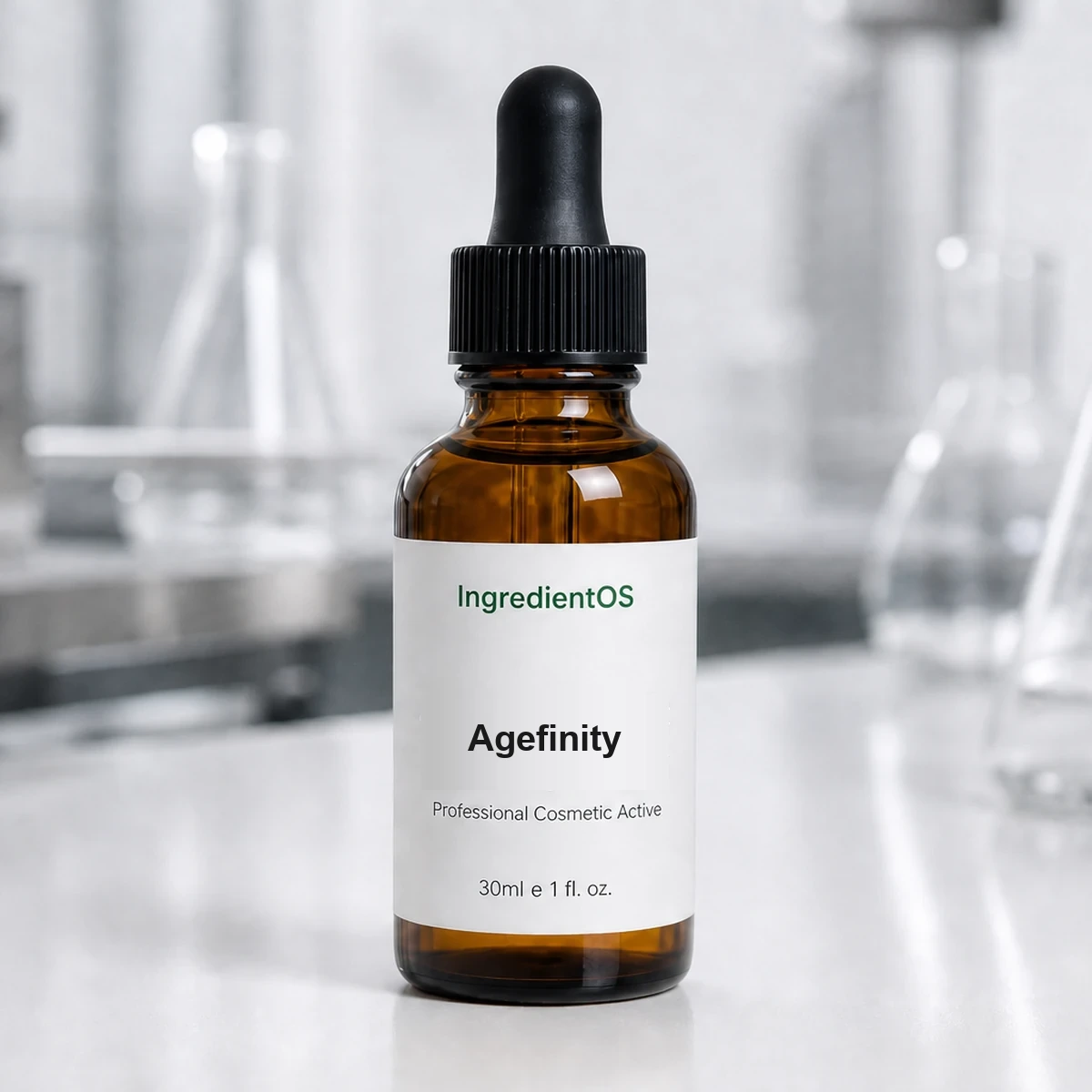
Agefinity
$15.99In stock
INCI: Glycerin, Water, Sodium Mannose Phosphate, Mannose
Usage Rate: 0.1-4% of the finished formula
Packaging
Liquid sizes — 0.33 oz (10 mL) sample through bulk (US · metric)
Ships from FloridaSecure checkoutUsually ships in 1–2 business daysFree US shipping on $50+
ApplicationAnti-Age cosmetics, creams, gels, serums, gels, balms, masks, gommages, beldi, scrubs, fluids
AppearanceLiquid active concentrate
pH5.0 Working pH 2.0-8.0
Description
Agefinity at a glance
Agefinity is a liquid appearance-focused cosmetic active built on a simple sugar, mannose, and its phosphate salt. The INCI is Glycerin, Water, Sodium Mannose Phosphate, Mannose. The liquid is colorless to pale yellow, has a pH of about 5.0 and dissolves in water. It is used at 0.1 to 4% of the finished product and tolerates a very wide pH window, from 2.0 to 8.0, which means it can go into almost any face care format, including acid based products. The supplier presents it as an active for the shape of the lower face, the so called contour of the jaw and neck.
Sugars as skin care actives
Sugars are often thought of as simple humectants, but some of them also act as signals. Mannose is a natural sugar found in fruits such as cranberries and in many plant polysaccharides. When it is linked to a phosphate group, it becomes a molecule that the skin recognizes in its own communication between cells. In cosmetic science, sodium mannose phosphate is linked to the upkeep of the support network of the skin. For the consumer, the key message is a firmer looking contour and smoother looking skin.
What it does
The supplier describes a set of visible results. Agefinity helps the jawline and neck look more defined and lifted, makes wrinkles look smoother, including crow's feet and lines on the neck, and gives the skin an energized, rested appearance. A soft focus effect helps small imperfections and signs of fatigue look less visible right after application. On the pack, use visual words: lifted looking, firmer looking, more defined contour, smoother looking neck.
How to formulate
Dose and process
Use 0.1 to 4%. Light daily serums can stay at 1 to 2%, while intensive contour creams and neck creams can go up to 4%. Add the liquid to the water phase of a gel or serum, or to an emulsion at cool-down below 40 °C.
Wide pH window
Few appearance-focused cosmetic actives tolerate pH 2.0 to 8.0. This makes Agefinity a good partner for renewing products with fruit acids, for example a night serum with mandelic acid, and for classic neutral creams. For a firming neck cream, a peptide such as acetyl tetrapeptide-2 adds a second firmness message. Browse more appearance-focused cosmetic actives in the cosmetic actives section.
Product ideas
Contour serums for the jaw and neck, neck and decollete creams, firming day creams, night creams, eye area gels, masks and fluid emulsions are the main uses. The supplier also mentions balms and scrubs, so a firming body balm or a facial scrub with a care active is possible as a line extension.
Sample recipe: contour defining neck cream, 100 g
Distilled water 72.20 g, glycerin 3.00 g, glyceryl stearate and PEG-100 stearate 5.00 g, cetearyl alcohol 3.00 g, caprylic/capric triglyceride 6.00 g, shea butter 3.00 g, dimethicone 2.00 g, xanthan gum 0.30 g, Agefinity 4.00 g, preservative 1.00 g, fragrance 0.20 g, sodium hydroxide solution 0.30 g. Heat water and oil phases to 75 °C, emulsify, cool to 40 °C, add Agefinity, preservative and fragrance, and adjust to about pH 5.5.
Claims and testing
Contour and neck claims are best supported with standard photos from the side and from below, taken before and after four to eight weeks of use. Self assessment questionnaires add the consumer view. Keep every claim cosmetic and visual.
Labeling
On the label the active appears as Glycerin, Water, Sodium Mannose Phosphate and Mannose. In marketing text, mannose sugar complex is a clear and accurate name. The glycerin base also adds a light humectant effect to the formula.
Storage
Store tightly closed in a cool, dark place. A certificate of analysis comes with every lot.
Product Specifications
INCIGlycerin, Water, Sodium Mannose Phosphate, Mannose
Usage Rate0.1-4% of the finished formula
SolubilityWater-soluble
StorageStore tightly closed in a cool, dry place away from light and heat. Refrigerate opened material where practical; respect supplier shelf life.
TDS / CoA available on request. Contact us
Frequently Asked Questions
What is the INCI of Agefinity?
Glycerin, Water, Sodium Mannose Phosphate, Mannose.
What dose is recommended?
0.1 to 4% of the finished product.
What pH range does it tolerate?
The material has a pH of about 5.0 and can be used in formulas from pH 2.0 to 8.0.
What is it best known for?
A firmer, more defined looking face contour and a smoother looking neck, together with a fresh, rested look.