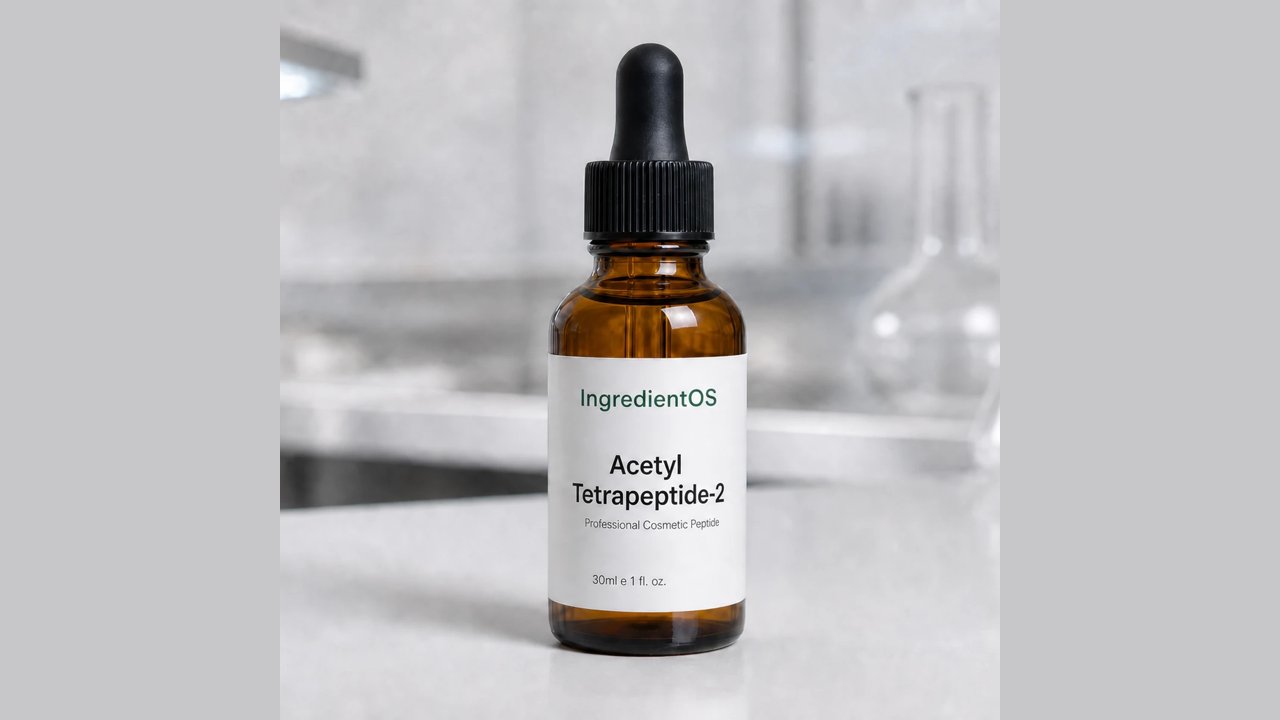
An acetyl tetrapeptide-2 firming cream is a leave-on emulsion that carries this four-amino-acid peptide, usually as a dilute solution at 1 to 2% of the formula, added in cool-down below 40 °C and kept in a pH of about 5 to 7. It is positioned for skin that looks firmer and less lax, most often on the neck, jawline and décolleté.
The peptide is small, water-soluble and easy to handle, so most of the formulation work goes into the cream base, the pairing with other firming actives and honest claims. This guide walks through each of those, using supplier data and the limited independent research that exists.
What acetyl tetrapeptide-2 is
The INCI name is Acetyl Tetrapeptide-2. The sequence is Ac-Lys-Asp-Val-Tyr-OH, abbreviated Ac-KDVY, with a molecular formula of C26H39N5O9 and a molecular weight of about 565.6. Our Acetyl Tetrapeptide-2 Solution lists CAS 757942-88-4. The sequence corresponds to residues 33 to 36 of thymopoietin, a thymus protein, which is why one supplier markets it as a thymus-inspired peptide. The same peptide is also sold as Thymulen 4 Peptide, and Lubrizol offers a solution grade under its own trade name.
Two supplier stories, one molecule
The two original suppliers tell different stories. One presents it around skin renewal and the skin's own defenses. Lubrizol positions its grade against sagging and reports, from its own lab work, increased expression of fibulin-5 and lysyl oxidase-like 1, two proteins involved in assembling elastic fibers, along with genes linked to cell adhesion. The only independent study that independent reviewers could find exposed cultured keratinocytes to the peptide for 48 hours and reported stiffer cells. None of this replaces a test on your own finished cream, but it explains why the ingredient is sold for firming rather than for expression lines.
Use levels: solution versus powder
The most common mistake with this peptide is confusing solution percentages with peptide percentages. Lubrizol's solution grade specifies 0.05% acetyl tetrapeptide-2 and a recommended use level of 1 to 2% in creams, lotions and serums, which works out to roughly 0.0005 to 0.001% peptide in the finished product. A European distributor of the pure powder recommends 0.002 to 0.005% peptide, with a maximum of 0.05%, and gives an optimum pH of 5 to 7. Our product page lists a pH of 4.5 to 6.5 for the solution and asks you to take the use level from the supplier documentation for your lot.
If you buy a solution, work in percentages of the solution as printed on the CoA. If you buy powder, you are working with amounts far below what a typical lab scale can weigh directly, so dissolve a measured quantity into a known mass of water to make a stock premix and dose from that.
Building the firming cream base
Emulsion architecture
Neck and décolleté creams need richness without heaviness, because the area is large and sits under clothing. A practical outline is an oil-in-water emulsion with a medium oil load, a mix of a light emollient ester and a plant butter, a gentle emulsifier system, glycerin as a humectant and a broad-spectrum preservative. The peptide goes into the cooled emulsion. Our product page notes that the peptide is easy to place in both gels and emulsions and recommends recording pH and viscosity before and after addition.
Process order
Make the emulsion as usual, cool it below 40 °C, add the preservative and any heat-sensitive humectants, then add the acetyl tetrapeptide-2 solution with gentle mixing. Check pH and bring it into the 5 to 6.5 zone if needed. Because the peptide dose is tiny, distribution matters: stir long enough to be sure the premix is fully dispersed through the batch.
Pairing with other firming actives
Our product page suggests pairing acetyl tetrapeptide-2 with a matrikine such as Palmitoyl Pentapeptide-4 for a two-peptide firming story, and with hyaluronic acid for a plump-looking finish. Another common partner is Palmitoyl Tripeptide-1 + Palmitoyl Tetrapeptide-7 Liquid, which brings a smoothing narrative to the same cream. Add each peptide separately during cool-down.
For an eye cream that borrows the same firming idea, keep acetyl tetrapeptide-2 for the contour story and use a dedicated eye peptide for the look of puffiness; the sibling guide acetyl tetrapeptide-5 eye cream covers that build. For a face serum version with several peptides, the peptide serum recipe for wrinkles shows how to keep a multi-peptide base stable.
What to keep apart
Avoid very low-pH exfoliating acids and pure L-ascorbic acid in the same product, since they sit well outside the peptide's comfortable pH. Strong oxidizers and long heating are also best avoided. If your line includes a retinol night cream, many brands keep it separate from the peptide cream and suggest alternating, which also keeps each product simpler to stabilize.
Where acetyl tetrapeptide-2 fits in a range
The application notes for our solution list lifting creams and concentrates, eye creams, neck and décolleté products, body creams for skin that looks less toned after weight change, and professional salon lines for mature skin. In a product range it works best as the hero of a contour or neck cream, with a sister serum that uses a different firming peptide so each product has its own clear story.
Stability and testing
Run the finished cream through room temperature, 40 °C and fridge storage for several weeks, and record color, odor, viscosity, pH and emulsion stability. Test in the final pack. A preservative challenge test on the finished product is standard before sale. Store the raw solution as its label directs and keep the CoA with your batch record so each batch can be traced to its lot.
Claims that stay cosmetic
Describe how the skin looks and feels: firmer-looking, more toned, smoother on the neck and décolleté, a more defined-looking jawline with regular use. Avoid wording about immune function, thymus activity or structural changes inside the skin, and do not quote the supplier's laboratory gene-expression data as if it were a consumer result. If you want percentage claims, commission a test on your own finished cream.
Getting started
Order the 10 mL sample of Acetyl Tetrapeptide-2 Solution, make a 100 g batch of a simple neck cream at the level from your CoA, and keep an identical batch without the peptide as a control for texture and stability. Other firming peptides in liquid form are in our peptide solutions section.
Frequently asked questions
What is the sequence of acetyl tetrapeptide-2?
It is Ac-Lys-Asp-Val-Tyr-OH, often written Ac-KDVY, with CAS 757942-88-4 and a molecular weight of about 565.6. It mirrors positions 33 to 36 of the thymus protein thymopoietin.
How much acetyl tetrapeptide-2 goes into a cream?
For a commercial solution containing 0.05% peptide, the supplier recommends 1 to 2% of the solution. One distributor of the pure powder lists 0.002 to 0.005% peptide, up to 0.05%. Always follow the CoA for your lot.
Is acetyl tetrapeptide-2 the same as Thymulen 4?
Thymulen 4 is one trade name for the same INCI ingredient, and Lubrizol sells it under another name. Vehicles and active content differ between grades, so compare CoAs before swapping one for another.
Can I use acetyl tetrapeptide-2 with retinol?
They can share a routine, but retinol creams are often oil-rich and light-sensitive while the peptide is water-soluble. Many brands keep them in separate products, or test the combination carefully for stability.
Try it with a 1 g sample pack
Neat peptide powders in 1 g packs, INCI on every page, shipped from Florida.
Shop peptide powders